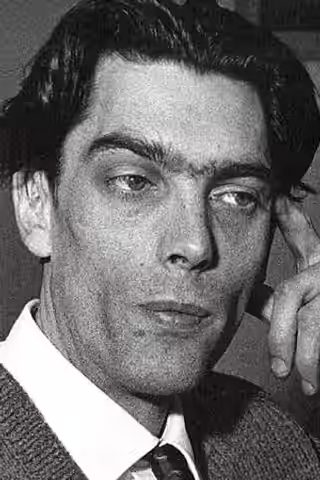
A face built for the wrong end of a corridor. Sacha Pitoëff was a stage actor the cinema borrowed for its enigmas, and in Last Year at Marienbad he is the one thing in the hotel we would not turn our back on.
Fi1m perspective
In Last Year at Marienbad (1961) Sacha Pitoëff plays a game with matchsticks. He plays it against every guest in Alain Resnais's hotel and he wins every time. "I can lose," he says, "but I always win." It is the only joke the film permits, and he delivers it with a gaunt face that does almost nothing, which is why it lands. We found ourselves watching him whenever he was in frame, even while Delphine Seyrig was doing the film's real work, because he looked like the one person in the building who already knew how the story ended. It is a small part and it is the part people remember.
The stage came first and it shows. He trained under Louis Jouvet, made his film debut in 1952 in The Seven Deadly Sins, and by the 1960s was running his own troupe in Paris while taking film work on the side. The films were mostly supporting parts, over fifty of them, and the casting was consistent: authority figures, intellectuals, men whose loyalties are not clear, in period pieces and intrigue films. He is a Russian in Anastasia (1956), Joliot-Curie in Is Paris Burning? (1966), a doctor in The Night of the Generals (1967), the Prime Minister in Jacques Demy's Donkey Skin (1970). Late on the work drifted toward horror, and Dario Argento cast him as the bookseller Kazanian in Inferno (1980). In his last decade he taught at ENSATT in Lyon.
What worked was the instrument. The voice is deep and the diction is exact, the diction of a man who spent his life saying difficult lines to a live audience, and directors with abstract or airless material knew what to do with it. Seyrig, his co-star in four films, is the collaborator who matters, because Marienbad needed two people who could stand very still and mean different things by it. What did not work was everything else the cinema usually wants. He could not play a lover, or a hero, or a man you would trust with your coat; the face would not allow it. So the parts stayed small, and a great many of them are the kind you have to look for in the cast list.
His reputation therefore rests on a handful of scenes, and we do not think that is a failure. Some actors are for carrying a film and some are for making a room feel wrong when they enter it, and the second job is rarer than it sounds. Start with Marienbad. If the matchstick game stays with you, know that twenty years later a horror director looked at the same face and put it in a bookshop.
Biography
Sacha Pitoëff (also credited as Sacha Pitoeff) was a Swiss-born French actor and stage director. Born Alexandre Pitoëff in Geneva on 11 March 1920, he was the son of actors Georges Pitoëff and Ludmilla Pitoëff. He studied acting and stage direction under Louis Jouvet at the Théâtre de l'Athénée in Paris.
Pitoëff began his film career in the early 1950s and appeared in more than fifty films. He is best known for his performance as M, the husband or companion of the female lead, in Alain Resnais's Last Year at Marienbad (1961). Other notable screen roles include appearances in Anastasia (1956), Is Paris Burning? (1966), Donkey Skin (1970) and Inferno (1980).
On stage he directed and performed in works by Anton Chekhov, Luigi Pirandello and others, founding his own company and achieving particular success with a 1967 production of Pirandello's Henry IV. He died in Paris on 21 July 1990.