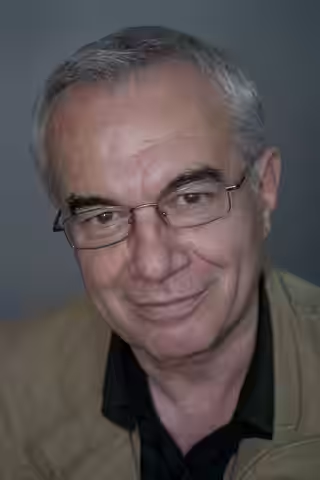
The director who shot Yol for Yılmaz Güney from a prison-written script and made it look like nobody's instructions. Plain, unhurried, good with skies and with actors nobody had heard of; less sure of himself whenever he reached for comedy.
Fi1m perspective
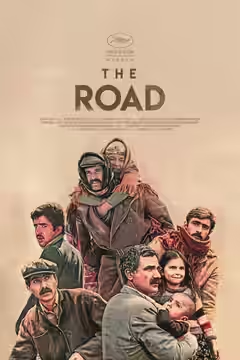
The scenes from Yol (1982) that stay are the ones with the least in them. Ömer goes home to a Kurdish village near the Syrian border, where the men smuggle and the army stops them, and hardly anyone speaks. Şerif Gören holds on the sky and lets the country do the talking. That is how he worked at his best: put a person in a landscape that does not care about them and wait.
He started in 1962 as an editor at Erman Film Studios in Istanbul, and from the mid-1960s he was Yılmaz Güney's assistant. He became a director by necessity, taking over Endişe (1974) when Güney was arrested, and he went on to direct more than thirty films through the 1970s and 1980s, some of them social-realist dramas about workers, migrants and peasants, some of them commercial pictures made quickly. Almanya Acı Vatan (1979) took the guest-worker story to Germany; Polizei (1988) went to Berlin with Kemal Sunal for comedy. He directed television later, and returned to features with Ay Büyürken Uyuyamam (2011). He died on 8 December 2024.
Yol is the film he is known for, and it is the one that raises the awkward question. Güney wrote it in prison, Gören directed it from his instructions, and Güney edited it after getting out of the country. How much of it is Gören's is not settled, and we are not going to settle it here. What we can say is that the film does not lean on its backstory. Five convicts get a week's leave, each goes home, and each finds outside worse than the cells, told plainly and without sentiment. Whoever decided where the camera should stand, the man standing behind it that winter was Gören.
His habits show through. He gave the big parts to actors who were not stars: Halil Ergün plays Mehmet Salih's shame without asking for pity, and Meral Orhonsay gives Emine the film's one stubborn flicker of wanting something for herself. He treated weather and ground as characters, in Yol and again in the rural films that followed, Derman (1983) and Kurbağalar (1985). And he could go heavy. The Mevlüt strand in Yol, a fiancée visited under the eyes of two veiled aunts, is played closer to comedy than the film can manage, and it is the one thread that falls short. Speed cost him elsewhere too: some of the pictures are loose in the cutting, and the later ones were received unevenly.
We came out of Yol thinking about those skies and the men under them, and about how little Gören needed to show to make a marriage look impossible. He once said "Devrimci sinema yapılmaz, yapılabilemez", roughly that revolutionary cinema cannot be made. It is a dry thing for a man who spent twenty years filming the poor to have said, and the films bear it out: they show the grinding down, not the getting up. Start with Yol. If the skies got to you, Derman and Kurbağalar are where he went back for more of them.
Biography
Şerif Gören was a Turkish film director. He began his career as an editor and assistant director, working with Yılmaz Güney, before directing his first feature, Endişe (The Anxiety, 1974).
Gören is best known for The Road (Yol, 1982), which he directed from a screenplay by Güney while the latter was imprisoned; the film shared the Palme d'Or at the Cannes Film Festival. He directed more than thirty films, including Polizei (1988), and also co-directed Hope (Umut, 1970).
Gören died on 8 December 2024 in Istanbul, aged 80.