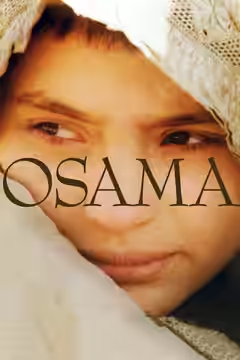
Siddiq Barmak makes family survival painfully immediate, but his writing can leave too little room for the people doing the surviving. We recommend Osama to those drawn to its subject, with reservations about how narrowly it defines its central character.
Fi1m perspective
In Osama (2004), a girl must pass as a boy so that her family can survive. Siddiq Barmak makes the family's need clear before giving us much opportunity to know the child who must meet it. We were distressed by the responsibility placed on her, because even her identity has to serve the adults around her. Marina Golbahari gives us reason to care about her beyond the practical problem she has been asked to solve. It is a forceful introduction to Barmak's work, though its emotional pressure becomes wearing.
Barmak began with short films and documentaries in the 1980s; Osama was his debut feature. He wrote, directed, produced and edited it, taking responsibility for both the girl's story and the time we spend with her. Mohsen Makhmalbaf was a key early supporter. Opium War (2008), Barmak's second feature, follows an encounter between two US soldiers and an Afghan farming family. His subject widened, but the interest in ordinary people coping with hardship remained.
Barmak regularly works with non-professional performers, and Golbahari is one of them. Yet Osama's family matters as much as its central disguise: Zubaida Sahar's Mother and Hamida Refar's Grandmother give the girl's task a human purpose. They keep us aware of why she must attempt it, rather than merely inviting us to worry about discovery. The writing is less generous when it comes to qualities she might possess or wishes she might have that do not concern her family's survival.
Barmak's editing keeps Osama to a disciplined 83 minutes, a welcome decision for so severe a story. Mohammad Reza Darvishi's music does less to unsettle us than the obligation already imposed on the girl. The pressure is there in the situation, and neither the cutting nor the score can supply the missing sense of a child with interests of her own. Choose it for Golbahari and the distressing family dilemma, but not if the evening calls for much relief.
Biography
Siddiq Barmak is an Afghan film director, screenwriter and producer. Born on 7 September 1962 in Panjshir, he received an MA in cinema direction from the Moscow Film Institute (VGIK) in 1987.
Barmak wrote, directed, edited and produced his debut feature Osama (2003). The film won the Golden Globe for Best Foreign Language Film in 2004. It was made with funding and technical assistance from Iranian director Mohsen Makhmalbaf. His second feature, Opium War (2008), won the Golden Marc'Aurelio at the Rome Film Festival. He has also written screenplays and directed short films.
Barmak directs the Afghan Children Education Movement (ACEM), an organisation that promotes literacy, culture and the arts and trains actors and directors for Afghan cinema. He has received the UNESCO Federico Fellini Silver Medal and the French Order of Arts and Letters.