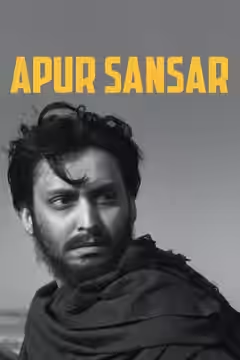
Soumitra Chatterjee makes thinking interesting to watch, and lets intelligence coexist with vanity and awkwardness. In The World of Apu, he earns our affection through the small hesitations and faults another actor might smooth away.
Fi1m perspective
In The World of Apu (1959), Soumitra Chatterjee leaves a small gap before Apu speaks, as though the thought has arrived but the words are still being considered. It is an inviting performance, funny about a man who can be absorbed in himself. Apu’s intelligence is apparent, but it does not make him particularly good at understanding other people. Chatterjee allows the awkwardness to remain, even when a smoother response might make his character more immediately likeable.
We grew fond of Apu because Chatterjee let him irritate us; his vanity made the tenderness easier to believe. Satyajit Ray gives him room to be fallible, and Chatterjee never treats the leading role as an entitlement to our approval. Alongside Sharmila Tagore, he makes the relationships persuasive, although we wish Aparna had more room in the film. That reservation does little to diminish the pleasure of his company.
This was his screen debut, and the partnership with Ray extended to 14 films through 1990. Amal in Charulata (1964), the Brahmin priest Gangacharan in Ashani Sanket (1973) and the detective Feluda in Sonar Kella (1974) required different sorts of bearing and authority. The attraction is not simply the change of occupation. His restraint leaves space for each character’s particular thoughts, rather than a familiar collection of actorly habits.
Ray was the crucial collaborator, but Chatterjee also worked extensively for other Bengali directors, including Mrinal Sen and Tapan Sinha. His return to theatre with his own productions in the late 1970s ran alongside the film work. There was a limitation to his responsiveness to a script: Ray observed that weak material could make his distaste visible in the performance. That limits how confidently we can recommend a film simply because he is in it.
We would begin with The World of Apu before following him into the other Ray films. It offers the pleasure of watching someone think without having every thought explained, and Chatterjee is a large part of why we recommend it so strongly. Allow him to be a little annoying before deciding how much you like him.
Biography
Soumitra Chatterjee (also credited as Soumitra Chattopadhyay) was an Indian actor who worked extensively in Bengali cinema and theatre. He made his film debut as Apurba 'Apu' Roy in Satyajit Ray's The World of Apu (Apur Sansar, 1959), the final part of the Apu trilogy.
He collaborated with Ray on fourteen films, including Devi (1960), Charulata (1964), Aranyer Din Ratri (1970), Ashani Sanket (1973), Sonar Kella (1974) and Joi Baba Felunath (1979) as Feluda, and Ghare Baire (1984). Chatterjee also appeared in more than two hundred films in total and maintained a parallel career in stage acting, playwriting and poetry. He received the Dadasaheb Phalke Award in 2012, the Padma Bhushan in 2004 and France's Commandeur de l'Ordre des Arts et des Lettres in 1999.