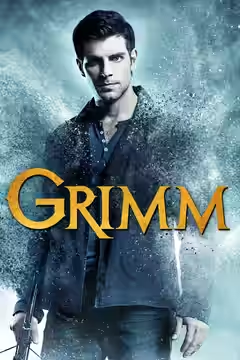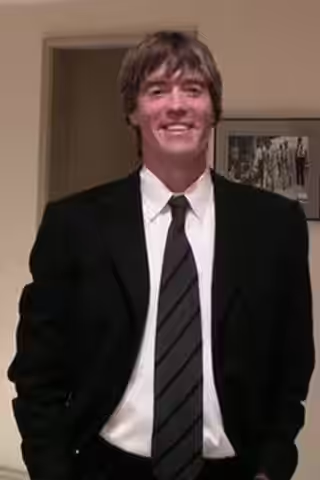
Stephen Carpenter's habit is the splice: a monster sewn into a genre that was getting along fine without one. On Grimm it produced a hook strong enough to carry six seasons; what was built on the hook was tidier than it was frightening.
Fi1m perspective
A detective looks across the interview table and, for a second, the suspect has an animal's face. That is the whole of Grimm (2011) in one image, and it is Stephen Carpenter's kind of idea: take a form that already works, the police procedural, and stitch a second one into it. The Brothers Grimm become case files. The creatures become a hidden species living quietly among us. It is a good hook, and it did what hooks are for, carrying the show through 122 episodes from 28 October 2011 to a short final run in 2017.
He came up in early-1980s horror, writing, directing and often shooting his own films, several of them with Jeffrey Obrow: The Dorm That Dripped Blood (1982), made while he was still at UCLA, The Power (1984) and The Kindred (1987), on which he was also the cinematographer. They are contained pictures, a campus, a laboratory, a small cast and something in the building that should not be there. Then a turn to studio screenwriting, and to comedy: Blue Streak (1999) and The Man (2005), both built on a mismatched pair who would rather not be in the same car. Then Grimm, created with David Greenwalt and Jim Kouf. Seen from a distance the career is one habit repeated: a monster put into a slasher, a crook put into a police station, a fairy tale put into a squad room.
The premise is where his credit sits, creator and story on the pilot, while Greenwalt and Kouf ran the show, and the premise is the part we admire. The execution is another matter. We sat down to the first episodes wanting to be frightened and came away fond instead, which is not the same thing. The faces under the faces are rubbery, David Giuntoli's Nick is too bland to make us feel what he sees, and the mythology grows until the show can no longer hold it. What keeps us there is Silas Weir Mitchell's Monroe, grumbling and reluctant, a creature who would much rather be left alone with his clocks than dragged into a case. He is company, and the show is pleasant, and pleasant is less than that opening image promised.
The pattern holds elsewhere. Soul Survivors (2001), which he wrote and directed, is remembered less for what it is than for the pacing and editing trouble that left it feeling cut short. Carpenter is a man who finds the door. Walking through it and making what lies on the other side properly dark has, so far, been someone else's job, and on Grimm nobody quite did it. If a new splice of his turns up, we will watch the pilot with interest and the rest with patience.
Biography
Stephen Carpenter is an American writer, film director and cinematographer. Born in Weatherford, Texas and raised in Kansas City, Missouri, he graduated from the University of California, Los Angeles School of Theater, Film and Television.
He co-created the NBC fantasy police procedural series Grimm (2011–2017) with David Greenwalt and Jim Kouf, and received story credit for the pilot episode. His screenplays include Blue Streak (1999) and The Man (2005); he also wrote and directed Soul Survivors (2001) and earlier films such as The Kindred (1987).
Carpenter has published novels including the mystery Killer (2010).