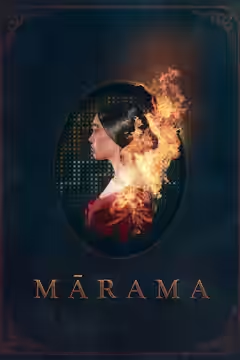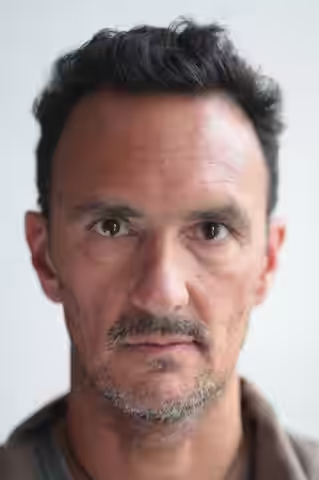
Taratoa Stappard makes slow horror out of the colonial story told backwards: the Māori woman arrives at the English door. One feature in, he is better at watching a face than at staging an event, and the face is enough to keep us interested.
Fi1m perspective
The camera in Mārama (2026) spends a great deal of its time on a woman who is not speaking. Mary, played by Ariāna Osborne, sits across from Toby Stephens's Nathaniel Cole and listens while he explains her own family to her, and Taratoa Stappard keeps the shot on her rather than on him. That is his one clear habit so far, and it is a good one: he trusts an actor's face to carry what other directors would put in dialogue. When Mary finally raises her voice, the film has spent an hour earning it.
There is not much career yet to survey. Stappard made shorts for the better part of a decade, Goalie (2016), Emkhatsini: Between (2018) and Taumanu (Reclaim) (2022), before Mārama, his first feature, which he wrote as well as directed and developed over five years. The subject is the one he keeps coming back to: people cut off from their culture and trying to find a way back, which he has said mirrors his own life, born in Hawera and living mostly in London. His particular turn on it is to run the colonial story in reverse, so the colonised person travels to the coloniser's country and finds the horror already there. "The horror is inherent in the themes of colonization," he has said, and the film takes him at his word.
What works is the patience. The first hour of Mārama is slow the way good haunted-house films are slow, and Dan Kircher's cutting lets scenes sit until they become uncomfortable. What does not work yet is the moment the story has to move from suggestion to event. The second half gets louder and less sure of itself, Kircher's editing starts to hurry, and a couple of scenes explain in dialogue what a look across a table had already told us. It was a first feature set, and that is where it shows: not in the frame but in the nerve. We came out angrier than we expected to, and it was not the house that did it but the few scenes given to Hinemoana (Mihi Te Rauhi Daniels) and Arorangi (Turia Schmidt-Peke), which are the truest thing in the film and are over too soon.
Mārama is meant to be the first of three Māori gothic horrors, and Sharlene George, who has produced three of his films, is presumably along for the rest. We would watch the next one. If he wants advice, it is to trust the quiet more than he did in his second hour, and to give the women at home as much screen time as the man in the house.
Biography
Taratoa Stappard is a New Zealand writer-director based in London. His mother is Māori (Ngāti Raukawa, Ngāti Toa and Ngāti Tūwharetoa) and his father was English. He completed his debut feature Mārama (2025), a Māori gothic horror film set in Victorian England in 1859, which he also wrote. The film premiered at the Toronto International Film Festival and has screened at festivals including Fantastic Fest and Sitges.
Stappard developed Mārama through programmes including the Edinburgh International Film Festival Talent Lab, BFI London, the 2020 imagineNATIVE Indigenous Screenwriting Intensive, the Toronto International Film Festival Writers' Studio, the Black List New Zealand Project and the Berlinale Co-Production Market. It is the first in a planned trilogy of Māori gothic horror stories. His earlier short films include Goalie (2016), Emkhatsini: Between (2018) and Taumanu (Reclaim) (2022).
Mārama and his shorts have received several awards and nominations, including wins at the Seattle International Film Festival and ImagineNative Film + Media Arts Festival.