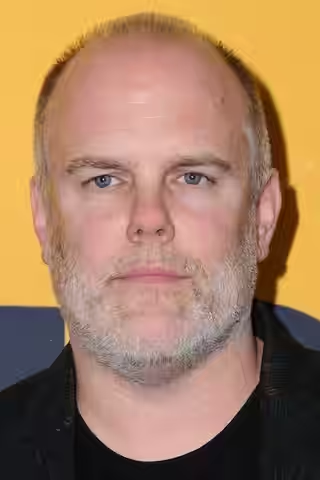
Kapinos writes men who know what is wrong with them and carry on regardless, in Los Angeles, usually with a drink. The dialogue is sharp, the appetite for shock is real, and Californication had about a season of story and ran for seven.
Fi1m perspective
Tom Kapinos's hero wakes up hungover in Los Angeles, says something clever to the woman he has just let down, and goes out to do it again. Californication (2007) opens that way and, seven seasons and 84 half-hours later, closes in roughly the same place. The man is Hank, a blocked novelist played by David Duchovny; the voice is Kapinos's. He writes talk that is quick, rude and well shaped, and for one season he had a good subject: a man who knows exactly what is wrong with him and does it anyway.
Kapinos moved from New York to Los Angeles in the mid-1990s, read scripts for an agency, sold a screenplay in 1999, and spent four years on Dawson's Creek (1999), where he wrote 20 episodes and rose to executive producer; he has called it a boot camp. He has said Californication "grew from my personal experience of coming to L.A. to be a screenwriter, getting a job on 'Dawson's Creek' and making a lot of money and then discovering that I was miserable." That is the programme's one real subject, and he wrote 66 of its 84 episodes himself.
What works is the sentences, and Duchovny's way with them; he can make a man explaining why he is about to behave badly sound almost reasonable. What does not work is anything the sentences are meant to add up to. Kapinos wants Hank to be a tragedy and a good night out at once, and in seven years he never chooses, so the show cannot let its man change and cannot admit that he will not. We laughed a great deal in the first season, mostly at the speed of the talk, and by the middle seasons we were irritated at being asked to laugh at the same scene in a worse mood, with more nudity to make up the difference. By the seventh season (2014) the frankness that once read as honesty had become the whole point, and a programme that had been sharp about its hero had started to agree with him.
After it ended he wrote the pilot for Lucifer (2016), the Devil living in Los Angeles and helping the police, which is the Hank idea with horns. The pilot fixed the tone and Tom Ellis's way of playing the part, and Kapinos then left the running of the series to Joe Henderson and Ildy Modrovich. White Famous (2017), which he created and wrote in full, ran ten episodes. We have not reviewed either. Kapinos's advice to other writers is to write what they want, and he has followed it; whether he has ever wanted to write a man who gets better is the open question. Watch the first season of Californication, which is one of the better things written about being paid well to be miserable, and treat the other six as optional.
Biography
Tom Kapinos is an American television writer, creator and producer. He began his career in the late 1990s after selling his first screenplay, The Virgin Mary, to Fox Studios. This led to work on the WB series Dawson's Creek (1998–2003), where he served as a writer and later as an executive producer.
Kapinos created the Showtime series Californication (2007–2014), on which he was also executive producer and wrote numerous episodes. He later developed and served as executive producer on the Fox series Lucifer (2016–2021), which continued on Netflix. He has additional writing credits on series including Roadies (2016) and White Famous (2017).