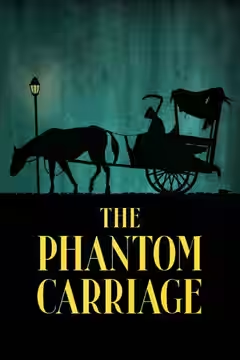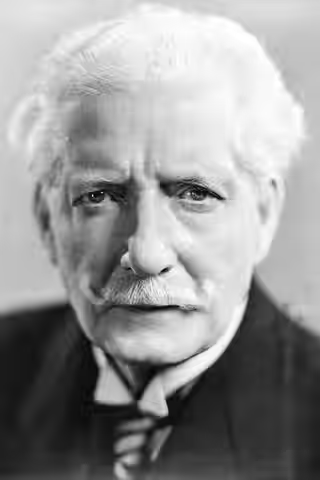
Tore Svennberg makes authority feel thoughtful, and sometimes kind. We rate his reflective supporting work in The Phantom Carriage, whose ghostly coachman gives the supernatural story a recognisably human presence.
Fi1m perspective
In The Phantom Carriage (1921), Tore Svennberg gives the ghostly coachman Georges a reflective gravity. The figure guiding the central character through a moral reckoning could easily become a device for delivering stern lessons. Svennberg's psychologically grounded approach keeps our attention on the person doing the guiding, and on his understanding of human weakness. We value this sort of supporting performance: it takes the story seriously without demanding that every moment announce the actor's importance.
His screen work began with Victor Sjöström's Sons of Ingmar (1919), followed by The Monastery of Sendomir (1920) and The Phantom Carriage. That association makes Sjöström the director to begin with here. Svennberg's realism had been developed through stage work in Ibsen and Strindberg. Georges benefits from that preparation: this is a figure who must understand human failings if we are to accept him as a guide through suffering.
We were frightened by The Phantom Carriage because its double exposures make the human suffering feel close. Sjöström's ghost story earns that response through patience, and Svennberg's grave presence fits it well. There is a limit to our enthusiasm: the warnings about alcohol can become too insistent, and a reflective performance cannot make every lesson welcome. We would have preferred the film to trust its frightened audience a little more.
The sound-era A Woman's Face (1938), in which he plays Consul Magnus Barring opposite Ingrid Bergman, offers a warmer use of the same authority. His grandfatherly kindness gives him something gentler to play than the spectral guide, and suggests why paternal supporting parts suited him. He continued into sound without abandoning the stage, and his film work ended with Stål (1940). Start with The Phantom Carriage, with some patience for its warnings about drink, before seeking out the gentler figure in A Woman's Face.
Biography
Tore Svennberg was a Swedish actor and theatre director. Born Olof Teodor Svennberg in Stockholm on 28 February 1858, he made his stage debut in 1877 and worked in touring companies and at the Swedish Theatre before joining the Royal Dramatic Theatre in 1920, where he served as director from 1922 to 1928.
His stage roles included parts in plays by August Strindberg and Henrik Ibsen. Svennberg appeared in films from 1919 onwards, including Sons of Ingmar (1919), The Phantom Carriage (1921) as Georges, A Woman's Face (1938) as Magnus Barring, and his final role in Stål (1940). He died in Stockholm on 8 May 1941.