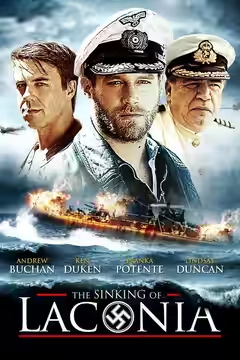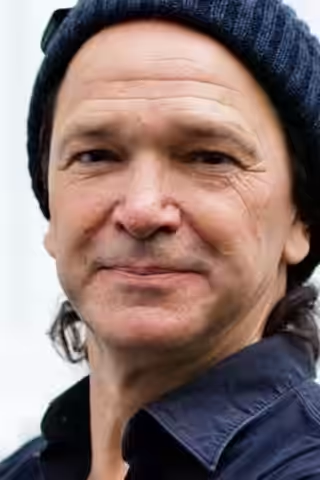
A German television director who, in the one piece of his we have reviewed, chose faces in a flooding corridor over a ship going down from a helicopter, and was right. He is reliable rather than singular, and The Sinking of the Laconia is where to start.
Fi1m perspective
The moment we remember from The Sinking of the Laconia (2011) is not the torpedo. It is a corridor filling with water, Italian prisoners locked in the holds below and Polish guards with rifles between them and the ladders, all of it shot at night and close. Uwe Janson had a television series to make and the scale that comes with one, and rather than fake a spectacle he kept the camera on the people. We were angry watching those holds, and we were meant to be: Alan Bleasdale's script is clear about who counted as cargo on a British ship, and Janson's close framing makes sure nobody watching can look away from them.
That is the one film of his we have reviewed, and it is the one we would send you to. The career around it is long, mostly German and mostly television. He began with a feature he wrote himself, Verfolgte Wege (1989), and from the early 1990s worked steadily in German television, across drama, comedy and literary adaptation. The adaptations are the thread: modernised versions of Brecht's Baal (2004), Wedekind's Lulu (2006) and Ibsen's Peer Gynt (2006), condensed for the screen with their settings brought up to date. Later came a two-part Luther drama, Zwischen Himmel und Hölle (2017), which he described as an attempt to show the reformer in all his facets, on the grounds that "Luther war nicht allein": Luther was not alone.
What he does well is hold a frame on a face and trust it. On Laconia that worked twice over, because the cast was British, German and Italian and the story needed us to read all of them without the script translating. He is comfortable with large casts and foreign locations; the Laconia series was a British-German co-production shot in South Africa, and it never looks like a compromise.
What he does less well, on the evidence of the adaptations, is know when to stop. Some critics felt the pictures and the close-ups in Peer Gynt crowded out the play, and we can believe it, because the instinct that served him on a sinking ship, get close and stay there, is the wrong one for Ibsen, who needs air. Our own reservation about Laconia was slower: it sags in its middle hour and draws some of the British broad, and a firmer hand on the cutting would have helped.
He has the reputation of a dependable television director rather than a name, and on what we have seen that is fair. It is less than an auteur and more than most. If you want to know what he can do, watch the holds.
Biography
Uwe Janson is a German director, screenwriter and producer. Born on 6 November 1959 in Königswinter, he studied scriptwriting and made his first short film in 1987 after an unsuccessful application to film school. He worked as an assistant director to Nico Hofmann and others, and his debut feature Verfolgte Wege (1989), which he also wrote, received several national and international awards.
Janson has directed numerous cinema and television productions in Germany and internationally, including work shot in South Africa, Australia and elsewhere. Notable credits include the television adaptations Peer Gynt (2006) and Reformation (2017), and the British-German co-production The Sinking of the Laconia (2011), a two-part drama for which he received a BAFTA nomination for Best Drama Serial.