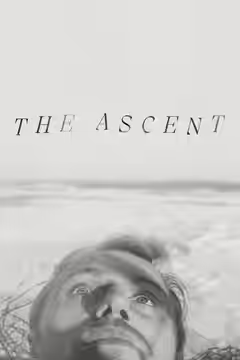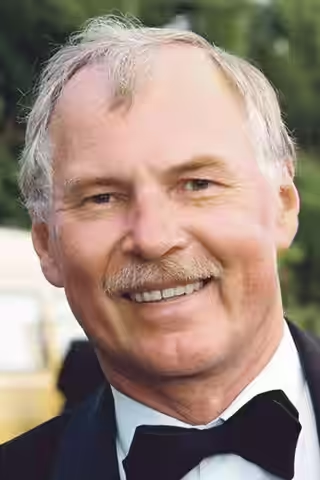
A capable man who knows which farm has food and how to ask, and whom we like, which is the trap. Gostyukhin has played soldiers, workers and drivers for fifty years; in The Ascent he showed what a decent man's practicality can carry.
Fi1m perspective
On screen he is the one who knows what to do. In Larisa Shepitko's The Ascent (1977), Rybak is fit while Sotnikov coughs into his sleeve; he knows the farms, knows how to talk to the people in them, finds the sheep, does the deals, and drags his sick friend across country when a colder man would have left him. Gostyukhin plays all of this without asking for credit. He simply gets on with it, the way the useful man in any group does, and we liked him for it within ten minutes. That liking is the point. What Shepitko does with it in the second half we will not describe, but we came out of the film shaken, and most of the shaking was his doing: a good soldier's face, watched closely, while the ground moves under him.
He came to acting late and sideways, an electrician before GITIS, then small film parts and a job making props at the Central Academic Theatre of the Soviet Army. The Ascent was the part that opened the door, and the Soviet 1980s kept it open. He was Katsuba, the stern and humane sergeant, in Starshina (1979); the lead, Viktor Belov, in Vadim Abdrashitov's Fox Hunting (1980); and Sergey, the Russian lorry driver, in Nikita Mikhalkov's Close to Eden (1991), where he is the outsider among Mongolian herders and the film's way in. He moved to Minsk in the early 1980s and has been based at its Theatre-Studio of Film Actors since. Then television found him: Dalnoboyshchiki (2001), a long-running series about long-haul drivers, made him far better known to a Russian audience than any of the films had. He turned up for Aleksei Balabanov in War (2002), as a father, and for Valery Todorovsky in Ottepel (2013), as a studio director, and he was still working in 2025, in Moy ded.
The type is consistent: rugged, principled, outwardly hard and inwardly soft, a man with a moral core and usually something eating at it. It is a good type and he wears it well. The question with such actors is always whether the director is doing the work or the actor is, and the honest answer here is that he is best when the director is very good. Shepitko gave him one exchange of fire, a hut, a cellar and a room, and he filled them. We have not reviewed the Abdrashitov or the Mikhalkov, so we will not judge them, but the pattern in his career is plain: his strongest work sits next to strong directors, and he seems to know it.
If you have not seen him, start with The Ascent, and do not start on a tired evening. It runs 110 minutes, most of them in snow, and its second half asks more of a viewer than most films ask in total. Gostyukhin is the reason it can.
Biography
Vladimir Vasilyevich Gostyukhin is a Soviet and Russian film and stage actor, also active in Belarus. Born on 10 March 1946 in Sverdlovsk (now Yekaterinburg), he began his career in the 1970s and has appeared in over 100 films and television productions.
He is best known for his role as Rybak in Larisa Shepitko’s The Ascent (1977). Other notable credits include Close to Eden (1991) as Sergey, War (2002) as Ivan’s father, and Red Ghost (2021) as Ded. Gostyukhin has also directed, with his sole feature Botanichesky Sad released in 1997, and maintains a long association with Belarusian theatre and cinema.