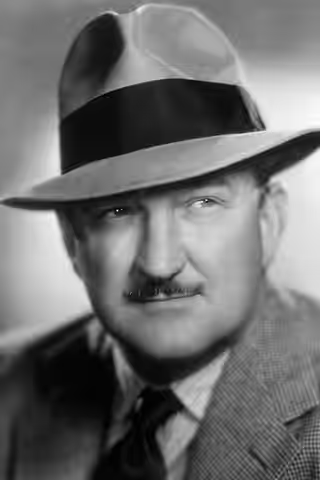
William A. Seiter gives foolish people time to embarrass themselves, and at his best the comedy keeps building. We rate his patient handling of performers, though patience can become sluggishness when a farce needs more urgency.
Fi1m perspective
Stan Laurel and Oliver Hardy behave like children in Sons of the Desert (1933), then expect the respect due to grown men. Seiter lets us enjoy their foolishness without making them unpleasant company. We laughed at how hard they work to protect their dignity, because each fresh embarrassment makes the effort more ridiculous. The important decision is to let the comedy develop rather than start again after every laugh. For us, this tightly controlled farce is the strongest reason to seek out his work.
Seiter had been directing comedy shorts since the 1910s, then moved into features in the early 1920s. His Universal comedies of the mid-1920s featured Reginald Denny, often with Laura La Plante, before sound brought further work with comic teams such as Wheeler & Woolsey. Across those changes, his preference was for a moderate pace and performers who could supply charm as well as jokes.
Musicals gave that patience another use: Roberta (1935) paired him with Fred Astaire and Ginger Rogers, while You Were Never Lovelier (1942) continued his work with Astaire. His handling of dance and light romance gives a useful second route into the films. The reservation is pace. In the Marx Brothers vehicle Room Service (1938), that measured approach becomes sluggish where the farce needs to move.
Back in Sons of the Desert, Mae Busch gives the leading pair formidable opposition, and Charley Chase makes the lodge's foolishness extend beyond them. Seiter's handling of the ensemble matters: the supporting players have comic work to do rather than merely watching the stars. There are limits to what the film offers, particularly its narrow view of marriage, and we would not mistake a well-managed domestic farce for a searching account of married life. At 65 minutes, however, it gives its slight story little chance to become wearisome. Start there, provided foolish husbands are company enough for an evening.
Biography
William A. Seiter (also credited as William Seiter) was an American film director. He was born in New York City on 10 June 1890 and died in Beverly Hills, California, on 26 July 1964. After attending Hudson River Military Academy, he entered films in 1915 as a bit player and stunt double at Mack Sennett’s Keystone Studios before directing comedy shorts and moving to features in the 1920s.
Seiter directed more than 100 films, specialising in light comedies and musicals. He is credited as director and writer on Sons of the Desert (1933), the Laurel and Hardy feature often regarded as one of their best. Other notable credits include Roberta (1935), Room Service (1938), You Were Never Lovelier (1942) and If I Had a Million (1932). He worked with stars including Fred Astaire, Ginger Rogers, Shirley Temple and the Marx Brothers, and was married to actress Laura La Plante from 1926 to 1934.