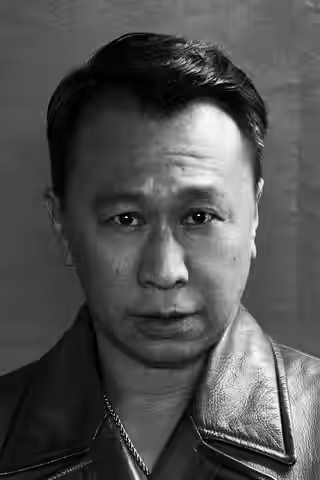
Yu An-shun does less than almost any actor we can name: the slouch, the stare, the line withheld. Hou Hsiao-hsien found it in a teenager in 1985, and Taiwanese cinema has been finding uses for it in ordinary men ever since.
Fi1m perspective
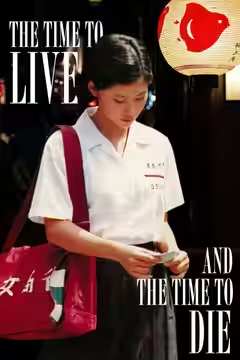
A teenage boy follows a schoolgirl home and does not say a word to her. That is Yu An-shun in the second half of The Time to Live and the Time to Die (1985), Hou Hsiao-hsien's film about his own childhood, and it is most of what the actor does in one walk. He plays Ah Ha with a slouch, a stare and hardly any lines. He runs with a gang and gets into street fights, and Hou keeps the camera well back and lets him do almost nothing in the frame, which turns out to be plenty.
It was his first film, and it should have been the start of a run. He went straight into Edward Yang's Terrorizers (1986) as a criminal boyfriend, which put him inside the New Taiwan Cinema at its height. Then the film work thinned out, and Yu went where the work was: a decade on Da Ai Television, the stage, and a long line of fathers, labourers and small-time men in supporting parts. He came back to prominent film roles only in the 2010s, in The Tenants Downstairs (2016), The Great Buddha+ (2017) and Nina Wu (2019), and then as the withdrawn, grieving pigeon trainer at the centre of Coo-Coo 043 (2022), with The Pig, the Snake and the Pigeon and The Abandoned both following in 2023. We have not reviewed the later films and will not pretend to have weighed them, but the parts tell their own story. He is the man Taiwanese cinema calls when it needs someone ordinary and does not want the ordinariness acted.
What he does is closer to observation than to performance. He is said to watch everyday people and borrow their gestures, and on screen nothing in his body looks decided on in advance. That is why he sits so well in Hou's long takes through open doorways, where an actor who reached for a moment would be caught reaching. There is a late bedroom scene in the Hou film that we will not describe, and it left us with something close to horror, not at anything shown but at how ordinary the bedroom looked while it happened; the scene works because nobody in it, Yu included, behaves as if they are in a scene.
The one reservation anyone makes about him is made in passing: he has stayed a character actor rather than a lead. He has said as much himself, "我不是明星,我是演員", that he is not a star but an actor. On the evidence of the film we have reviewed, that is the right way round.
Start with the Hou, provided you can sit through 136 minutes of a boy doing badly at school and saying very little about it. Then notice how many Taiwanese films of the last decade have found room for the same slouch, grown older. He is still working, across film, television and stage, and we would expect the parts to keep getting quieter and better.
Biography
Yu An-shun is a Taiwanese actor. Born on 5 November 1967 in Yunlin, he made his screen debut in Hou Hsiao-hsien’s The Time to Live and the Time to Die (1985), in which he played the lead role of Ah Ha (also credited as Ah Hsiao).
He subsequently appeared in Edward Yang’s Terrorizers (1986) and later films including The Great Buddha+ (2017), Nina Wu (2019) and The Pig, the Snake and the Pigeon (2023). His television work includes the series The World Between Us (2019) and Copycat Killer (2023). He has received several Golden Bell Awards, including Best Supporting Actor in a Television Series in 2017.