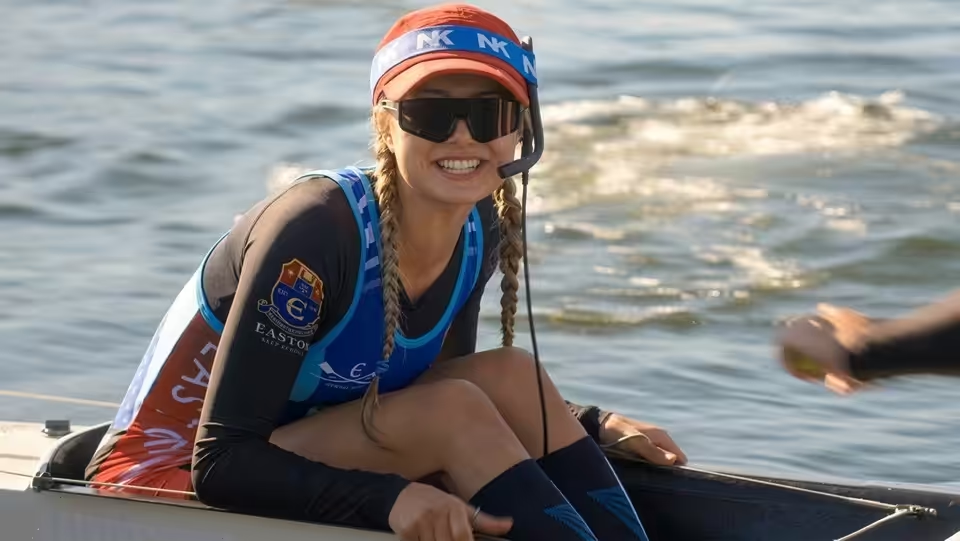
Vivian Lin’s rowing drama is at its best on the water, where Bradley S. Creasser’s photography gives the sport real weight. On dry land it is a stiff private-school soap, rescued now and then by Jessica Paré as the mother.
Vivian Lin’s eight-episode series takes the oldest shape in the young-adult drawer, a teenage girl, a new town, a rich school and two boys, and puts an oar in her hands. Teagan Tao (Miku Martineau) arrives, is noticed, joins the crew, and spends a little over six hours deciding what she wants and who she wants it with. Crew Girl is decent company in its best stretches and dull in its worst, and the worst outnumber the best. If you already like this genre it will fill an evening or two. If you do not, the rowing is the only reason to stay.
Rowing is a good choice for this kind of story, and it is the one properly fresh thing here. It is a team sport in which nobody speaks, so the drama has to live in shoulders and breathing and the small adjustments of eight people trying to become one. Bradley S. Creasser photographs the boats with more care than the series gives to anything else: the water is allowed to be cold and grey rather than postcard blue, and the effort looks like effort. We enjoyed these passages without reservation, and more than once we felt the pull of wanting a race to go well for people we did not otherwise much care about. That is the sport doing the work the script should be doing, but it is work all the same.
Jessica Paré, as Ella Emerson-Tao, is the other reason. The mother-and-daughter scenes are the only relationship in the series that behaves like one, with two people who know each other’s tricks and are tired of them. Paré plays Ella as a woman who has made a large decision and is not sure it was the right one, and she gets most of the laughs the series has, because she underplays where everyone around her leans in. When she is in a scene the dialogue sounds like speech. When she leaves, it goes back to sounding like lines.
That is the central problem. The boys, Josh Regis (Samuel Braun) and Cam Dillinger (Kyle Clark), are types before they are people, and the writing does not do much to promote them. Conversations are built so that each character states a feeling, the other states a competing feeling, and the scene ends; almost nobody interrupts, changes their mind or says something they did not intend. Martineau has to carry a great deal of screen time on very little, and she is likeable and steady, which is about what the material allows. The triangle the series is built around never gets sharp enough to cut anyone.
Then there is the family scandal, which starts as a hum in the early episodes and becomes the main plot in the later ones. It moves slowly and it explains itself often, and it has the same fault as a lot of streaming drama built to be watched in a single sitting: it stretches a few revelations across six hours because six hours were ordered. Around the fifth episode we noticed we were checking how many remained, and were a little cross with ourselves for it, because the series had done nothing to deserve resentment. It had simply stopped moving.
The school does not help. It is a very handsome place in which very handsome young people have almost no lessons, no money worries and no adults beyond a coach and one parent. Heartbreak High (2022) shows how much energy a teen series gets from letting its school be messy and crowded and specific; Gossip Girl (2007) got away with the gloss by being wicked about it. Crew Girl is neither messy nor wicked. It is polite, and polite is a hard thing to sustain for eight episodes.
Against its own genre, then, this sits in the middle: better made than most, and less alive than the ones people remember. Watch it with a teenager who rows, or when you want six hours of nothing that will upset you. On the water, let it run. On land, you will not miss much if you reach for the remote.