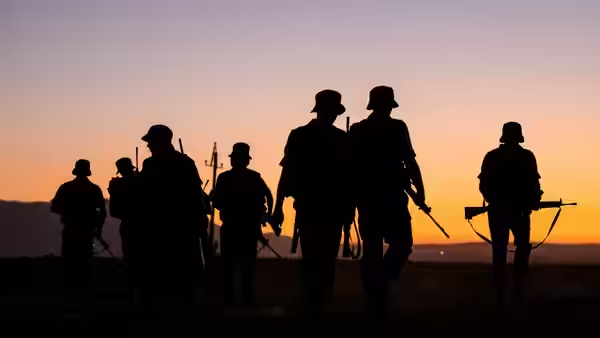
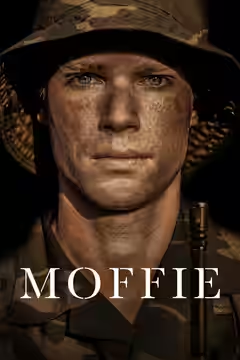
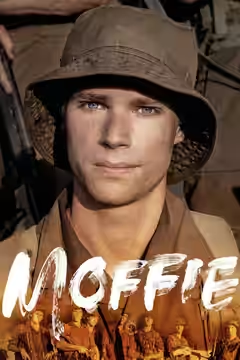
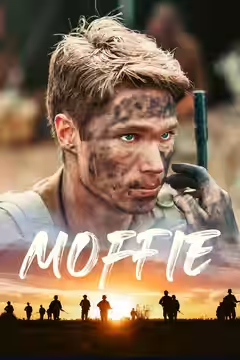
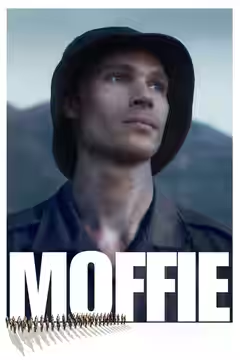
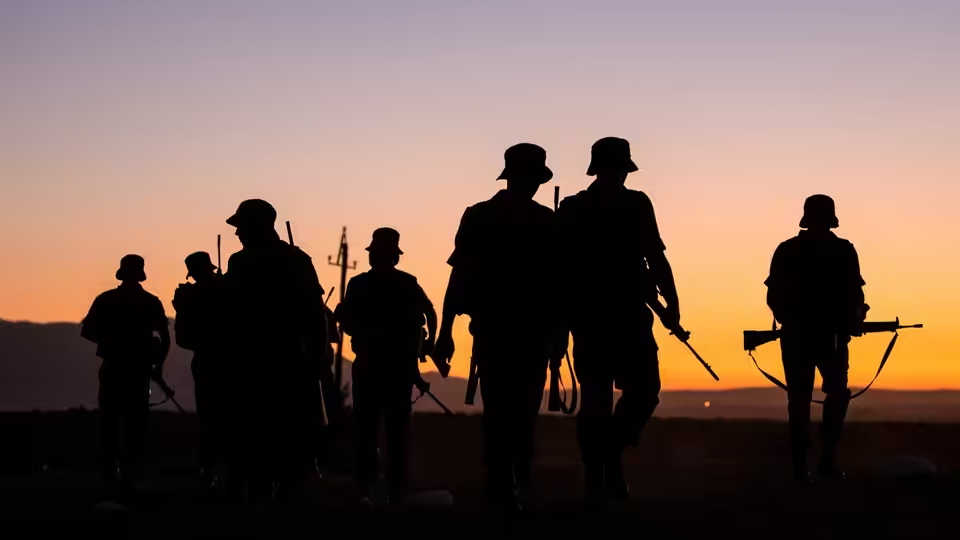
Silhouetted soldiers carrying rifles walk across open ground at sunset
Film review

Moffie

2020 · Directed by Oliver Hermanus · 1h 44m

In a sentenceAll that military training, and the hardest thing is knowing where to look

In apartheid-era South Africa, Nicholas Van der Swart (Kai Luke Brümmer) enters military service needing to keep his homosexuality hidden. Training brings bullying, humiliation and homophobic abuse; showing what he feels could make him a target. His days are spent among men including Dylan Stassen (Ryan de Villiers), Michael Sachs (Matthew Vey) and Sergeant Brand (Hilton Pelser). Nicholas wants to get through his service without being exposed, but friendship and attraction complicate the effort to stay unnoticed. The military demands a display of masculinity that leaves him watching himself as closely as the men around him.

Plays from YouTube when you press play; nothing loads from them until then.

Fi1m review

Oliver Hermanus makes a forceful, difficult drama about a gay conscript in apartheid South Africa. Kai Luke Brümmer’s restraint gives the cruelty a human scale, though the storytelling becomes less sure as it goes on.

Moffie is a forceful, troubling drama, and we recommend it with a reservation about its increasingly uneven storytelling. Oliver Hermanus approaches military training through the effort of a gay conscript to avoid being noticed. In apartheid South Africa, Nicholas Van der Swart must conceal feelings that the institution around him treats as grounds for humiliation. The film’s interest is in the daily work of keeping those feelings from showing, and in how much of a young man’s attention that work consumes.

Kai Luke Brümmer gives that vigilance a physical presence without turning Nicholas into a succession of signals for us to decode. His reserve makes the bullying harder to watch, because the performance offers so little release from it. We felt worn down by the homophobic abuse; the repetition of slurs makes ordinary proximity to other men seem dangerous. The friendships matter because they offer some relief without removing the need for caution.

Jamie Ramsay’s cinematography lets us understand why Nicholas cannot simply stop looking at the men around him. The attention to male bodies makes attraction palpable even when the military setting makes it frightening. That is a difficult judgement to get right: photographing these men with care could soften our sense of their capacity for cruelty. Here, the beauty makes Nicholas’s predicament more painful, because we can understand the longing as well as the fear.

Franz Lewis’s production design helps make shared military space feel unsafe, even before anyone speaks. The surroundings offer little sense of somewhere Nicholas could stop monitoring himself, which serves the film’s tightly restricted view of his experience. Braam du Toit’s score presses that anxiety further, and its intensity is often effective. It can also feel too insistent, telling us to brace ourselves when the faces and the proximity of the men have already done the work.

George Hanmer and Alain Dessauvage make Nicholas’s memories feel close enough to disturb the military present. The editing gives his fear a history without requiring the central performance to become more demonstrative. The broader pacing is less convincing, with later stretches feeling both hurried and prone to drift. Across 104 minutes, some developments need more room, while other passages repeat an anxiety the film has already made clear.

The screenplay by Oliver Hermanus and Jack Sidey remains strongest when it stays close to the practical business of concealment. Its close focus on Nicholas’s suffering also leaves the wider racial hierarchy of apartheid less fully examined. That choice is understandable, and it gives the lead performance room to register. Still, we wanted a fuller sense of how this military culture serves the society outside it.

Anyone expecting military action to provide the main drama should adjust those expectations. The film has already made the business of surviving other men’s company frightening enough. Its tenderness comes as a relief, and the central performance keeps that relief from feeling cheaply offered. We recommend it, with patience for the uneven stretches and fair warning about the sustained verbal cruelty.

Critical consensus AI synthesised

76
Positive
13
Mixed
4
Negative
0

Most critics respond warmly to Moffie’s portrayal of gay repression within apartheid-era military service, finding tenderness and desire amid the bullying and indoctrination. Praise centres on the intimate cinematography, which makes both attraction and claustrophobia palpable, and on Kai Luke Brummer’s restrained, physically expressive performance. The reviews repeatedly describe a punishing but rewarding drama, attentive to the psychological damage of homophobia without losing sight of the conscripts’ longing for closeness.

The spread runs from strong enthusiasm to mixed approval, with no outright negative verdicts. Reservations concern uneven storytelling and, in some reviews, the treatment of race or heavy-handed direction. The Hollywood Reporter finds the later sections both meandering and rushed. A revealing disagreement concerns the flashback: Deadline considers its placement disruptive, while The AV Club singles it out as harrowing. Even the more reserved responses find value in the depiction of military hatred and clandestine intimacy.

IndieWire
9 April 2021 · A- · Ryan Lattanzio
90

Lattanzio calls the film a powerful portrayal of gay repression and apartheid. He praises its sensual cinematography and editing, which make the protagonist’s claustrophobia and memories vivid.

Read the full review →
Sight and Sound
9 September 2019 · Jamie Dunn
85*

Dunn finds the film an unsettling, thrillingly cinematic portrait of repression and self-loathing. He particularly praises its feverish atmosphere, shaped by intimate cinematography and an intense score.

Read the full review →
Variety
5 September 2019 · Critics Pick · Guy Lodge
85*

Lodge calls the film a formally assured, piercing masterpiece. He particularly praises its tactile, sensually attentive cinematography and its sensitive portrayal of desire under brutal homophobia.

Read the full review →
Los Angeles Times
8 April 2021 · Robert Abele
80*

A compelling, emotionally intelligent drama that examines the violence of military indoctrination and the criminalization of gay identity. The critic praises Kai Luke Brummer’s magnetic reserve and the film’s evocative cinematography.

Read the full review →
The i Paper
23 April 2020 · ★★★★ · Joseph Walsh
80

Walsh finds the film a tough but rewarding drama that exposes the fear and hatred of apartheid-era conscription. He singles out its potent depiction of psychological anguish and the poisonous force of homophobic slurs.

Read the full review →
Time Out
23 April 2020 · ★★★★ · Dave Calhoun
80

The critic finds the bootcamp drama bruising yet tender in its treatment of coming out. They single out its subtle beauty in expressing the pain and uncertainty of that experience.

Read the full review →

Straight answers AI written, from our review

Is Moffie worth watching?
Moffie is worth watching for its restrained central performance and troubling account of a gay conscript’s military service; we score it 80 out of 100. We recommend it to viewers drawn to intimate, demanding drama rather than military action, with reservations about uneven later storytelling and a warning about sustained homophobic abuse.
How long is Moffie, and what is it rated?
Moffie runs 1h 44m. It is a drama and war film.
Where can I watch Moffie in Azerbaijan?
Moffie is not on any streaming or rental service in Azerbaijan at the moment. It is available in 10 other countries; change your country at the top of the page to see where. Availability is checked daily.
How violent or frightening is Moffie, and is it suitable for children?
Moffie has a UK 18 certificate and is not suitable for children, with bullying, humiliation and sustained homophobic abuse making it a difficult watch. We find its fear comes from Nicholas’s need to conceal his sexuality among men who could turn on him; the repeated verbal cruelty is wearing rather than merely incidental.
How does Moffie compare to Beau Travail?
Moffie offers a more emotionally immediate account of concealed desire in military life than Beau Travail, whose slow, spare storytelling can hold us further away. We favour Moffie for the closeness of its central performance, despite uneven pacing; Beau Travail better suits viewers drawn to drama conveyed through drills, movement and things left unsaid.
Is Moffie based on a true story or a book?
Moffie is adapted from a novel by André Carl van der Merwe. We cannot establish how closely it follows the book or how much draws on true events, but the film gives newcomers a clear central predicament: a gay conscript must hide his feelings within an abusive military culture.
What should I watch after Moffie?
After Moffie, try Beau Travail (1999, Fi1m 86): Another military life shaped by unspoken desire, told through movement and routine. Then Weekend (2011, Fi1m 86): A quieter account of the courage involved in letting another person close.

Cast

If you liked this, try…

  1. Beau Travail (1999, Fi1m 86)Another military life shaped by unspoken desire, told through movement and routine.

  2. The Wound (2017) · not reviewed yetSecrecy and masculine ritual put another South African gay man under pressure.

  3. Merry Christmas, Mr. Lawrence (1983) · not reviewed yetCaptivity, attraction and military authority make every exchange between men potentially dangerous.

  4. A Special Day (1977) · not reviewed yetTwo isolated neighbours find intimacy while fascist ceremony occupies the streets outside.

  5. Weekend (2011, Fi1m 86)A quieter account of the courage involved in letting another person close.