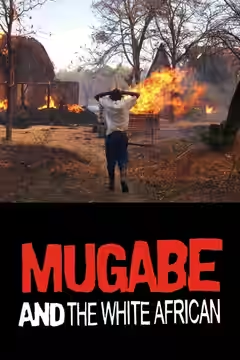
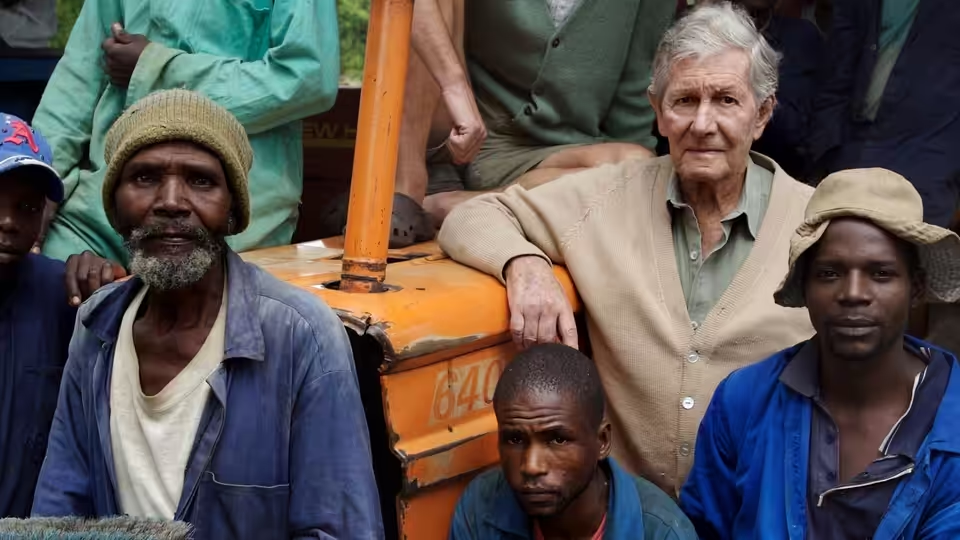
An older white man sits beside Black farm workers around an orange tractor
Film review

Mugabe and the White African

2009 · Directed by Lucy Bailey, Andrew Thompson · 1h 30m

In a sentenceA minister’s relative wants your farm, which is a poor start to any discussion about property rights

At the Campbells’ farm, the family fights to keep its land as a minister’s relative arrives to take it over. Directors Lucy Bailey and Andrew Thompson follow the family’s resistance and the danger surrounding the dispute over their land, with Elizabeth Morgan Hemlock and David Pearson producing. Mugabe appears only in news clips, while the film stays with the Campbells and the farm they want to retain. Their attempt to prevent the takeover brings them into conflict with someone whose claim comes with political connections, as ownership of the farm becomes a struggle over who has the power to enforce it.

Fi1m review

Lucy Bailey and Andrew Thompson make the Campbells’ fight for their farm tense and distressingly personal. The documentary earns our sympathy, though its limited historical context leaves important questions about the land dispute unanswered.

Lucy Bailey and Andrew Thompson make the threatened loss of the Campbells’ farm feel immediate, frightening and painfully personal. Mugabe and the White African is a gripping documentary, though its account of the dispute leaves too much history unexplained. It stays close to people trying to hold on to their land while others claim the right to take it. The directors make that situation comprehensible without making the wider politics sufficiently clear.

The encounter with a minister’s relative, who arrives to take over the farm, makes the danger horribly specific. We were frightened by the prospect that a political connection might count for more than the family’s claim to its land. There is nothing reassuring about watching the dispute unfold, even without knowing what follows. The directors keep our attention on the encounter itself, where the imbalance between the people involved is enough to make us anxious.

The footage is carefully composed, and that care matters in a film with such an alarming subject. We can take in the farm and attend to the people in it without the images competing with the dispute for our attention. The framing gives the people involved a seriousness that hurried reporting might lose. There is room to consider their attachment to the farm as well as the immediate danger of losing it.

Mugabe himself appears only in news clips. Keeping him within that public footage, separate from the close attention paid to the Campbells, helps the directors maintain their concentration on the family. The news clips provide a point of reference while the farm gives the dispute an immediate, concrete setting. The title might suggest an encounter with Mugabe, but the family’s struggle remains the subject.

The lack of historical context is the substantial weakness. A dispute about land demands some account of how ownership came to be contested, and the film gives too little space to that question. The family’s vulnerability is persuasive, but sympathy alone cannot explain the larger conflict. We wanted more help in distinguishing what this particular case demonstrates from what it cannot settle. That would not require treating the threat as reasonable; it would give us a firmer basis for understanding why the threat exists.

Within those limits, the attention to the Campbells is humane. They are given the time and seriousness that make resistance feel like something people have to sustain through danger and uncertainty. The narrative tension holds because keeping the farm matters to these people. At 90 minutes, the film makes a concentrated demand on our attention, even when its wider explanation feels incomplete.

Viewers looking for a political documentary with people at its centre should find enough here to justify the evening. It is a difficult watch because the threat to the family is made so immediate. The limited context remains a serious caveat. We would not make it your only account of the dispute.
Critical consensus AI synthesised

75
Positive
4
Mixed
1
Negative
0
The Guardian
10 January 2010 · Philip French
80*

French finds the documentary gripping and chilling, presenting the Campbells’ fight as a nightmare of injustice and danger. He singles out the encounter with a minister’s relative arriving to take over the farm as especially chilling.

Read the full review →
Time Out
5 January 2010 · ★★★★ · Dave Calhoun
80

Calhoun gives the documentary a positive four-out-of-five rating. He notes that Mugabe appears only in news clips, rather than in the intimate meeting the title suggests.

Read the full review →
The Hollywood Reporter
14 October 2010 · The Associated Press
78*

The review finds the documentary urgent and dramatically compelling, though it wishes for more historical context. It praises the story’s narrative tension and the courage of the sympathetic subjects.

Read the full review →
Slant Magazine
19 July 2010 · ★★★/4 · Joseph Jon Lanthier
75

The critic finds the documentary aesthetically confident, humane, and compelling, despite some structural limitations. He praises its tense, carefully composed footage and sensitive portrayal of the struggle over the farm.

Read the full review →
Screen Daily
22 October 2009 · Fionnuala Halligan
64*

The review’s verdict and specific praise or criticism are not visible in the accessible text. The page identifies it as a review of the 2009 documentary, but its critical assessment is behind the paywall.

Read the full review →

Straight answers AI written, from our review

Is Mugabe and the White African worth watching?
Mugabe and the White African is worth watching for its tense, humane account of a family resisting the threatened takeover of its farm, and we score it 78 out of 100. We recommend it to viewers drawn to political documentaries centred on people, but its limited historical context makes it an incomplete explanation of the land dispute.
How long is Mugabe and the White African, and what is it rated?
Mugabe and the White African runs 1h 30m. It is a documentary film.
Where can I watch Mugabe and the White African in the US?
Mugabe and the White African is not on any streaming or rental service in the US at the moment. It is available in 2 other countries; change your country at the top of the page to see where. Availability is checked daily.
How violent or frightening is Mugabe and the White African, and is it suitable for children?
Mugabe and the White African has a UK 12A certificate and is frightening because the threat to the Campbells’ home and livelihood feels immediate and personal. We find the politically connected attempt to take their farm distressing; the certificate permits under-12s with an adult, but this is better suited to older children and teenagers comfortable with real-world intimidation.
How does Mugabe and the White African compare to Harlan County U.S.A.?
Mugabe and the White African offers a tense family-centred land dispute, while Harlan County U.S.A. follows resistance on a Kentucky picket line and is our stronger recommendation. Both patiently observe people whose livelihoods are threatened by power, but we would choose the former for its close attention to the Campbells, with the caveat that it leaves important historical questions unanswered.
What should I watch after Mugabe and the White African?
After Mugabe and the White African, try Harlan County U.S.A. (1976, Fi1m 88): Another patient account of people resisting power that can threaten their livelihoods. Then The Gleaners and I (2000, Fi1m 85): A gentler documentary about ownership and people making use of what others discard; and Collective (2019, Fi1m 88): Another investigation of public power whose immediate human consequences are difficult to dismiss.

If you liked this, try…

  1. Harlan County U.S.A. (1976, Fi1m 88)Another patient account of people resisting power that can threaten their livelihoods.

  2. The Gleaners and I (2000, Fi1m 85)A gentler documentary about ownership and people making use of what others discard.

  3. 5 Broken Cameras (2011) · not on Fi1m yetA land dispute recorded from close quarters, with danger shaping the filming.

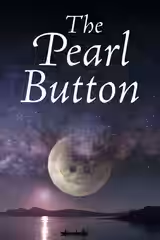
  4. The Pearl Button (2015) · not on Fi1m yetFor the historical breadth missing here, linking landscape, dispossession and state violence.

  5. Collective (2019, Fi1m 88)Another investigation of public power whose immediate human consequences are difficult to dismiss.