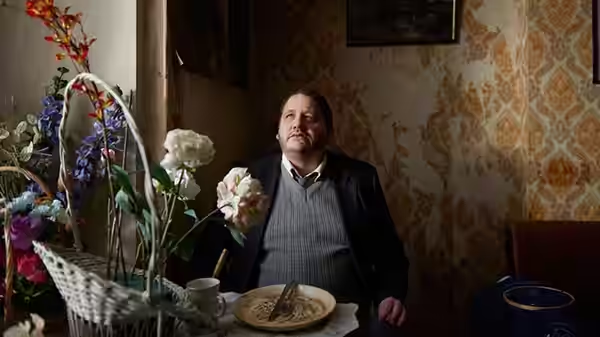
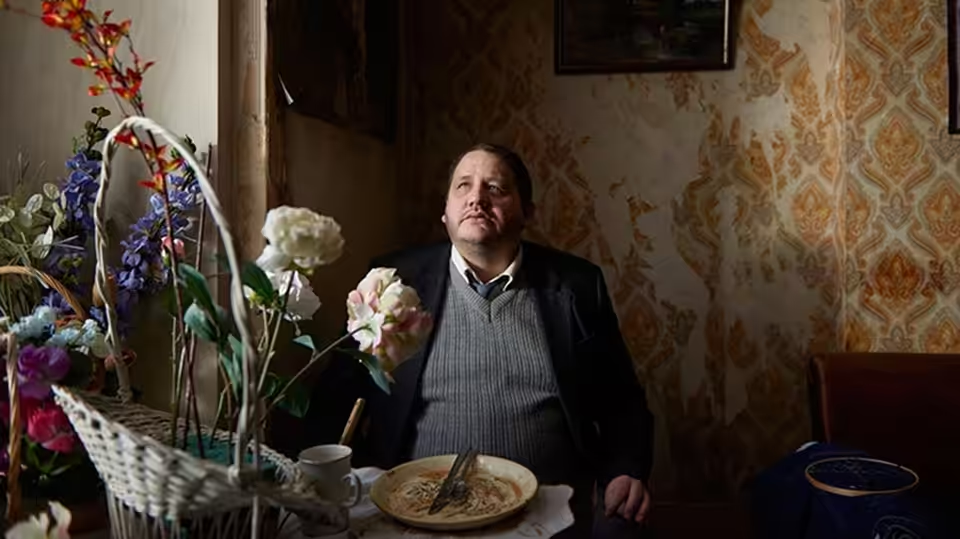
Ray (Justin Salinger) sits at a dining table amid flowers, looking upward
Film review

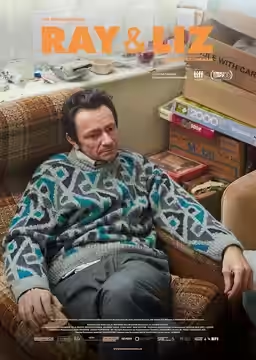
Ray & Liz

2018 · Directed by Richard Billingham · 1h 47m

In a sentenceA family portrait with nowhere comfortable to sit

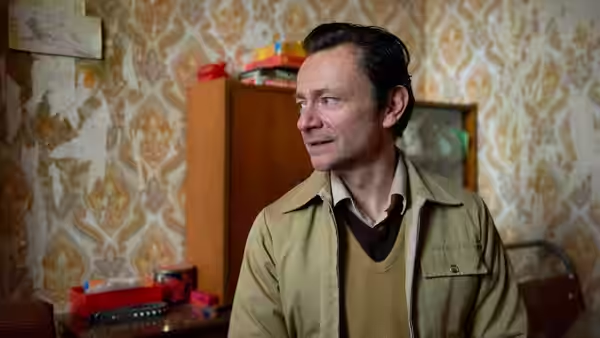
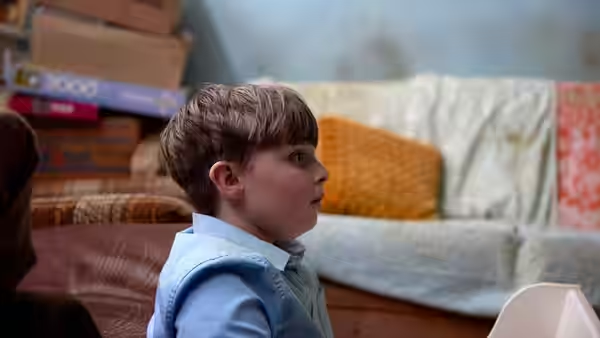
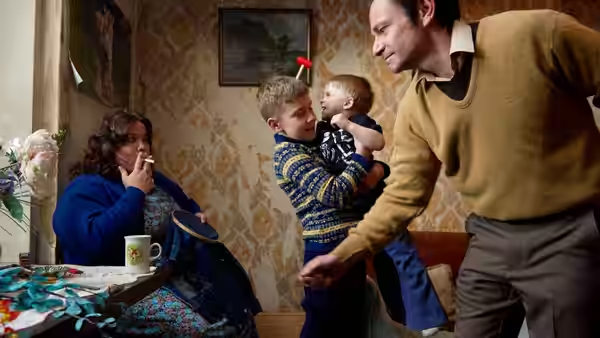
Ray (Justin Salinger) and Liz (Ella Smith) raise their children in a deteriorating home where poverty and neglect shape daily life. Richard (Jacob Tuton) is ten; Jason (Callum Slater) is two. The boys depend on their parents for care, but boredom and the adults’ own difficulties leave little space for their needs. The story returns to this childhood through separate episodes, moving between the family at different ages. Within the cramped household, the children need attention from parents whose behaviour makes everyday life uncertain.

Fi1m review

Richard Billingham’s childhood memoir is moving, uncomfortable and worth the patience it asks for. Closely observed performances and cramped, grainy images make the neglect hard to bear, though some episodes feel disconnected and overlong.

Richard Billingham’s Ray & Liz is a moving family drama that asks for patience and mostly earns it. Writing and directing this account of his childhood, he gives boredom and neglect time to become uncomfortable. There is little attempt to make his parents easier company, or to turn each remembered incident into a tidy stage in a story. The unevenness matters, but so does the care with which he keeps looking at people whose company can be hard to bear.

Justin Salinger and Ella Smith play Ray and Liz, with Patrick Romer and Deirdre Kelly taking the older roles. Having different performers at different ages makes the changes in the family tangible, even when the links between episodes are loose. The acting helps keep the parents from becoming a pair of case studies in failure. There is room for humour in these performances, and for recognisable human awkwardness, without much invitation to find the adults endearing.

Dan Landin’s grainy 16mm photography makes the interiors feel cramped before we have had time to examine their condition. We felt hemmed in. The compositions leave so little room around the family that even looking at them can feel intrusive. The closeness also lets us study faces as carefully as the rooms, which is crucial in a film where the setting could so easily take over.

Beck Rainford’s production design deserves much of the credit for making the home feel inhabited. The accumulated detail suggests familiarity with these surroundings, down to the parts another film might hurry past. Only occasionally does the care of the reconstruction draw attention away from the family living in it. For most of the film, the decaying rooms make the parents’ difficulties and the children’s dependence on them painfully immediate.

Tracy Granger’s editing does not always make the separate episodes feel connected, and this is where our main reservation lies. Some passages linger until boredom becomes part of the family’s circumstances; elsewhere we found ourselves waiting for a connection that never quite develops. We understand why a childhood remembered in pieces should resist a neat plot. At 107 minutes, though, the film has stretches that feel stalled, even allowing for the difficult lives it is asking us to sit with.

Joshua Millard-Lloyd’s Jason gives the film a welcome unpredictability. His performance has enough life to keep the child from becoming merely someone to worry about, and the attention to his experience broadens a film that can seem shut inside its rooms. Dramas about poverty sometimes press so insistently for pity that the children scarcely get to be people. Here we have a sense of a boy finding his own freedom, without being asked to forget how badly he needs care. Choose it for an evening when you can give it your full attention and do without much reassurance.

Critical consensus AI synthesised

76
Positive
17
Mixed
4
Negative
1

Most critics find Ray & Liz a moving, unsentimental account of family poverty and neglect, with praise centred on Billingham’s intimate knowledge of the people and rooms he depicts. The grainy 16mm imagery, cramped compositions and detailed recreation of the family home draw repeated approval. Several reviews also find humour, affection and empathy within the bleakness, crediting the film with neither blaming its subjects nor asking for easy sympathy.

The main division concerns the fragmented storytelling: some critics value its refusal to tidy up memory, while others find the episodes disconnected or insufficiently developed. The Guardian offers the clearest dissent, finding the film frustrating and claustrophobic despite its vivid evocation of the past. The broadly positive AV Club also questions the reliance on grotesque detail and meticulous art direction. The spread is wide, but reservations more often qualify admiration than overturn it.

Evening Standard
8 March 2019 · ★★★★★ · Charlotte O'Sullivan
100

O'Sullivan calls the film an instant classic while emphasizing its upsetting, unsentimental portrait of family life. She praises Billingham's ability to make the decrepit rooms feel richly expressive, with every detail helping tell the story.

Read the full review →
Slant Magazine
31 August 2018 · ★★★½/4 · Carson Lund
88

Lund finds the film moving and specific, avoiding exploitative miserabilism despite one episode that verges on it. He especially praises the vivid production design and the atmospheric sequences following young Jason.

Read the full review →
Los Angeles Times
18 July 2019 · Justin Chang
85*

Chang finds the film bleak yet remarkably free of bitterness, with humor and hope threaded through its sadness. He praises its diaristic detail and the way its cramped, textured imagery evokes Billingham’s photographs and imperfect memory.

Read the full review →
Variety
7 August 2018 · Critics Pick · Guy Lodge
85*

Lodge calls the film a uniquely moving, formally rigorous memoir with strong emotional force. He particularly praises its grainy 16mm imagery and the intimate compositions that rework Billingham’s photography.

Read the full review →
IndieWire
11 July 2019 · B+ · David Ehrlich
83

Ehrlich finds the film powerful despite its bleakness and elliptical, almost unfinished feeling. He praises its refusal to tidy up the memories or impose retroactive grace on a life shaped by boredom and neglect.

Read the full review →
Little White Lies
7 March 2019 · 4/4/4 · David Jenkins
80

Jenkins calls it a very special, grimly poetic film that treats its subjects with neither sympathy-seeking nor blame. He praises Billingham’s affectionate recreation of the decaying childhood home and its vividly rendered details.

Read the full review →

Straight answers AI written, from our review

Is Ray & Liz worth watching?
Ray & Liz is worth watching for its closely observed performances and moving account of childhood neglect, and we score it 82 out of 100. We recommend it for an evening when you can give a demanding family drama your full attention, with the caveat that some episodes feel disconnected and overlong.
How long is Ray & Liz, and what is it rated?
Ray & Liz runs 1h 47m. It is a drama film.
Where can I watch Ray & Liz in Peru?
Ray & Liz is not on any streaming or rental service in Peru at the moment. It is available in 5 other countries; change your country at the top of the page to see where. Availability is checked daily.
How violent or frightening is Ray & Liz, and is it suitable for children?
Ray & Liz has a UK 15 certificate and is unsuitable for younger children; its portrayal of parental neglect makes it an uncomfortable watch. We find the cramped home and the children’s dependence on unreliable adults particularly distressing, so sensitive teenagers and adults should expect little reassurance.
How does Ray & Liz compare to Ratcatcher?
Ray & Liz and Ratcatcher both find small childhood freedoms amid poverty and neglect, and we recommend both with reservations about their storytelling. We favour Ray & Liz for closely observed family performances, though its episodes can feel disconnected; Ratcatcher is the better fit for a child-centred account of guilt and squalor, though some relationships remain thinly drawn.
What should I watch after Ray & Liz?
After Ray & Liz, try Ratcatcher (1999, Fi1m 88): A child’s small freedoms persist amid poverty, neglect and difficult surroundings. Then Nobody Knows (2004, Fi1m 87): Children build routines of their own when adult care falls away; and The Quiet Girl (2022, Fi1m 84): For another child’s view of neglect, with more room for tenderness.

Cast

Awards

European Film Award for European Discovery of the Year, 2019

Nominated
European Film Award for European Discovery of the Year

IFFR audience award, 2019

Nominated
IFFR audience award

If you liked this, try…

  1. The Long Day Closes (1992) · not reviewed yetAnother childhood remembered through rooms, faces and the sounds that linger.

  2. Ratcatcher (1999, Fi1m 88)A child’s small freedoms persist amid poverty, neglect and difficult surroundings.

  3. Nobody Knows (2004, Fi1m 87)Children build routines of their own when adult care falls away.

  4. The Kid with a Bike (2011) · not reviewed yetA neglected boy’s need for care receives fierce, clear-eyed attention.

  5. The Quiet Girl (2022, Fi1m 84)For another child’s view of neglect, with more room for tenderness.