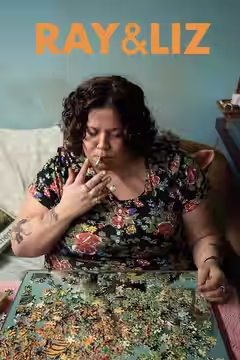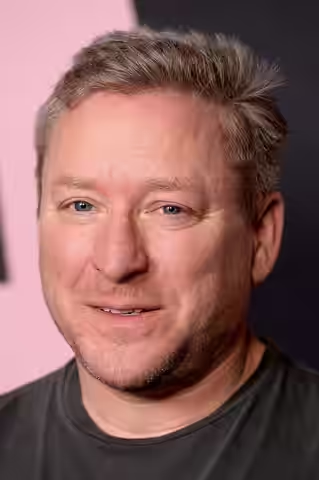
Richard Billingham brings a photographer’s attention to the cramped rooms and difficult people of his childhood. We rate his care with actors and domestic detail, though Ray & Liz sometimes holds a scene longer than it needs to.
Fi1m perspective
In Ray & Liz (2018), the camera gives the objects in a cramped flat almost as much attention as the people. Richard Billingham holds the shot and lets family life become uncomfortable. He does not soften his parents’ behaviour simply because he is telling his own childhood story. We found the neglect hard to bear because those cramped, grainy images give us so little distance from it.
The photographs collected in Ray’s a Laugh (1996) supplied much of the material for this first feature. Between them came Fishtank (1998), a documentary video study of his father, and the short Ray (2016), which became the basis of the feature’s first section. This is a gradual move from still photographs to drama, with the same family remaining central. Billingham uses photographs, audio recordings and memory, but he does not organise the remembered incidents into a reassuring account of growing up. The three-part structure leaves the connections for us to make.
Cinematographer Daniel Landin works within a boxy 4:3 frame, using 16mm film to give those rooms their grain. The limited space matters: people and household objects have to share it, with little room to look elsewhere. Production designer Beck Rainford’s reconstruction of domestic detail helps the flat feel occupied rather than arranged for our inspection. This precision makes the family’s surroundings tangible without requiring anyone to explain them.
Billingham is equally attentive to gait, gestures and the physical presence of his actors. The attention to Midlands accents belongs to the same effort to get the people right. The closely observed performances keep his parents recognisable as people even when their behaviour is hardest to bear. He does not ask us to admire him for having lived among them.
The reservation is how long we are asked to stay with some of these incidents. The separate episodes can feel disconnected and overlong, and Tracy Granger’s editing does not always give them enough forward movement. Some scenes continue after we have understood what they are showing us. Start with Ray & Liz; just do not put it on to unwind.
Biography
Richard Billingham is an English photographer, artist and filmmaker. Born in 1970 in Cradley Heath in the West Midlands, he first came to prominence with the 1996 photobook Ray's a Laugh, which documented his family in their council flat.
He has also made short films including Fishtank (1998) and Ray (2016). His debut feature, Ray & Liz (2018), which he wrote and directed, is an autobiographical drama drawn from the same material and set in the 1980s.
Billingham was awarded the Citibank Private Bank Photography Prize in 1997 and was shortlisted for the Turner Prize in 2001. He is Professor of Fine Art at the University of Gloucestershire.