Michael Samuels’s drama about young Holocaust survivors is moving and carefully acted, though sometimes too reassuring. The young ensemble deserves a tighter script, but its tentative friendships make the film worth our time.
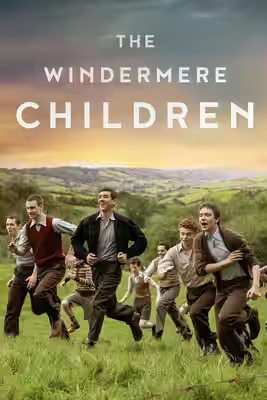
The Windermere Children is a moving drama about the help young Holocaust survivors need, though its reassuring tone sometimes makes their recovery seem simpler than it should. Director Michael Samuels and writer Simon Block are interested in how children begin to trust other people again. Friendship and creative activity give them ways to express themselves without having to explain everything they have endured. It is a patient approach, and mostly the right one for a subject that hardly needs additional dramatic force.
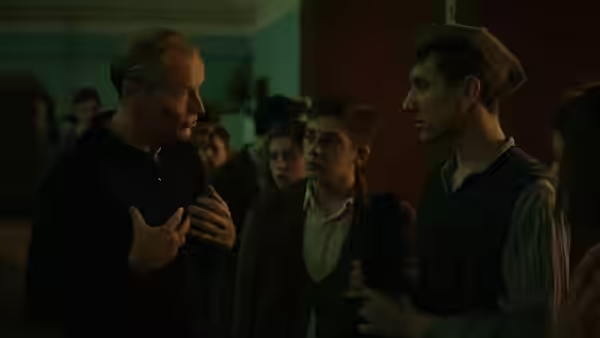
Thomas Kretschmann as Oscar Friedmann, Romola Garai as Marie Paneth and Iain Glen as Jock Lawrence give the adult side of the story a reassuring steadiness. The younger cast supplies the uncertainty that keeps it from becoming too comfortable. Marek Wroblewski’s Schmuel ‘Sam’ Laskier and Pascal Fischer’s Benyak ‘Ben’ Helfgott belong to an ensemble whose company matters more than a single commanding performance. We want more time with these children, even when the film seems satisfied that we have understood them.
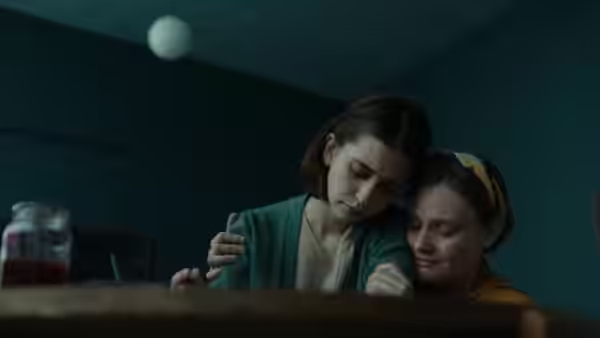
We were moved by the children’s efforts to find friends, because the film takes that need seriously rather than using it as a brief relief from suffering. Creative activity also gives them something to do besides explain themselves to an attentive adult. These are sensible dramatic choices, and Simon Block is strongest when he allows recovery to remain tentative. The children have already been through enough without having to deliver a speech that neatly explains what the audience should learn.
Ashleigh Jeffers’s production design helps establish an atmosphere of protection, and Alex Baranowski’s music encourages our sympathy. Both serve the film’s wish to show that care can make a difference, and neither distracts from the performers. The difficulty is that the surrounding comfort sometimes gets ahead of the children, making recovery feel more orderly than the performances suggest. We would have preferred less reassurance, especially when the young cast is already doing the emotional work.
Victoria Boydell’s editing keeps the ensemble manageable within 88 minutes, but the film’s breadth has a cost. Attention is divided among enough people that a developing attachment can feel interrupted by the need to check in elsewhere. Simon Block gives us a group whose recovery we care about, yet some individuals remain less distinct than they deserve to be. A narrower focus would have given the young performers more room, particularly when a relationship has begun to interest us.
We do not think the answer would have been a harsher film simply to prove that the subject has been taken seriously. A drama about children who have survived the Holocaust is entitled to show the help they receive, and to take pleasure in friendship. Michael Samuels earns much of the hopefulness through the young ensemble. The weaker passages are those in which the film makes us feel secure before we are persuaded that the children do. See it for the young cast, who deserve as much attention as the familiar names.