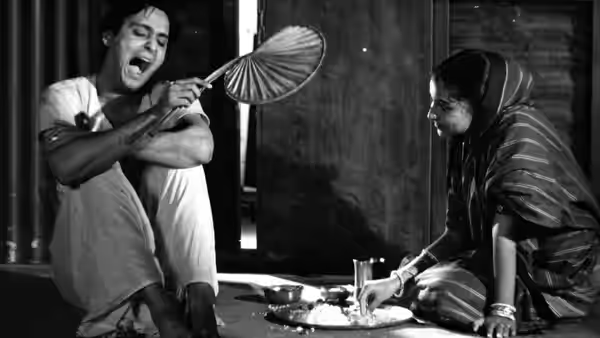
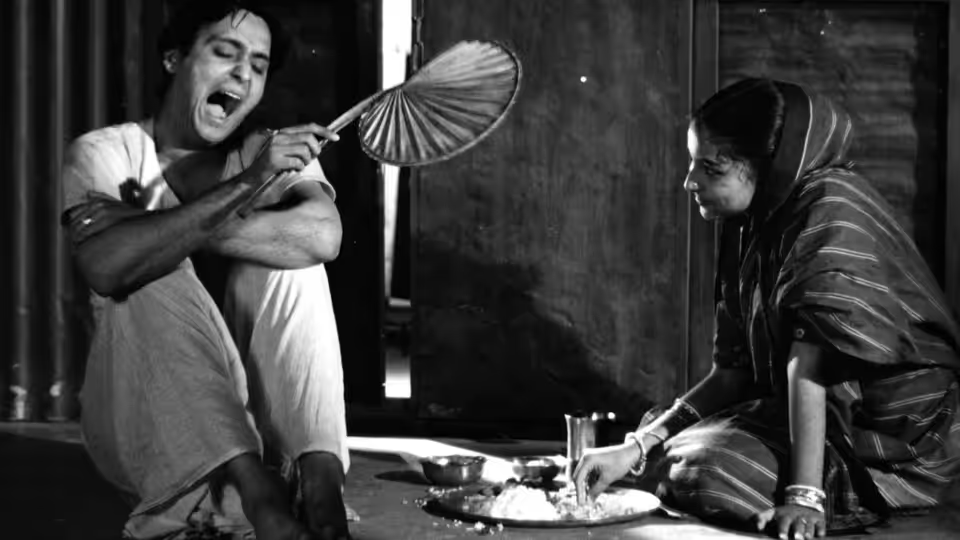
A man playfully holds a fan while a woman serves food at a low table
Film review

The World of Apu

1959 · Directed by Satyajit Ray · 1h 45m

In a sentenceApu gets the title; Sharmila Tagore gets our undivided attention

Apurba ‘Apu’ Roy (Soumitra Chatterjee) is the central character of The World of Apu, alongside Aparna Roy (Sharmila Tagore) and Pulu (Swapan Mukherjee). The drama also features Apu’s neighbour (Belarani Devi), a landlord (Dhiren Ghosh), an office associate (Shanti Bhattacherjee), Shashinarayan (Dhiresh Majumdar) and his wife (Sefalika Devi). Satyajit Ray writes and directs, adapting a novel by Bibhutibhushan Bandyopadhyay. Subrata Mitra supplies the cinematography and Ravi Shankar the music for a film that runs for 105 minutes.

Plays from YouTube when you press play; nothing loads from them until then.

Fi1m review

Satyajit Ray’s The World of Apu is tender, funny and worth anyone’s evening. Soumitra Chatterjee and Sharmila Tagore make its relationships persuasive, though we sometimes wish the film would give Aparna more room.

Satyajit Ray’s The World of Apu earns an unusually strong recommendation because it makes its people worth knowing. We care about Apu without needing to approve of him, and the film allows him enough vanity to keep the affection honest. Soumitra Chatterjee gives him intelligence without making him infallible or especially good at understanding anybody else. There is humour in that, and the humour matters: affection would become rather tiring if everyone behaved impeccably. The screenplay draws on a novel by Bibhutibhushan Bandyopadhyay.

Chatterjee is particularly good at the slight hesitation between thinking something and deciding to say it. Apu can appear absorbed in his own thoughts without becoming inaccessible, and the performance leaves room for awkwardness. We are allowed to notice when he is being irritating, which makes the film’s tenderness easier to accept. There is no demand to treat him as an exemplary person simply because his name is in the title.

Sharmila Tagore, as Aparna Roy, makes an equally strong impression with less apparent effort. Her attention to her fellow actor changes how we watch him; she can make an expression seem less assured than it first appeared. We were moved by how carefully these two listen to each other. Neither seems to be waiting politely for the next line, and that small distinction makes their closeness convincing. Aparna often seems to have noticed more than she chooses to say.

Subrata Mitra’s cinematography rewards that sort of watching; the faces hold our attention without seeming to have been arranged for our admiration. Bansi Chandragupta’s production design feels equally responsive to the actors, giving them surroundings that seem inhabited rather than displayed. We do not find ourselves looking past a performance to admire the setting. That restraint helps, because small changes of expression need to count in a film so interested in how people regard each other.

Dulal Dutta’s editing gives a reaction its proper weight, so that a scene need not belong only to the person speaking. We have time to register how a remark has landed without feeling that the film is waiting for us to catch up. Ravi Shankar’s music contributes warmth without making us feel pushed into sympathy. The emotion stays proportionate to the people we have come to know. At 105 minutes, the film does not need great length to make those people familiar.

The reservation is with how the screenplay distributes its attention. We wanted more of Aparna’s thoughts, and her performance makes that wish harder to dismiss as a request for a different film. Apu’s feelings receive a degree of consideration that can make everyone else’s seem secondary, however persuasively they are acted. His performance makes that concentration rewarding, but it cannot remove the slight frustration of seeing another interesting person chiefly through the leading man’s concerns.

The wit gives The World of Apu an advantage over relationship dramas that become solemn whenever affection matters. Its characters remain capable of amusing us, and the film rarely presses for a response before the actors have earned it. There is pleasure here in watching people gradually become familiar, including the things about them that we might find trying in company. Give the performances an uninterrupted evening; neither benefits from being watched between other things.

Critical consensus AI synthesised

2 of 6
Positive
2
Mixed
0
Negative
0
Los Angeles Times
28 May 2015 · Robert Abele
90*

Abele praises the trilogy as an eloquent, compassionate achievement, and finds its final installment deeply moving. He singles out the performances of Soumitra Chatterjee and Sharmila Tagore, as well as the father-and-son final scene.

Read the full review →
Variety
31 December 1958 · Variety Staff
82*

The review calls the film an unusual, timeless story and says it surpasses its predecessors in craftsmanship. It particularly praises the truth of its relationships and its wit, tenderness, and human revelations.

Read the full review →

Straight answers AI written, from our review

Is The World of Apu worth watching?
The World of Apu is worth watching for its tender, funny relationships and persuasive performances, and we score it 91 out of 100. Soumitra Chatterjee and Sharmila Tagore make it an unusually strong recommendation for anyone drawn to character-led drama, though we wish Aparna’s thoughts received as much attention as Apu’s.
How long is The World of Apu, and what is it rated?
The World of Apu runs 1h 45m. It is a drama film.
Where can I watch The World of Apu in Thailand?
The World of Apu is not on any streaming or rental service in Thailand at the moment. It is available in 6 other countries; change your country at the top of the page to see where. Availability is checked daily.
How violent or frightening is The World of Apu, and is it suitable for children?
The World of Apu has no UK certificate listed, while its US classification suggests parental caution for children under 13. We cannot give a specific assurance about violence or frightening material from the information available; its tender relationships and humour alone do not establish that it is suitable for younger children.
How does The World of Apu compare to Pather Panchali?
The World of Apu earns our stronger recommendation for its central performances, while Pather Panchali offers a broader interest in family life through its attention to childhood and different generations. We favour the former for the closeness between Chatterjee and Tagore; the earlier film better suits anyone wanting an ensemble family drama, provided its occasionally drifting pace is welcome.
Is The World of Apu based on a true story or a book?
The World of Apu is adapted by writer-director Satyajit Ray from a novel by Bibhutibhushan Bandyopadhyay, rather than presented as a true story. We cannot assess its fidelity to the book from the information available, but its persuasive relationships give viewers a reason to watch without needing prior knowledge of the source.

Cast

Awards

International Submission to the Academy Awards, 1960

Nominated
International Submission to the Academy Awards

If you liked this, try…

  1. Pather Panchali (1955, Fi1m 93)Ray’s earlier attention to childhood makes ordinary family life absorbing and painful.

  2. The River (1951) · not on Fi1m yetFamily life, first love and disappointment, observed with patience rather than sentimentality.

  3. Still Walking (2008) · not on Fi1m yetA family gathering where affection and resentment keep interrupting each other.

  4. A Summer at Grandpa's (1984) · not on Fi1m yetChildren watch closely while the adults struggle with problems they cannot explain.

  5. The Quiet Girl (2022) · not on Fi1m yetSmall acts of care carry the feeling in this restrained family drama.

The World of Apu (1959) review: A tender drama with room for wit (Thailand) | Fi1m