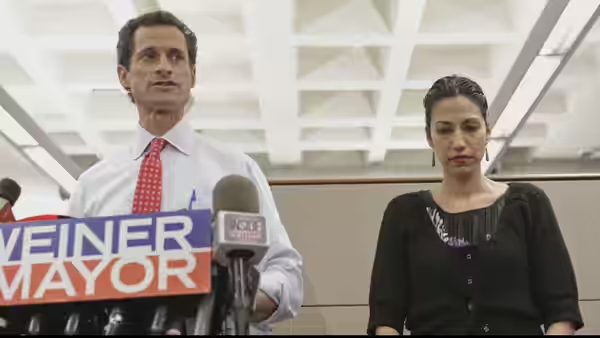
A scene from Weiner
Film review

Weiner

2016 · Directed by Josh Kriegman, Elyse Steinberg · 1h 36m

In a sentenceA politician destroys himself on camera and keeps checking that the camera is on

New York, 2013. Anthony Weiner, a Democratic congressman from the city until he resigned in 2011 over lewd photographs sent to women online, announces that he is running for Mayor of New York. At his side is his wife, Huma Abedin, a long-serving aide to Hillary Clinton, and their small son Jordan. A young staff gathers in a bare office: Camille Joseph as campaign manager, Barbara Morgan handling the press, Amit Bagga as senior advisor. Weiner marches in parades with a flag in each hand, argues on doorsteps, takes questions about his past with a grin and climbs in the polls. Then a gossip website publishes new messages, sent after the resignation under the name Carlos Danger, and the campaign has to decide what to do about the man at the front of it.

Plays from YouTube when you press play; nothing loads from them until then.

Fi1m review

Josh Kriegman and Elyse Steinberg had the kind of access most documentary makers never get, and they used it to make something funny, horrible and hard to look away from. What they did not do is work out what they think of the man they were watching.

Josh Kriegman and Elyse Steinberg followed Anthony Weiner through his 2013 campaign for Mayor of New York and were still filming when it fell apart. Kriegman had worked for Weiner in Congress, which is how the camera got through the door, and the result is 96 minutes of a kind we rarely see: a politician, his wife and his staff filmed while something goes badly wrong, with no publicist standing between them and the lens. It is gripping, it is often funny, and it never decides what it is for. We recommend it anyway.

The film opens with Weiner at his loudest, shouting on the floor of the House in 2010 over a bill for the emergency workers of 11 September, and then with the late-night jokes that followed his resignation a year later. Kriegman shot it himself, mostly from the shoulder, and he stays close: the back seat of the car, the kitchen of the flat, the corner of an office where Camille Joseph, the campaign manager, and Barbara Morgan, the communications director, try to keep the day on schedule. The early stretch is a comeback film and Weiner is good at it. He waves flags in parades, charms a room of pensioners, and climbs in the polls while the staff start to believe in him.

Then the new messages surface and the film becomes something else. Eli Despres’s editing is the reason it works. He cuts between the television coverage and the room where the people on television are sitting, so that we watch Weiner watch himself, sometimes with a small smile he cannot keep down. A press conference is intercut with the staff standing behind a door listening to it. The pace picks up as the campaign loses its footing, and Despres knows when to hold on a face and let nothing happen. Jeff Beal’s score is used sparingly; most of the sound in this film is television, and that is the right decision.

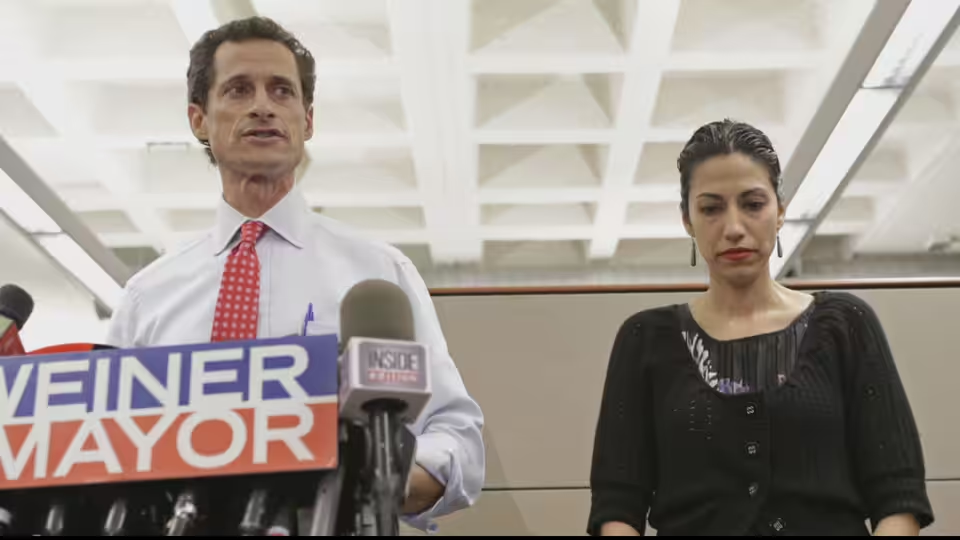
Huma Abedin is the person we could not stop watching. She says very little. There is a scene in the flat, after the news has broken, in which Weiner talks and she stands at the counter looking at a point somewhere past him, and the look goes on long enough that we wanted the camera to turn away. It did not, and neither did we, and we have not felt so plainly ashamed of watching a documentary in some time. Kriegman and Steinberg never comment on this, but each time Abedin asks whether the camera has to be there, and she asks more than once, they are telling us they have thought about it too.

Weiner himself is a remarkable subject because he does not know how to be filmed badly. He explains himself in car journeys, quick and funny and always a step ahead of the question. He is most alive in a shouting match with a man in a bakery, which he then watches back on a laptop and plainly enjoys. The staff around him, Amit Bagga and Barbara Morgan in particular, are shown doing the quiet, awful work of a campaign that has stopped being about policy, and the film is kind to them without saying so.

What the film does not do is think. It has a case to make about the press, that the cameras chase the sex story and ignore the housing plan, and it makes the case and then makes it again; Weiner makes it himself, which rather takes it out of the directors’ hands. The harder question, why a man who had already lost everything once did it again, is put to him once, in the car, and he says he does not know. The film takes him at his word and moves on. A documentary this close to its subject needed either to press him or to find the answer in the footage, and it does neither.

The campaign films it descends from, Primary (1960) and The War Room (1993), were about how an election is won. This is about how one is lost, and it is better on how than on why. Watch it with someone who follows politics, because the argument afterwards is half the evening, and watch it at home, where you can look away when Abedin does.

Critical consensus AI synthesised

71
Positive
12
Mixed
6
Negative
0

Most critics come away impressed, and none of the eighteen reviews is outright negative. The praise gathers almost entirely in one place: the access. Reviewers marvel that the filmmakers were present for Anthony Weiner’s mayoral campaign as it fell apart, and for the long, tense silences between him and Huma Abedin. Many call it riveting and entertaining, with a streak of surreal comedy, and the gap between what Weiner says at the podium and what happens off it is singled out again and again.

The reservations gather too. Several critics say the film shows a great deal and explains little, offering scant insight into why Weiner behaves as he does and leaving the obvious questions unanswered. Collider calls it a wasted opportunity, Slant finds its media criticism familiar and its purpose thin, and Vulture is troubled by the voyeurism it invites. The spread is wider than the mean suggests, running from top marks to a shrug, though nobody argues it is dull.

IndieWire
24 January 2016 · A · Eric Kohn
95

Kohn calls the documentary a genre-defining portrait of a political campaign and a media-driven fall from grace. He singles out its extraordinary access and the tense silences that reveal the fallout for Huma Abedin.

Read the full review →
The AV Club
19 May 2016 · A- · Noel Murray
90

Murray finds the documentary valuable for capturing political frenzy and exposing the media’s priorities. He especially praises its intimate access to the campaign and its revealing contrast between public appearances and behind-the-scenes footage.

Read the full review →
The Guardian
24 January 2016 · festival review · Lanre Bakare
82*

Bakare finds the documentary riveting, portraying it as a political tragedy with surreal comic turns. He especially praises the filmmakers’ extraordinary access to Weiner and his family.

Read the full review →
Time Out
18 April 2016 · ★★★★ · Joshua Rothkopf
80

Rothkopf gives the documentary a strongly positive verdict. Its fly-on-the-wall portrait of Weiner’s mayoral campaign and political comeback is the central focus singled out.

Read the full review →
The New York Times
19 May 2016 · A.O. Scott
78*

The review treats the documentary as a compelling portrait of a political campaign unraveling. It singles out the filmmakers’ close access to Anthony Weiner and his campaign.

Read the full review →
The Hollywood Reporter
24 January 2016 · festival review · THR Staff
75*

The critic finds the documentary invigorating and expertly told, despite its limited insight into Weiner’s psyche. They especially praise the filmmakers’ access, which makes the campaign’s collapse gripping to watch.

Read the full review →

Straight answers AI written, from our review

How long is Weiner, and what is it rated?
Weiner runs 1h 36m. It is a documentary film.
Where can I watch Weiner in Singapore?
Weiner is not on any streaming or rental service in Singapore at the moment. It is available in 28 other countries; change your country at the top of the page to see where. Availability is checked daily.

Cast

Awards

Sundance Film Festival Grand Jury Prize for Best Documentary, 2016

Won
Sundance Film Festival Grand Jury Prize for Best Documentary

If you liked this, try…

  1. Primary (1960) · not reviewed yetKennedy and Humphrey in Wisconsin, filmed from inside the car; the form begins here.

  2. The War Room (1993) · not reviewed yetClinton’s 1992 campaign from the staff’s side, when access like this still astonished.

  3. Street Fight (2005) · not reviewed yetCory Booker’s first run for Newark mayor, nastier and poorer than anything here.

  4. Grey Gardens (1975, Fi1m 86)Two women who cannot stop performing for a camera that will not leave.

  5. The Queen of Versailles (2012) · not reviewed yetA documentary about one thing that becomes, mid-shoot, a documentary about collapse.