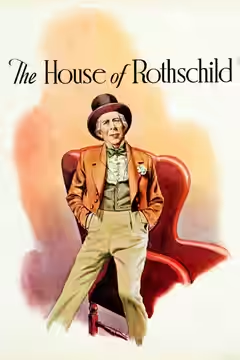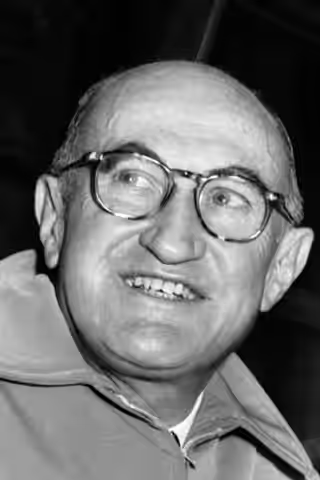
A studio hand who finished other people's films and rarely started an argument of his own. The House of Rothschild shows the method: stand the actors up, light them well, get out of the way. Reliable, sometimes handsome, seldom more.
Fi1m perspective
In The House of Rothschild (1934) George Arliss enters, stands, delivers and exits, and Alfred L. Werker watches him do it from the stalls. That is the Werker method in one shot, and there is nothing wrong with it when the man standing there is Arliss. The camera holds still. J. Peverell Marley lights the Frankfurt ghetto low and close so the family seem to sit on top of one another, and when the film reaches London the frame opens out to high windows and long tables. The point about money and room is made without a word, and it is the cinematographer who makes it.
Werker began as an assistant director in 1917 and co-directed his first feature, Ridin' the Wind (1925), with Del Andrews. He then spent the better part of thirty years on contract, at Fox and 20th Century-Fox in three separate spells, at Paramount, and at Eagle-Lion in the late 1940s. His particular use to the studios was as a film doctor, the man sent in to finish a picture another director had left through illness, scheduling or the sack. That is a real skill and an unglamorous one. It means matching someone else's shots, keeping the cast calm and bringing the thing in on time, and it leaves very little of you on the screen.
The result is a filmography with better films in it than it has a director. The Adventures of Sherlock Holmes (1939) is often counted among the strongest of the Rathbone and Bruce pictures. He Walked by Night (1948) helped set the pattern for the semi-documentary police procedural, though Anthony Mann shot part of it uncredited, and the shots people remember tend to get handed to Mann. Repeat Performance (1947), a time-loop mystery, and Lost Boundaries (1949), about racial passing, are the odd ones out and suggest a curiosity the B-picture schedule rarely gave him room for. We have not reviewed them and will not pretend to. In Rothschild, the briskest stretch is a montage of couriers and letters cut by Allen McNeil and Barbara McLean, and it moves faster than anything his static camera manages.
We should be fair to the man at the back of the stalls. The opening of Rothschild, the gates locked at dusk and the tax man calling whenever he likes, got to us more than the stiff staging around it should have allowed, because Werker lets the scene sit: nobody hurries, nobody underlines, the frame stays small and crowded until the point has gone in. Made in 1934, when Jews were being pushed out of German public life again, that patience was a choice, and a decent one. Then the romance starts, the film insists its bankers were saints, and we were back to watching entrances and exits and waiting for Arliss.
He retired after The Young Don't Cry (1957) and died in 1975. Start with Rothschild for Arliss and the Holmes film for Rathbone, and do not expect the director to make himself known. He never did; that was the job.
Biography
Alfred L. Werker was an American film director whose career spanned from 1917 to 1957. He began with production and assistant directing roles before co-directing his first feature, Ridin' the Wind (1925), with Del Andrews. He later worked for Fox Film Corporation, where he was brought in to reshoot and re-edit Hello, Sister! (1933).
Werker directed The House of Rothschild (1934) and The Adventures of Sherlock Holmes (1939). In the 1940s he directed comedies such as A-Haunting We Will Go (1942) and films including Shock (1946), Repeat Performance (1947) and He Walked by Night (1948), the last of which was completed by uncredited director Anthony Mann. He was nominated for a Directors Guild of America award for Lost Boundaries (1949).