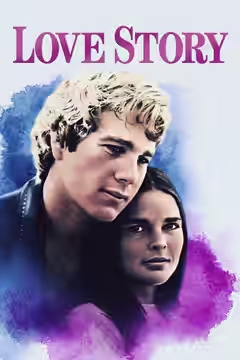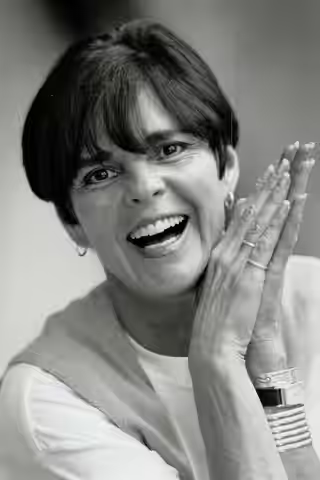
Ali MacGraw had one note, and for a few years it was the note the films wanted: a quick, rude, unimpressed woman who tells the rich boy he is stupid. Asked for anything else she was out of her depth, as she has said herself.
Fi1m perspective
Early in Love Story (1970), Jennifer Cavilleri sizes up the rich boy and calls him Preppie. Then she tells him he is stupid. Ali MacGraw plays her rude, quick and unimpressed, and she is the only person in the film who seems to have come from anywhere in particular. Everyone else is an outline. MacGraw has been called a poor actress for most of fifty years, and we would put it differently: she had one note, and for a few years it was the note the films wanted.
She came to it late and from the side. Thirty when she made her debut, in Goodbye, Columbus (1969), she had spent her twenties in fashion, as a model and stylist, with no acting school behind her. Then Love Story, and then The Getaway (1972), opposite Steve McQueen, which pushed her toward action pictures and was followed by five years off screen. She came back for Convoy (1978), her second film for Sam Peckinpah, was funny in Sidney Lumet's Just Tell Me What You Want (1980), and spent much of the 1980s on television, in The Winds of War (1983) and Dynasty. By the 1990s she had more or less stopped.
The parts, when they suited her, were variations on Jenny: clever, spirited girls without much money, set against men with a great deal of it. She was good at being unimpressed, and she was easy with her leading men, O'Neal and McQueen. What she could not do was the big scene. From Goodbye, Columbus on, reviewers found her stiff when a part asked for feeling, and by Dynasty she looked out of her depth, a verdict she has since agreed with more readily than any critic. She has said she thinks of herself as a pop star rather than a trained performer, and that is fair and not unkind. Pop stars are not asked to act; they are asked to be there, and she was.
What got to us in Love Story was not the ending, which the film announces at the start and holds you to, but the way she says Preppie, as though she has already decided he will let her down and is rather looking forward to it. That is a real person, and the film has no other. She knew exactly what she had been part of. 'Love means never having to say you're sorry. With that absurd lie, millions of boxes of Kleenex were sold, and a number of careers were launched. Including mine.' See Love Story for her mouth and Lai's piano. The rest is for the curious, and she would probably tell you the same.
Biography
Ali MacGraw is an American actress. Born Elizabeth Alice MacGraw on 1 April 1939 in Pound Ridge, New York, she studied art history at Wellesley College before working in fashion magazines and as a model.
She made her feature-film debut in Goodbye, Columbus (1969) and rose to prominence as Jennifer Cavilleri opposite Ryan O'Neal in Love Story (1970). For the role she won the Golden Globe Award for Best Actress in a Motion Picture – Drama and received an Academy Award nomination for Best Actress.
MacGraw's other screen credits include The Getaway (1972), Convoy (1978), Players (1979) and the television miniseries The Winds of War (1983). She has also appeared in Dynasty (1985).