A television director of the old apprenticeship, Andrew Grieve puts period on a budget and makes it stand up: nine Poirots, eight Hornblowers and one Welsh hill. Dependable rather than distinctive, and there are worse things to be.
Fi1m perspective
A wooden deck, a young officer trying not to look as frightened as he is, and a broadside that has to be made for television money and look as if it cost more. That is the Andrew Grieve shot, and he made it eight times across the Hornblower films (1998–2003), with Ioan Gruffudd in all of them. Grieve is not a director you notice. He is the one who gets the ships out and back without anyone drowning, which is a harder job than it sounds.
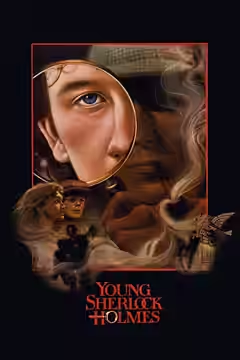
He came up the slow way, as an assistant director on features from the late 1960s, among them Poor Cow (1967) for Ken Loach and work for Tony Richardson, and then as second unit director on Young Sherlock Holmes (1985). He did not direct a feature until he was nearly fifty. On the Black Hill (1988), which he also wrote from Bruce Chatwin's novel, follows rural life on the Welsh border across decades and was shot where it is set. We have not reviewed it, and its reputation is mixed: the landscape is admired, the structure is episodic, and it is not always clear what a scene is for. Grieve has said what he wanted from it, "Personal films about real people, that's what I'm interested in." The career that followed was mostly other people's people.
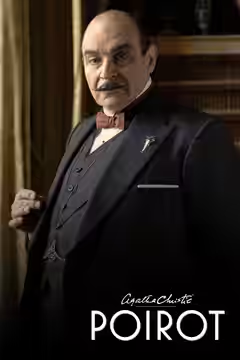
That career was television, and the best of it was period. Between 1990 and 2000 he directed nine episodes of Agatha Christie's Poirot, the series we scored 83 and still recommend. Our review credits David Suchet with holding the whole thing up and does not single out any director, which is about right for a show whose directors were asked to serve the format rather than bend it. What Grieve was asked for, and gave, was a 1930s that looks right and a plot with a dozen moving parts kept legible. Then came Hornblower, then Wire in the Blood (2002–2005), Kingdom (2008) and the drama-documentary Heroes and Villains: Cortés (2008).
Hornblower is where he is both at his best and most exposed. The ship-to-ship action is staged on a television scale, and some of it is plainly staged, with cuts covering what the money could not. We admired it anyway. Watching the first film, The Even Chance (1998), we felt the deck tilt in a way we had not expected from a Sunday evening drama, and it was the smoke and Gruffudd's face in it that did it, not the cannon. The Duchess and the Devil (1999) is one of the more coherent entries. The complaint that some of the fighting looks awkward is fair, and we would not argue with it.
So: a craftsman, Cardiff-born, who learned the job from the bottom and never pretended to be more than good at it. Start with the Poirots if you want to see what he does; start with Hornblower if you want to see him trying something harder. The one film that is wholly his own is the one he made first.
Biography
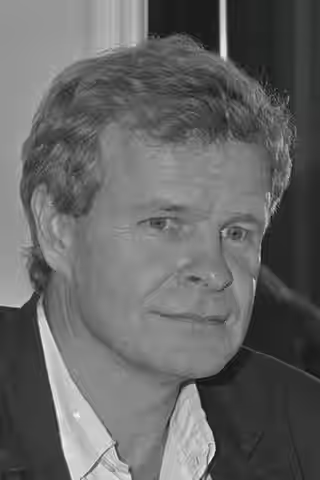
Andrew Grieve (born 28 November 1939) is a British television and film director from Cardiff, Wales.
He directed nine episodes of Agatha Christie's Poirot (1989) between 1990 and 2000. Grieve also directed multiple entries in the Hornblower series, including Hornblower: The Even Chance (1998), Hornblower: The Frogs and the Lobsters (1999), Hornblower: Mutiny (2001) and Hornblower: Retribution (2001). His work on the series earned the Silver FIPA award in 1999.
Grieve wrote and directed the feature On the Black Hill (1988), which won the Golden Shell at the San Sebastian Film Festival. Other credits include episodes of Wire in the Blood, Lorna Doone (1990) and the BBC drama-documentary Heroes and Villains episode on Hernán Cortés (2008). Earlier in his career he worked as second unit director on Young Sherlock Holmes (1985) and as assistant director on Poor Cow (1967).