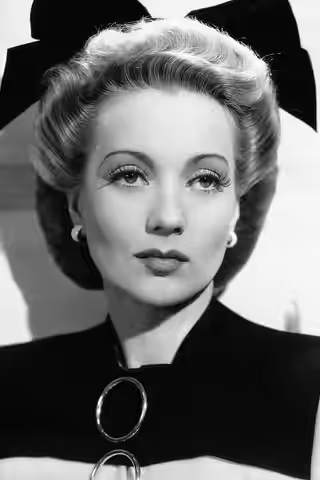
Sothern's trade was the woman who talks fast, knows exactly what she is worth and is not sure anyone else does. Ten Maisie films fixed her as a wisecracking showgirl; the drier supporting work she did afterwards is where we would send you first.
Fi1m perspective
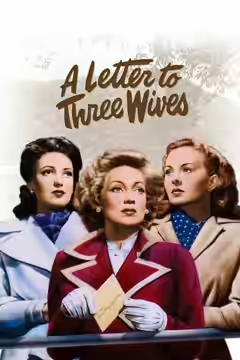
Watch her at the dinner table in A Letter to Three Wives (1949). Rita Phipps writes radio serials for a living, her husband George teaches school for a fraction of what she earns, and the sponsor who pays for all of it, Mrs Manleigh, has come to eat. Sothern spends the evening apologising: for the money, for the serials, for the sponsor, for her own competence. The words are all deference and the woman saying them plainly is not, and that gap is where Sothern did her best work. Kirk Douglas gets the speech about what radio advertising does to the people who listen, and the film stops so that he can make it; we found we were watching her face instead, and minding on her behalf.
She got there the long way. She was an extra in silent films from 1927 under her own name, Harriette Lake, went to Broadway for musicals in the early 1930s, came back to Hollywood with a new name and contracts at Columbia and RKO, and did not become anybody in particular until MGM handed her Maisie Ravier in 1939. Maisie was a Brooklyn chorus girl, brassy and resourceful, and Sothern played her ten times through 1947 and again on radio. The trick of those films was the turn: Maisie arrives vulgar and accident-prone and leaves charming and well-groomed, and Sothern could make the change inside a single picture without it looking like two different women. Brother Orchid (1940), made at Warner Bros in the middle of the run, is the supporting part from that stretch most worth looking up.
The cost of playing one woman ten times is that the public stops seeing anyone else, and after 1950 the film parts thinned out. Television took her in: Private Secretary (1953–57), opposite Don Porter, then The Ann Sothern Show (1958–61), then guest turns with Lucille Ball on The Lucy Show. Sothern's own verdict on the early films was harder than ours. Watching them again late in life, she said she was amazed at how poor an actress she had been, and put whatever success they had down to glamour rather than acting. Glamour does not get you through the Manleigh dinner. Timing does, and hers was exact.
Her last role was Tisha Doughty in The Whales of August (1987), a supporting part beside veteran stars, and then she stopped. We have not reviewed it and will not pretend to. Start instead with A Letter to Three Wives, where she is quick and dry and makes a woman saying sorry look like a woman who means nothing of the kind. Save Maisie for a wet afternoon. She would have told you the same, and then apologised for it.
Biography
Ann Sothern (born Harriette Arlene Lake) was an American actress whose career in stage, radio, film and television spanned nearly six decades. She began in bit parts in late-1920s films and made her Broadway debut in 1930, later starring in musicals. In 1939 she was cast by MGM as Maisie Ravier in a series of comedies that ran until 1947 and included a radio spin-off.
Sothern appeared in A Letter to Three Wives (1949) as Rita Phipps. She starred in the CBS sitcom Private Secretary from 1953 to 1958 and in The Ann Sothern Show from 1958 to 1961, receiving three Primetime Emmy nominations for the former. Later film roles included The Whales of August (1987), for which she received an Academy Award nomination for Best Supporting Actress. She died in 2001.