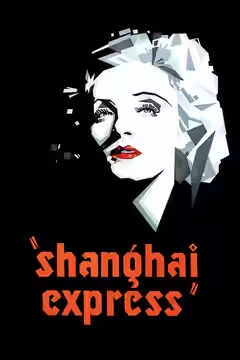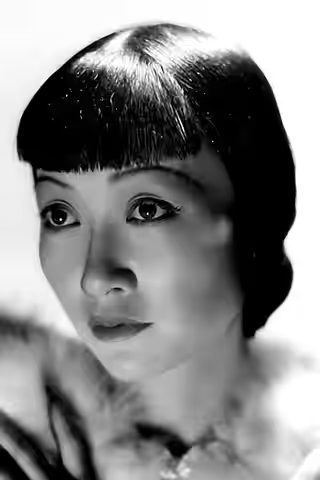
Anna May Wong spent a career being handed small parts, silence and a death in the last reel, and made the small parts the thing you remember. Watch her listen in Shanghai Express and the leads fall away.
Fi1m perspective
In Shanghai Express (1932) Hui Fei sits across the compartment and listens. Josef von Sternberg gives her a handful of lines and a great deal of waiting, and Anna May Wong turns the waiting into the performance: a look held a beat too long, a face that has decided something before anyone else on the train has noticed there is a decision to make. Clive Brook, with all the dialogue, is furniture beside her. There is a stretch in the second half where the film is briefly hers, and it moved us more than the romance did, largely because of how little she was given and how completely she used it.
That was the pattern, and she knew it. She began as an extra in 1919 while still at school, had her first lead in The Toll of the Sea (1922), and was properly noticed as the Mongol slave in The Thief of Bagdad (1924), a small part in a large picture that people came out talking about. Hollywood then did what it did. The leads went to white actors in make-up, the love scenes with white co-stars were kept from her, and she died. "I was killed in virtually every picture I appeared in. Pathetic dying seemed to be the best thing I did." She left for Europe in 1928, made three films with the director Richard Eichberg, and got in Piccadilly (1929) a leading part, Shosho, with the picture built around her rather than beside her.
Sound was not kind. Her voice in the early talkies was heard as flat, and the silent-era acting, all eyes and the set of the mouth under hard light, had less room to work. She came back to America for Shanghai Express, was not cast in The Good Earth (1937), and moved into B-pictures, which were smaller and gave her more say. Daughter of Shanghai (1937) let her play the lead and be loved on screen by another Asian American actor, which the big studio pictures had never allowed. In 1951 she led a television series, The Gallery of Madame Liu-Tsong, the first Asian American to do so.
What she does, when she is allowed, is hold still and let you work out what she is thinking, and she is usually a step ahead of the script. The blunt fringe and the level stare became a look, and the look was borrowed for a hundred Dragon Ladies and tragic Lotus Blossoms; the woman underneath it, sizing up everyone else on the train and finding them wanting, was hers. Start with Shanghai Express, where the film needs her far more than it admits. Then find Piccadilly. She dies in most of her pictures; the ones worth your evening are the ones that noticed she was alive first.
Biography
Anna May Wong, also known as Wong Liu Tsong, was an American actress. Born on 3 January 1905 in Los Angeles, California, she began her career as an extra in silent films before securing her first leading role as Lotus Flower in The Toll of the Sea (1922), one of the earliest Technicolor features. She gained wider recognition for her performance as the Mongol slave in The Thief of Bagdad (1924) and appeared as Tiger Lily in Peter Pan (1924).
Wong worked extensively in Europe during the late 1920s, starring in Piccadilly (1929). She returned to the United States and played Hui Fei in Shanghai Express (1932). Her later credits include Impact (1949) and The Savage Innocents (1960). She also appeared on stage, radio and television, becoming the first Asian American to headline a US television series. Wong died on 3 February 1961 in Santa Monica, California.