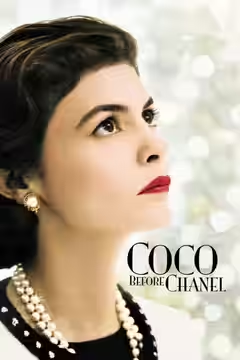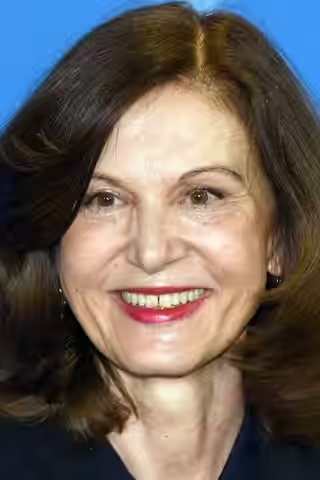
Anne Fontaine makes quiet, well-acted films about women who decide to live differently, and she cares more about the deciding than the result. Coco Before Chanel shows her gift with actors and her reluctance to be unkind to a heroine.
Fi1m perspective
Anne Fontaine's films tend to stop where another director's would begin. Coco Before Chanel (2009) ends before the Paris salon, the perfume and the little black dress; what it gives us instead is a girl from an orphanage who moves into a rich man's house and will not leave, and 110 minutes on how she came to decide that everyone around her was dressed wrong. Fontaine has said that she tries "to work on my characters' blind side, in a kind of Freudian way", and that is what the film is doing. It watches a woman before she knows who she is.
She came to directing from acting, in the 1980s, and made her first feature in 1993. Dry Cleaning (1997) was the breakthrough; Nathalie... (2003), a drama about desire and substitution, followed, and was later remade in English as Chloe. Coco Before Chanel made her name abroad. Since then she has moved between small dramas, literary adaptations such as Gemma Bovery (2014), and period pieces, the most prominent being The Innocents (2016), set among nuns in a Polish convent in wartime. Boléro (2024) is the latest. The women in these films keep disobeying somebody, a family, a church, a rule about how to behave, and disobedience is plainly her subject.
What she does well is actors. Our review found Tautou and Poelvoorde making a slow film bearable, and the consensus on The Innocents is that the restraint and the performances are the point. Caroline Champetier, who has shot three of her films, is the collaborator who recurs. The fault, in the one film we have reviewed, is that the restraint goes too far. A film about a dressmaker that barely shows her sewing has put its drama in the wrong place; the hats appear and are admired, and the thinking that produced them happens off screen. We will admit that when the closing sequence finally arrived and Chanel at last got to work in front of us, we sat up and were moved, and then were annoyed that the film had kept it from us for so long. Fontaine says her stories all contain some cruelty. Chanel is a subject who could have taken a good deal of it, and the film prefers her as a heroine of self-reliance and does not ask what else she was.
Critics have found some of the adaptations too faithful, Gemma Bovery in particular, and Boléro has drawn the complaint that it does not finish its ideas. We have not reviewed those and will not judge them. We can say that the gentleness we found in Coco Before Chanel seems to be a habit rather than a lapse. If you are new to her, The Innocents is the film most people point to; if you want to see what she can do with a cast, Coco Before Chanel will show you, slowly. We would like, next time, to see her be as hard on a heroine as she says she is.
Biography
Anne Fontaine (born Anne-Fontaine Sibertin-Blanc) is a Luxembourgish film director, screenwriter and former actress. She was born on 15 July 1959 in Luxembourg City and lives and works in France.
She began her career as an actress and dancer in the 1980s before moving into directing. Her first solo feature, Les histoires d'amour finissent mal... en général (1993), won the Prix Jean Vigo. She is known for films including Dry Cleaning (1997), Coco Before Chanel (2009), which she directed and co-wrote, The Innocents (2016) and Reinventing Marvin (2017).
Fontaine is married to film producer Philippe Carcassonne.