Anthony Asquith spent nearly forty years putting British plays on screen and making them move. At his best, in Pygmalion (1938) and the Rattigan films, he is quick, well-mannered and exact; in the star-laden pictures at the end he is a hired hand.
Fi1m perspective
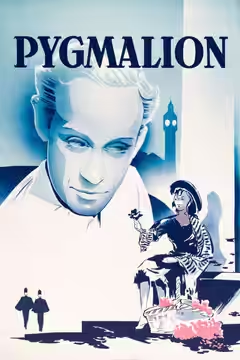
Shaw's play tells you that Eliza Doolittle has her lessons. The 1938 film of Pygmalion shows them: marbles in the mouth, a candle flame that must not flicker at the aitches, a gramophone horn, and four minutes do what Shaw did with a scene change. The pace of that sequence belongs to David Lean, who cut it, but the instinct is Anthony Asquith's, and it is the instinct of his whole career. He took British plays, found the things they only talked about, and put them on the screen.
He learned to do that without words. Asquith spent six months in Hollywood in 1925 watching how films were made, came home to British Instructional Films and directed four silents, of which A Cottage on Dartmoor (1929) is the one still talked about, for how carefully it is framed. Then a lean stretch, until Pygmalion, co-directed with Leslie Howard for the producer Gabriel Pascal, started him again. The war kept him busy at Gainsborough and Two Cities on comedies, thrillers, war films and melodramas, whatever the studio needed.
The films that are most his came after, and nearly all of them came with Terence Rattigan. They made ten together, from The Winslow Boy (1948) to Asquith's last film in 1964, and The Browning Version (1951) is the one people mean when they say Asquith could direct actors. Anatole de Grunwald, who produced and wrote for him repeatedly, is the other name that recurs. His subject, in the Rattigan films and in The Importance of Being Earnest (1952), is the person who is not allowed to say what they feel, and he films them at the distance good manners require, which is closer than it sounds. He had wanted to make The Browning Version for years, he said, and it shows.
The case against him is that he was a good servant of other men's plays and not much more, and that the big international pictures at the end, The V.I.P.s (1963) and The Yellow Rolls-Royce (1964), are the work of a hired hand. We think the second charge is fair and the first is not. Look again at Pygmalion, where Harry Stradling lights the Wimpole Street house hard and clean so that Eliza stands in it like a smudge; we minded on her behalf more than we had expected to, and that is direction, not service. He could also soften what he served. The embassy reception is his addition, "I wanted to include a scene of triumph at the ball," he said, and the waltz the film enjoys more than Higgins does is the result; the last stretch softens with it.
Start with Pygmalion, which is where he started again. If it takes, go on to Rattigan, and to The Browning Version first.
Biography
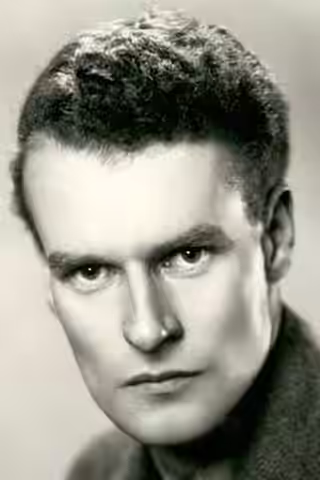
Anthony Asquith (9 November 1902 – 20 February 1968) was an English film director. Born in London, he was the son of Prime Minister H. H. Asquith. He began his career directing silent films in the late 1920s, including A Cottage on Dartmoor (1929).
Asquith directed adaptations of stage plays throughout his career. He co-directed Pygmalion (1938) with Leslie Howard. He maintained a long collaboration with playwright Terence Rattigan, working on ten films including The Winslow Boy (1948) and The Browning Version (1951). Other films include The Importance of Being Earnest (1952), The Yellow Rolls-Royce (1964) and The V.I.P.s (1963).