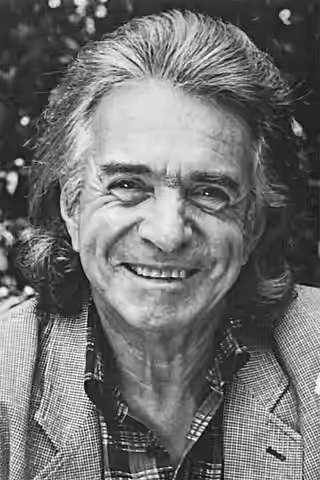
Arthur Hiller made more than thirty films and left almost no fingerprints on them. He gave the writer space and the actors time, and the films are as good as their scripts. With Paddy Chayefsky that was good; elsewhere it was luck.
Fi1m perspective
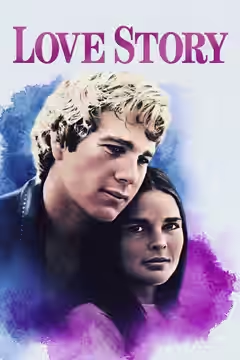
Watch the dinner in Love Story (1970). Ray Milland's Oliver Barrett III sits across from his son and says almost nothing that could be quoted against him, and Arthur Hiller does nothing to help him. No cut to underline the cruelty, no angle, no music. The camera stays at the table and the disapproval comes off Milland like cold from a window. That is Hiller's method in one scene: find the place to put the camera, keep it there, and trust the person in front of it.
He learned the method where it was a requirement. He came out of Canadian radio and television in the late 1940s and early 1950s, then American series work in the mid-1950s, Perry Mason, Alfred Hitchcock Presents, jobs where the director shoots the script on schedule and does not get in its way. His first feature was The Careless Years (1957). The Americanization of Emily (1964), an anti-war satire written by Paddy Chayefsky, made his name, and Love Story six years later made him famous. The Hospital (1971), the second Chayefsky script, a black comedy about medicine, is the work most people who admire him point to. Then came the comedies: Silver Streak (1976) with Gene Wilder and Richard Pryor, The In-Laws (1979) with Alan Arkin and Peter Falk, and two films written by Neil Simon.
The comedies show what he was good at. Put two actors in a frame and he would leave them there and let them play off each other rather than cutting them apart, which is why the Wilder and Pryor pairing worked well enough to be repeated. His other gift was restraint with material that invited excess. In Love Story that restraint is what keeps the thing watchable, and we were moved, against our expectations, by John Marley's Phil Cavilleri, a widowed baker who says the name Oliver as if he is not yet sure he is allowed to. Hiller simply lets him say it. What the restraint cannot do is put anything inside Erich Segal's lovers, who stay outlines from the first line to the last, and the film is a calculated piece of work that a director with more of his own to add might have filled.
That is the recurring complaint about Hiller, and it is fair: a reliable craftsman, a utility player, a man who subordinated himself to writers and performers. When the script was strong the modesty looked like taste. When it was not, as with Man of La Mancha (1972) or the later See No Evil, Hear No Evil (1989), there was no Hiller underneath to fall back on, because there had never been one. He knew it. "Film directors think they always have to be right," he said of taking on Love Story, "but some of us get lucky now and then when we turn out to be wrong."
So choose his films by the name on the screenplay, not the name on the direction. It is what he would have done.
Biography
Arthur Hiller was a Canadian-American film and television director. He began directing television in Canada and later in the United States before making feature films from the late 1950s, most often comedies but also dramas and romances.
Hiller directed over 30 feature films. His best-known work includes Love Story (1970), nominated for seven Academy Awards; The Hospital (1971); Silver Streak (1976); and The In-Laws (1979). He collaborated with screenwriters Paddy Chayefsky and Neil Simon on several projects.
Hiller served as president of the Directors Guild of America from 1989 to 1993 and of the Academy of Motion Picture Arts and Sciences from 1993 to 1997. He received the Jean Hersholt Humanitarian Award in 2002. He also directed An Alan Smithee Film: Burn Hollywood Burn (1997) under the pseudonym Alan Smithee.