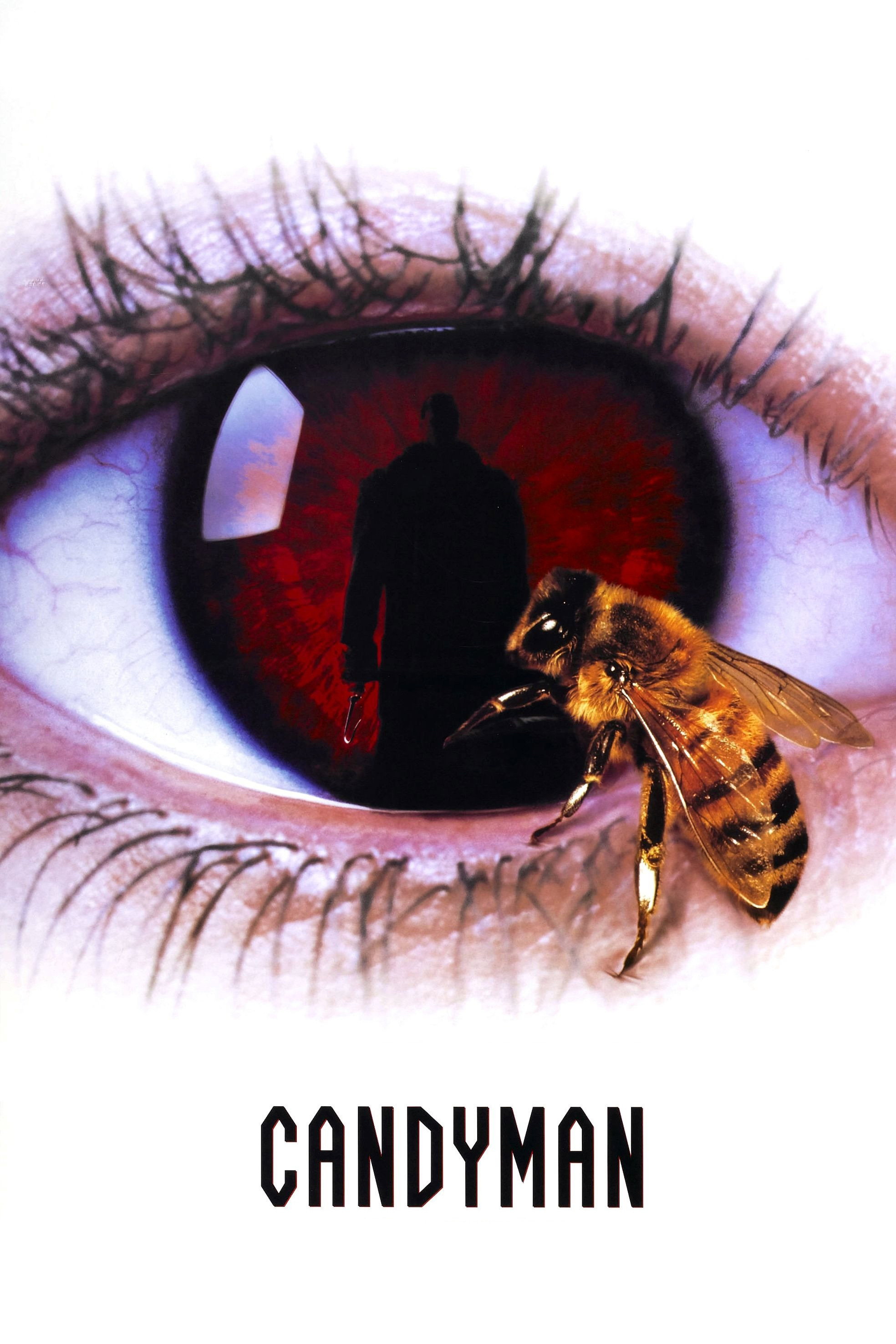
Bernard Rose brings an uneasy romance to horror and keeps returning to literary adaptations. We rate his ability to make a place frightening, but Candyman shows how easily his fascination with an outsider can push everyone else aside.
Fi1m perspective
The housing projects in Candyman (1992) are unsettling before anything supernatural happens. Anthony B. Richmond’s cinematography gives the decay an uneasy romance, while Jane Ann Stewart’s production design makes the deterioration difficult to ignore. Rose makes the surroundings matter before he uses them to stage a scare, though the images sometimes encourage us to admire what ought to trouble us. This is compelling horror, with a problem worth attending to.
Rose’s feature career began with the dark fantasy of Paperhouse (1988), before Candyman brought his international breakthrough. The period films Immortal Beloved (1994) and Anna Karenina (1997) followed, but literary adaptation was already there: Candyman had relocated a Clive Barker story to Chicago. The turn to digital filmmaking came with Ivans xtc. (2000), a contemporary Tolstoy adaptation. He continued adapting Tolstoy in contemporary settings, repeatedly working with Danny Huston, so a view of Rose that stops at horror misses a substantial part of his work.
In Candyman, the strongest reason to watch is the attraction Rose allows its monster. We were disturbed by how strongly Tony Todd’s performance and Philip Glass’s romantic score drew us towards him. Glass sustains apprehension during the quieter passages; Rose has little need to hurry towards another shock when Todd can hold our attention. Dan Rae’s editing sometimes does hurry, however, and the film alternates slack stretches with violence that the preceding scenes have not sufficiently earned.
The more serious weakness is Rose’s handling of the people around Helen Lyle. Her freedom to investigate an urban legend contrasts with the residents’ inability to keep its dangers at a comfortable distance, and Rose makes that difference unsettling. Yet his writing gives Helen so much attention that the community can seem to exist chiefly to supply her ordeal. Vanessa Williams’s Anne-Marie McCoy makes us want more time with the residents, and the film would have benefited from giving it to her. Start with Candyman: its flaws matter, but Todd and the dread are more than enough reason to stay.
Biography
Bernard Rose (born 4 August 1960) is an English film director and screenwriter. He trained at the National Film and Television School, graduating in 1982 with a master's degree in filmmaking. He began his career directing music videos for artists including UB40 and Frankie Goes to Hollywood before moving on to British television films and his feature debut, Paperhouse (1988).
Rose wrote and directed the horror film Candyman (1992). His other credits include the historical dramas Immortal Beloved (1994) and Anna Karenina (1997), the independent drama Ivans xtc. (2000), for which he was nominated for Independent Spirit Awards, and later works such as The Devil's Violinist (2013) and Frankenstein (2015). He has frequently cast actors Danny Huston and Tony Todd.