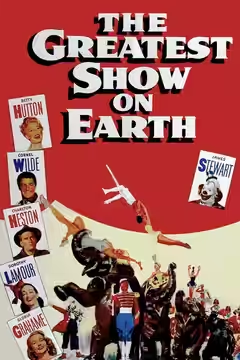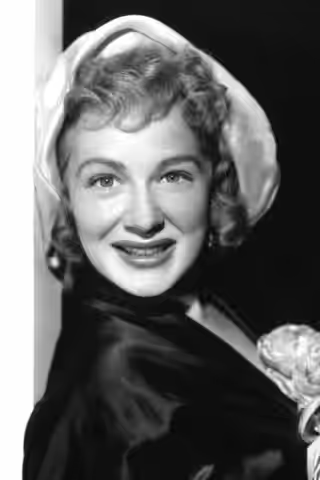
Betty Hutton had one setting, and it was full volume. In a circus ring or a Preston Sturges farce that is a gift; in a caravan opposite Charlton Heston it is a long afternoon. She is best watched from below.
Fi1m perspective
Halfway through The Greatest Show on Earth (1952), Holly goes up into the rigging to outdo the rival who has taken her place in the centre ring, and Betty Hutton plays the whole duel shouting. She is not shouting at anyone in particular. It is simply how she works: every line pitched as if calling across a field, every gesture large enough to be read from the cheap seats. The style had a name in her Paramount years, whoop-and-holler, and it is exactly that.
Paramount signed her out of the bands and the Broadway revues and put her in The Fleet's In (1942), then in a run of fast, brassy comedies and musicals as the blonde nobody could talk over. Preston Sturges made her a star in The Miracle of Morgan's Creek (1944), as Trudy Kockenlocker, and that is still the film her reputation rests on, though we have not reviewed it. MGM cast her in Annie Get Your Gun (1950), replacing Judy Garland. Then DeMille put her in a circus, she left Paramount after a row in 1952, and there were only a handful of films after that; the last was Spring Reunion (1956), and The Betty Hutton Show ran on television from 1959 to 1960.
The circus film shows both sides of her in one afternoon. She trained for six months on the trapeze and does many of her own stunts, so the body on the wire is hers, and it tells. We gripped the arm of the sofa during the duel with Wilde's Sebastian, not because we believed the rivalry, which we did not for a second, but because Barnes's camera keeps looking down past the wire at the sawdust and Hutton is up there anyway. Then the film comes down to earth, and the same energy that carried the ring has nowhere to go. In a caravan opposite Heston's jaw, calling across a field starts to wear, and the scenes between them are the stiffest in a film that runs 152 minutes.
That is the pattern, and it was never really hers to fix. She needed directors who ran as fast as she did, Sturges above all, and scripts that gave the noise something to hit. When Paramount stopped finding them, the pictures suffered; Dream Girl (1948) is the one most often named among the vehicles that did not suit her. She said herself, of the years after her producer left the studio, "After he left I started doing scripts that I knew weren't good for me." It is an unusual thing for a star to admit, and it matches what is on screen.
See her in the ring, where the shouting has a floor a long way beneath it and makes sense. Approach the caravan scenes with a drink.
Biography
Betty Hutton was an American actress and singer. Born Elizabeth June Thornburg on 26 February 1921 in Battle Creek, Michigan, she began performing as a child and later sang with the Vincent Lopez Orchestra before appearing on Broadway in the early 1940s.
She signed with Paramount Pictures and rose to prominence in films including The Miracle of Morgan's Creek (1944) and the title role in Annie Get Your Gun (1950). Hutton played Holly, a trapeze artist, in Cecil B. DeMille's The Greatest Show on Earth (1952). She also starred in her own television series, The Betty Hutton Show (1959–1960).
Hutton died on 12 March 2007 in Palm Springs, California.