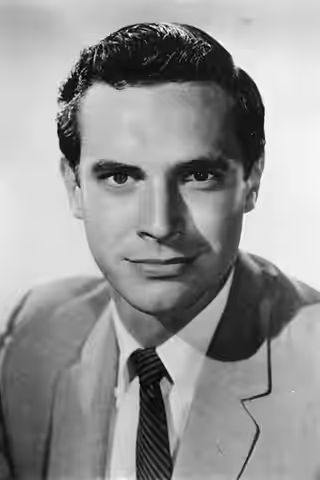
A dark, well-bred face that Hollywood read as trouble: Bradford Dillman was at his best playing clever men you should not trust, and he spent most of his career being paid to be pleasant instead. The good work is early, and much of it is O'Neill.
Fi1m perspective
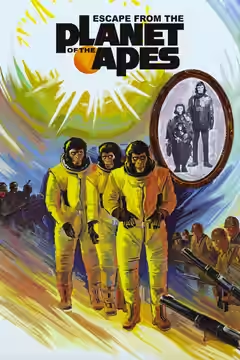
Watch Bradford Dillman in Escape from the Planet of the Apes (1971) and you see the problem. As Dr. Lewis Dixon, the animal psychologist who takes the talking chimpanzees under his wing, he is courteous, attentive and kind, and he has nothing to do but be those things and drive the car. He does it well. We found ourselves liking him and slightly sorry for him, because the face is that of a man who could plainly play something sharper, and the film never asks him to.
The sharper thing came first. Dillman began on Broadway in 1956 as Edmund Tyrone in Long Day's Journey into Night, the first actor to play O'Neill's version of himself, and Fox signed him the following year. In Compulsion (1959), Richard Fleischer's film of the Leopold and Loeb case, he played Arthur Straus, the dominant half of the pair, opposite Orson Welles, and critics found him chilling: the intelligence turned all the way inward, the charm used as a weapon. That performance fixed him as a type. Dark hair, an Ivy League bearing, the look of a man from a good family with something to hide. For a few years he was the suave villain or the suspect, and he was good at it.
Then he left Fox around 1962 and the parts got smaller. Through the 1970s and 1980s he worked steadily, mostly in television guest roles and supporting parts in films, and he was frank about why. He had six children to feed, and he called his policy "the Safeway solution": take what is going. It is an honourable reason and it produced a great deal of routine work. Piranha (1978) gave him a lead in a horror film that has since found a following, and Escape gave him the part described above. He is reliable in all of it, and reliable is the word one reaches for when the material is not.
The exception, by his own account, is O'Neill. He went back to the playwright in John Frankenheimer's The Iceman Cometh (1973) as Willie Oban, and called it his favourite screen role. We have not reviewed it and will not judge it here, but it is telling that the part he loved was the one that let him be clever and ruined at the same time, which is the combination Compulsion had promised.
So: one strong early film, a stage reputation the screen mostly wasted, and a long middle of decent men in decent suits. If you want to see what he could do, start with Compulsion. If you want to see what he was usually asked to do, Escape will tell you inside ten minutes, and you will like him anyway.
Biography
Bradford Dillman was an American actor and author. Born in San Francisco in 1930, he graduated from Yale University and studied at the Actors Studio. He made his Broadway debut in 1956, originating the role of Edmund Tyrone in Eugene O'Neill's Long Day's Journey into Night and receiving a Theatre World Award.
Dillman appeared in over 140 film, television and stage productions between 1953 and 1995. His film credits include Dr. Lewis Dixon in Escape from the Planet of the Apes (1971), J.J. in The Way We Were (1973), Captain McKay in The Enforcer (1976), Paul Grogan in Piranha (1978) and Captain Briggs in Sudden Impact (1983). He shared the Best Actor prize at the 1959 Cannes Film Festival for his role in Compulsion. He also appeared in episodes of Columbo, Wonder Woman, Murder, She Wrote and Mission: Impossible. Dillman died in Santa Barbara, California, in 2018.