Ellis writes in a flat voice about rich young people who feel nothing and buy everything, and on screen it has worked best when someone else directs it. Mary Harron found the joke; the series of The Shards has not found the fear.
Fi1m perspective
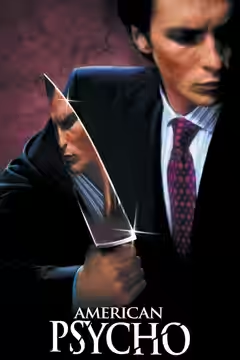
Patrick Bateman wants the other men at the table to notice his taste, his possessions and his appearance, and Christian Bale plays that wanting until it is exhausting to watch. That is Ellis's method carried onto the screen almost intact: the shopping and the killing described in the same level tone, with nobody stepping forward to say which one should trouble us. In Mary Harron's American Psycho (2000) we laughed for a long time, and then felt slightly ashamed of ourselves, because the joke was a man humiliated by the men he wanted to impress, and we had enjoyed that more than was comfortable. Harron and her co-writer Guinevere Turner put his vanity at the centre and let the horror take its chances. It was the right call.
Ellis was a student at Bennington College when Less Than Zero came out in 1985, and the book fixed his subject for the decades that followed: rich, disaffected young people in Los Angeles or New York in the 1980s, drugs, parties, and something violent underneath that nobody quite mentions. The Rules of Attraction (1987) and the novel of American Psycho (1991) followed, then Glamorama (1998), Lunar Park (2005), a ghost story with a narrator called Bret Easton Ellis, and Imperial Bedrooms (2010). The Shards (2023), his first novel in thirteen years, went back to a Los Angeles prep school in 1981 and put a serial killer in it, with a narrator who again shares his name. The prose is flat by design, full of brand names and lists, and feeling keeps giving way to sensation. When it works, the flatness is the point. When it does not, the lists go on and the reader waits.
The trouble with that voice is that it lives on the page. Ellis's own screenplays, The Informers (2008), The Canyons (2013) for Paul Schrader and Smiley Face Killers (2020), have been poorly received for their dialogue and tone, and since we have not reviewed them we will only say the pattern is telling. A camera cannot be affectless; it shows a room, and an actor has to say the line out loud and mean something by it. Harron got round this by treating the book as comedy. The series of The Shards (2026), which Ellis created with Ryan Murphy, has not got round it yet. Igby Rigney, playing a teenager called Bret Easton Ellis, is the clearest reason to watch, and he makes adolescent uncertainty interesting without becoming easy to read. Around him, suspicion gathers on a mysterious newcomer, the nine episodes give it room, and the tension keeps slipping away into diversions that would be easier to forgive if the mystery held.
"Neutrality, distance, reserve: I have always believed in these things as my guiding aesthetic," Ellis said in 2019. Distance is a fine quality in a narrator and a hard one to film, and the best Ellis on screen so far is the version where somebody else decided what we should feel about him. Read the novels. Watch Harron. Give the series a couple of episodes for Rigney, and stop when you notice you have stopped worrying about who the killer is.
Biography
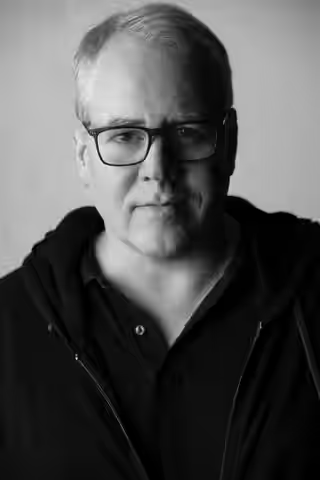
Bret Easton Ellis is an American novelist and screenwriter. His debut novel, Less Than Zero, was published in 1985. He is best known for American Psycho (1991), which was adapted into a film in 2000, and The Shards (2023), a semi-autobiographical work set in 1981 Los Angeles.
Ellis created and wrote the television series adaptation of The Shards, which premiered in 2026. Other works adapted for the screen include The Rules of Attraction (2002) and The Informers (2008).