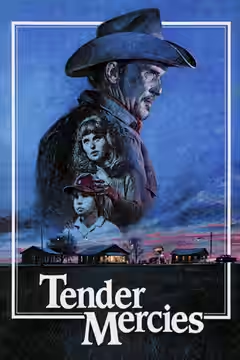
Bruce Beresford sets the camera up and lets good writing and good actors do the work. When the writing is as good as Horton Foote's, the result is Tender Mercies; when it is not, there is very little to hide behind.
Fi1m perspective
A man sits in a Texas motel and sings a hymn to the window, alone, because his daughter has just asked whether he remembered it and he said no. Bruce Beresford holds the shot and does not cut. That is his whole method in one take: find the moment in the script that matters, put the camera where it can see it, and refuse to interfere. We stopped Tender Mercies (1983) for a minute after that scene, and we are still not sure whether it was Robert Duvall's plain baritone or the fact that nobody moved the camera that got at us. Probably both.
The career looks unplanned and mostly was. Beresford made short films as a student at the University of Sydney, spent the late 1960s in London at the British Film Institute, and went home to make The Adventures of Barry McKenzie (1972), which is about as far from a Texas motel as cinema goes. Breaker Morant (1980), a court-martial drama he also wrote, made his name, and Hollywood came calling with Tender Mercies. He has spent the decades since moving between American studio work and Australian material: Driving Miss Daisy (1989), Black Robe (1991), Mao's Last Dancer (2009), Ladies in Black (2018) and The Travellers (2025).
What holds it together is a preference for plays and novels over original screenplays, and for people over spectacle. His films keep returning to the outsider who has landed among people who did not ask for him: the drunk on Rosa Lee's property, the Jesuit in seventeenth-century Canada in Black Robe, the hired driver in Driving Miss Daisy. He has said of that last film that when the writing is that good "you've really just got to set the camera up and photograph it", and he has been criticised for exactly that: an academic director who films a text rather than makes a film. There is something in it. King David (1985) is the film usually named when the charge is made, and we would not argue it away.
But the charge misreads what restraint costs. Holding that shot on Duvall is a decision, and a braver one than cutting. Beresford's unhurried, classical style gives actors room, and actors have used it: Duvall in Tender Mercies, Morgan Freeman, whom he has directed twice. The weakness comes from the same habit. Because he will not rescue a script with the camera, he is only ever as good as the pages, and the pages have not always been good.
If you have not seen Tender Mercies, start there; of everything he has done, it is the one we would keep. Then Breaker Morant, which talks more and trusts its actors just as far. Approach the rest knowing what you are getting: a director who will not get in the way, which is a virtue right up until something needs to.
Biography
Bruce Beresford is an Australian film director, screenwriter and producer. He was born on 16 August 1940 in Paddington, New South Wales. He graduated from the University of Sydney and worked for the British Film Institute Production Board in London from 1966 to 1971 before returning to Australia.
Beresford began directing feature films during the Australian New Wave. His early credits include Breaker Morant (1980), for which he received an Academy Award nomination for Best Adapted Screenplay. He later directed Tender Mercies (1983) in the United States, earning an Academy Award nomination for Best Director. Other films include Driving Miss Daisy (1989), Double Jeopardy (1999) and Ladies in Black (2018).