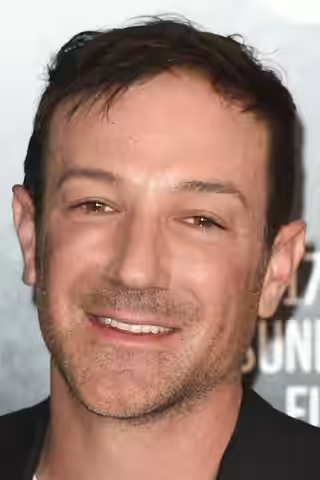
Bryan Fogel makes documentaries that start small and end up at the door of a state, and he has a gift for getting people in danger to talk to him. The evidence he gathers is nearly always stronger than the dressing he gives it.
Fi1m perspective
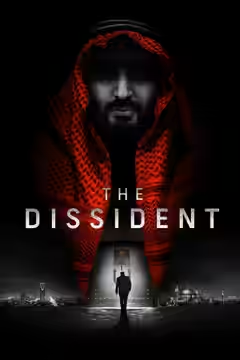
The best thing in The Dissident (2020) is white type on a black screen. Turkish prosecutors describe the recordings made inside the Saudi consulate in Istanbul, and Fogel puts the transcribed lines up a few at a time while they talk. Nobody raises their voice. We were horrified, and what did it was how ordinary the men sounded, like tradesmen discussing a difficult job. Fogel had the sense to leave those sentences alone, and for a few minutes the film is as good as anything of its kind.
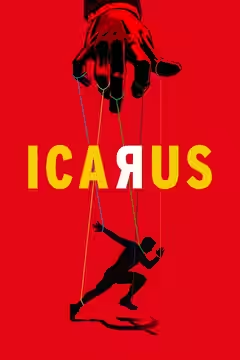
He did not begin anywhere near this. Fogel started in stand-up and acting, co-wrote the long-running play Jewtopia and directed its film version in 2012. Then came Icarus (2017), which set out as a personal investigation into sports doping and ended up with the Russian whistleblower Grigory Rodchenkov and a state-run programme. That is the shape he has kept ever since: a contained premise that opens onto an authoritarian government. The Dissident did it with the killing of Jamal Khashoggi, and Icarus: The Aftermath (2022) went back to Rodchenkov in hiding.
What he does well is access, and the patience access needs. He gets people in real danger, Rodchenkov, Omar Abdulaziz, Hatice Cengiz, to sit in front of a camera and to keep sitting there for years. He gets documents and footage other filmmakers do not. And with his cinematographer Jake Swantko and his co-writer Mark Monroe he builds it as a thriller, so that the Saudi state's paid Twitter accounts, or the spyware found on a dissident's phone, come out as clearly as a plot. Abdulaziz, funny and frightened and visibly guilty in Montreal, is the closest thing The Dissident has to a lead, and the film is better whenever it stays with him.
The weakness is a nervousness about his own material. In The Dissident the transcripts speak for themselves, so Fogel adds animated bees and a swelling score to say it again, and the effect is a little embarrassing. The complaint most often made about Icarus is that it lingers on Fogel himself before it finds its subject. He trusts his sources completely and his audience rather less.
He has said that after Icarus he went looking for a story about freedom of speech and freedom of the press, and he found one. Start with The Dissident, and when the bees arrive, wait. The prosecutors come back.
Biography
Bryan Fogel is an American film director, producer and writer. He was born in Denver, Colorado, and graduated from the University of Colorado Boulder.
Fogel began his career in stand-up comedy and acting. He developed, co-wrote and starred in the off-Broadway play Jewtopia, which he later adapted into a 2012 feature film as director and writer.
He is best known for the documentaries Icarus (2017) and The Dissident (2020), on both of which he served as director, writer and producer. Icarus won the Academy Award for Best Documentary Feature.