Budd Boetticher’s Westerns give guarded men time to reveal themselves and rarely waste ours. We rate his patient direction of actors above his occasional dramatic flourishes; Ride Lonesome is the place to start.
Fi1m perspective
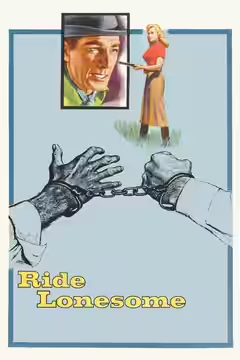
Randolph Scott can hold something back in Ride Lonesome (1959) without making Ben Brigade seem blank. Budd Boetticher, its director and producer, keeps the chase moving but does not hurry Scott into explaining himself. It is a tense, affecting Western, and a good place to begin with a director whose patience with actors is worth seeking out. At 73 minutes, it has little space to waste. Yet there is room for the people involved to interest us as much as the pursuit.
Bullfighter and the Lady (1951) established his interest in ritual and masculine codes before the sustained partnership with Scott began with Seven Men from Now (1956). That cycle of Westerns, ending with Comanche Station (1960), repeatedly put a guarded hero among people whose intentions need watching. Producer Harry Joe Brown and screenwriter Burt Kennedy were recurring collaborators in this run. Bullfighting remained a concern: much of the 1960s went into the documentary Arruza (1971). The concentrated run of Westerns sits within a career that was never confined to them.
In Ride Lonesome, Kennedy’s dialogue is sharp without making every line demand applause. Boetticher understands that it needs clear delivery and enough time to register, leaving the actors to suggest what has not been said. We were moved by Scott’s quiet performance, because it makes Ben Brigade matter without asking him to explain every feeling. Heinz Eric Roemheld’s music is less central to the film’s appeal than this confidence in faces and conversation. The writing and direction leave Scott enough room to be reserved without becoming remote.
At Lone Pine, the spare landscapes give his confrontations a clear setting, while precise movement and timing build tension without a rush of cuts. The repeated journeys and contests of honour can nevertheless grow familiar across the Westerns; there are limits to working the same situations again. Our reservation about Ride Lonesome is smaller and more specific: a few overplayed scenes disturb the otherwise measured acting. They interrupt the mood without undoing the care elsewhere. Start there, particularly if Westerns tend to lose your interest when everyone stops riding and starts talking.
Biography
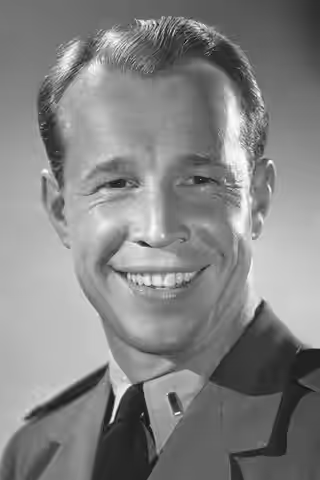
Budd Boetticher, born Oscar Boetticher Jr., was an American film director. He was born on 29 July 1916 in Chicago, Illinois, and died on 29 November 2001 in Ramona, California.
Boetticher is best known for a series of Westerns made in the late 1950s with actor Randolph Scott and screenwriter Burt Kennedy. These include Seven Men from Now (1956), The Tall T (1957), Decision at Sundown (1957), Buchanan Rides Alone (1958), Ride Lonesome (1959, which he also produced) and Comanche Station (1960). He had earlier directed The Killer Is Loose (1956) and Bullfighter and the Lady (1951).