Film review

The More the Merrier

1943 · Directed by George Stevens · 1h 44m

In a sentenceA stranger takes half your flat, rents half of that to a soldier, and then has the nerve to be right about everything

ComedyRomance

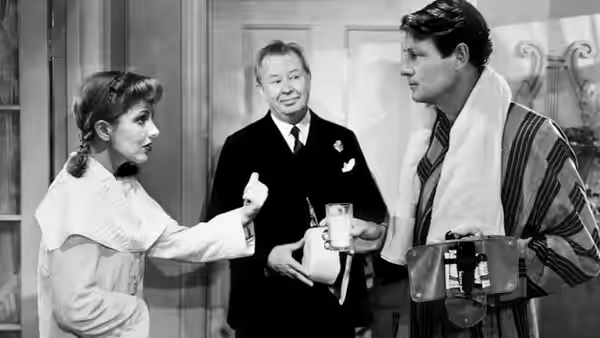
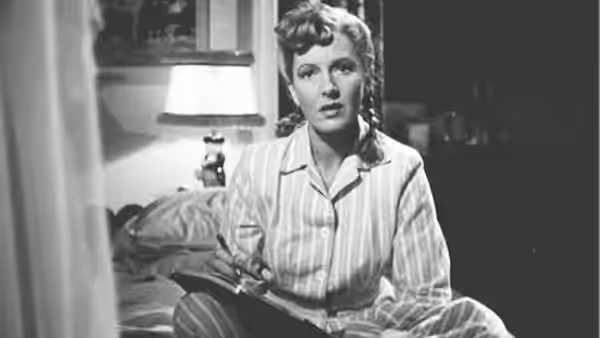
Wartime Washington, and the city is full. Constance Milligan (Jean Arthur), a government worker with her days planned to the minute and a fiancé, Charles J. Pendergast (Richard Gaines), advertises half of her small flat out of civic duty. Benjamin Dingle (Charles Coburn), a wealthy older man in town for a housing committee whose hotel has no room for him yet, talks his way in against her better judgment. Without telling her, he then rents half of his half to Joe Carter (Joel McCrea), a serviceman with a few days in the capital before he is sent overseas. Connie pins up a morning timetable for the bathroom, the coffee and the front door; the two men fail to keep to it, and Dingle, having decided Pendergast is the wrong man for her, quietly starts arranging her life.

Plays from YouTube when you press play; nothing loads from them until then.

Fi1m review

George Stevens puts three strangers in one small Washington flat and gets more warmth, and more heat, out of a shared bathroom than most romances manage in a bedroom. The last half hour turns to farce and loses its footing, and we did not much mind.

In wartime Washington there were more people than beds, and George Stevens’s comedy builds an entire film out of one flat with one bathroom. It is among the warmest comedies of its era, and one scene on a front step at night is the frankest thing Hollywood managed under the Production Code without anybody removing a stitch. It is also a film that runs out of ideas about people in its last half hour and replaces them with plot. That is the caveat; the recommendation is unreserved.

Constance Milligan (Jean Arthur) has organised her life so tightly that she need never think about it. She has a fiancé, Charles J. Pendergast (Richard Gaines), a government man who is safe in every sense, and she has a timetable on the wall that divides the morning into minutes. Into this walks Benjamin Dingle (Charles Coburn), a rich old man who needs a room and simply refuses to hear the word no. He then lets half of his half to Joe Carter (Joel McCrea), a serviceman with a few days before he goes overseas, and the timetable falls apart before breakfast.

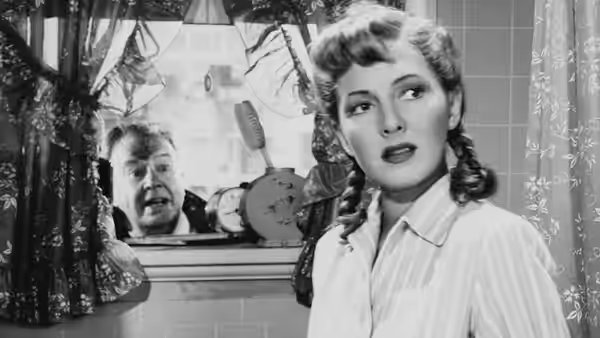
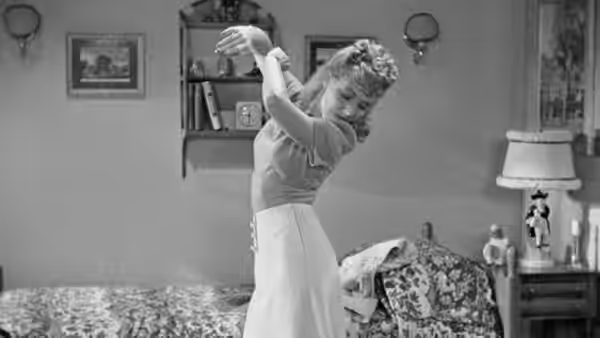
Coburn is the reason the first hour works. Dingle’s motto is “Damn the torpedoes, full speed ahead”, and Coburn plays him as a man who has spent seventy years being obeyed and finds it funny that it still works. The morning sequence, in which two men who have never met try to share a bathroom, a coffee pot and a corridor to Connie’s schedule, is almost wordless, and Otto Meyer cuts it to the rhythm of somebody who is late for everything. We laughed out loud, and then laughed again at our own reflection when Dingle got his trousers caught.

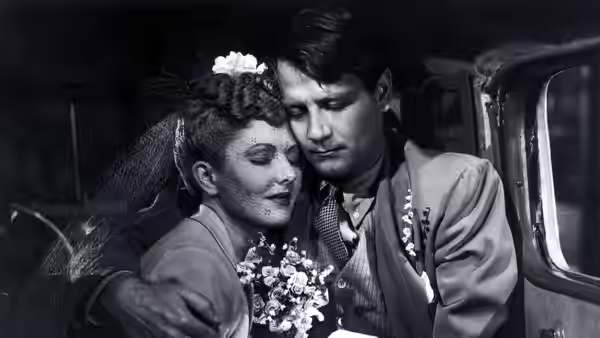
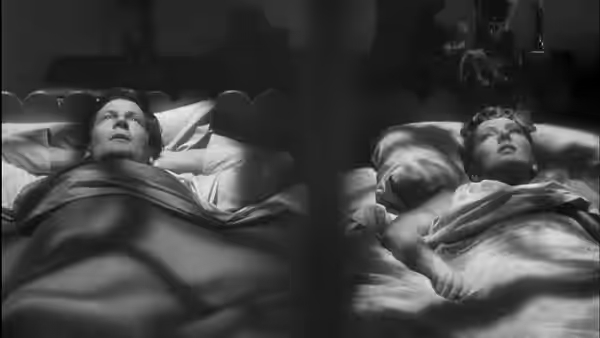
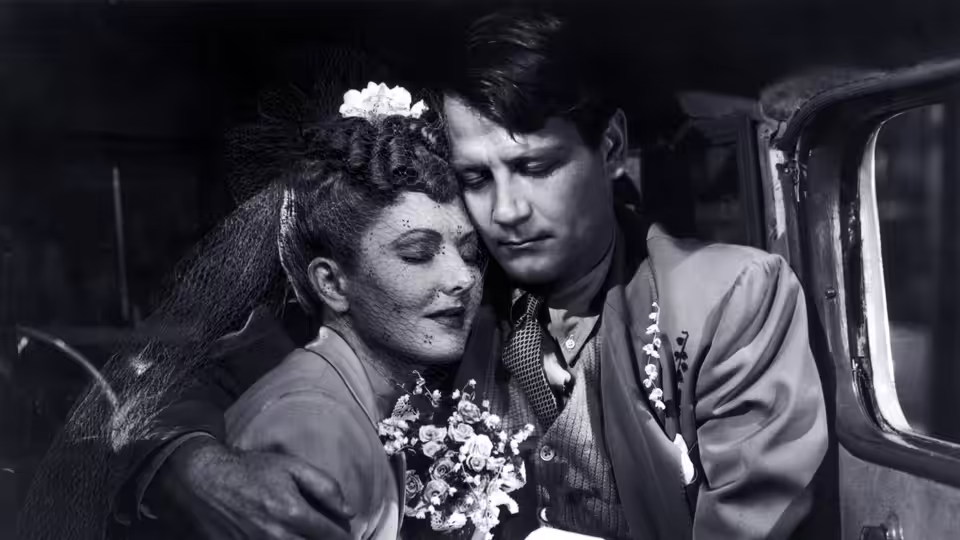
Arthur and McCrea have the harder part, which is to fall in love in a flat with no privacy while pretending not to. Arthur’s voice, which always sounds as though it is about to crack and never does, is the film’s best instrument; she delivers Connie’s lists of Pendergast’s virtues at speed, as if saying them quickly will make them matter. McCrea does very little and does it slowly, which is exactly right against her. The scene on the front step is the one everyone remembers, and they are right. Connie talks and talks about her fiancé while Joe’s hand finds her shoulder, then her arm, then the back of her neck, and she keeps talking. Stevens holds the shot and lets it run. We were not ready for how much it carries; we found we were holding our breath, in a comedy, over two people sitting on a step.

Ted Tetzlaff shoots the flat so that we always know exactly how little room there is. Doors open into people; a man in a doorway blocks a whole scene; the camera sits in the corridor and waits. Leigh Harline’s music is light and stays mostly out of the way, which is the correct decision for a comedy this dependent on timing. Nothing in the film is showy, and everything in it is placed.

Four writers are credited, Robert Russell, Frank Ross, Richard Flournoy and Lewis R. Foster, and in the last half hour you can feel all four of them. A diary is read, a misunderstanding grows, three FBI agents (Bruce Bennett, Frank Sully and Don Douglas) arrive with a senator (Clyde Fillmore) and a teenage boy (Stanley Clements), and the film stops being about three people in a flat and becomes about getting everyone to the right place at the right time. We will not describe where it goes. It is competent farce, and it is sentimental in a way the first hour never is, and at 104 minutes the film is at its best when nothing is happening except a queue for the bathroom.

Stevens had made Swing Time, Woman of the Year and The Talk of the Town before this, and he went off to film the war soon after and never made anything this light again. Seen that way, this is the last of a run, and it has the ease of a director who knows the form completely and has not yet stopped enjoying it.

Watch it with someone you could share a bathroom with, and pay attention to the front step. Everything after it is a bonus, and some of it is a chore.

Critical consensus AI synthesised

81
Positive
7
Mixed
0
Negative
0

The reviews are uniformly warm, from the film’s release to the present day, with no dissent to speak of. Most critics find it a sparkling, spontaneous comedy that turns the wartime Washington housing shortage into farce, and the praise clusters on the cast. Charles Coburn’s elderly matchmaker is repeatedly singled out as the film’s engine, and Jean Arthur’s rapid-fire delivery draws steady admiration. George Stevens’s off-hand, intimate direction is credited with giving the players room to be charming.

The spread is narrow. Where critics part is on what the film is really about. Film Comment treats the romance between Arthur and Joel McCrea as the point, finding the tender scenes its strongest, while the older notices regard the leads as capable rather than central. Reservations are mild: Time Out notes a drift towards sentimentality, and The New Yorker finds the comedy falls apart towards the end. Nobody rates it less than good.

Film Comment
2 July 2019 · Sheila O’Malley
90*

The critic praises the scorching romantic chemistry between Jean Arthur and Joel McCrea as a high-water mark of comedy and romance, noting how director George Stevens gives space for charming performances amid the wartime housing crisis plot. She singles out the tender, sexy scenes and the film's handling of desire and obstacles for particular acclaim.

Read the full review →
The New York Times
14 May 1943 · Bosley Crowther
90*

The critic calls the film a warm and refreshing comedy sparked by a clever idea about wartime housing in Washington. Stevens directs brilliantly in an off-hand style, with joyous situations and sparkling, spontaneous dialogue.

Read the full review →
Variety
31 December 1942
90*

The review describes the film as a sparkling and spontaneous farce-comedy of the wartime era. Charles Coburn steals the show with his performance while the romantic leads carry their parts effectively amid hilarious complications.

Read the full review →
Empire
1 January 2000 · William Thomas
75*

The film is a madcap attempt to blend 1930s screwball comedy with a wartime setting focused on a Washington DC housing shortage. The critic highlights the unbeatable cast, particularly Charles Coburn's Oscar-winning turn and Jean Arthur's rapid-fire dialogue.

Read the full review →
Time Out
10 September 2012 · TCh
75*

The critic finds it an engaging post-screwball comedy about wartime housing shortages and romantic mix-ups. They praise the sympathetic ensemble playing and Stevens' intimate direction while noting a drift towards sentimentality.

Read the full review →
The New Yorker
8 May 1943
70*

The film is a largely laughable comedy about housing shortages in wartime Washington involving a young woman, an elderly businessman, and a young inventor sharing an apartment. It features funny situations handled well by the cast, especially Arthur and Coburn, though it tends to fall apart toward the end.

Read the full review →

Cast

Awards

Academy Awards, 1944

Nominated
Best Actress
Nominated
Best Director
Nominated
Best Picture
Nominated
Best Story
Nominated
Best Writing, Adapted Screenplay
Won
Best Supporting Actor

If you liked this, try…

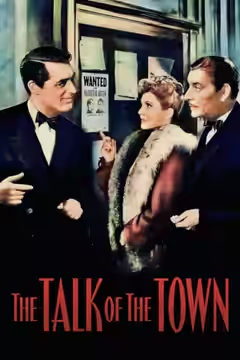
The Talk of the Town poster75

The Talk of the Town

1942 · Stevens and Arthur again, with two men and a house; the argument is politics this time

The Shop Around the Corner poster

The Shop Around the Corner

1940 · Lubitsch’s cramped Budapest shop, where two people fall in love while being rude to each other

I Know Where I'm Going! poster

I Know Where I'm Going!

1945 · A wartime engagement to the wrong man, undone by weather, on a Scottish island

The Apartment poster91

The Apartment

1960 · Another small flat lent to the wrong people, with Wilder’s sadness underneath the jokes

Walk, Don't Run poster

Walk, Don't Run

1966 · The remake, moved to Tokyo, with Cary Grant in the Dingle role and less heat