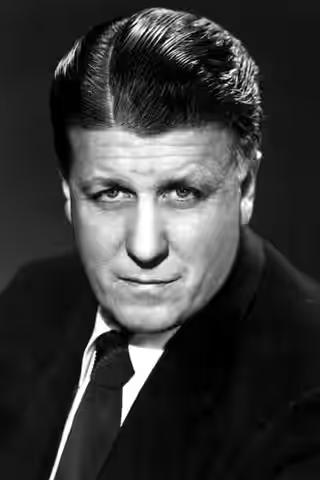
George Stevens made films slowly and let his actors take their time, and when the material was small that patience produced something exact and painful. After the war he pointed the same care at America, and the results are grander, longer and not always better.
Fi1m perspective
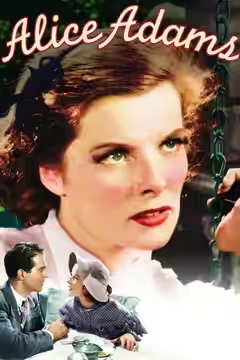
Watch the dinner in Alice Adams (1935). Alice has invited the rich boy on the hottest night of the year, hired a maid for the evening, chosen a menu that would sit heavy in January, and told her father to keep his jacket on. Nothing goes wrong quickly. George Stevens and his editor Jane Loring hold every shot a beat past the point where another director would have cut, so each small humiliation arrives and settles at the table. We winced through it, and the wincing is the point: the food is wrong and the maid is bored, but the disaster is that Alice keeps talking.
That is his method in one scene. Set it up, then wait. He had come to directing from the camera, shooting Laurel and Hardy shorts in the 1920s, and a Laurel and Hardy short is nothing but set-up and waiting. RKO gave him features in the mid-1930s, Alice Adams made his name, and for a few years he did whatever the studio needed and did it well: Swing Time (1936) with Astaire and Rogers, Gunga Din (1939), Woman of the Year (1942), which put Katharine Hepburn opposite Spencer Tracy for the first time. Hepburn made three films with him, and Alice Adams is the one to start with; he gives her room to lie and room to be caught, and she is exact in both.
Then the war. Stevens ran a US Army Signal Corps film unit that recorded D-Day and the liberation of Dachau, and the director who came back was not the man who had made Swing Time. The post-war films are long, slow and serious: A Place in the Sun (1951), Shane (1953) and Giant (1956), usually grouped as a trilogy about America, then The Diary of Anne Frank (1959) and The Greatest Story Ever Told (1965). William Mellor shot three of his films, and the trilogy is where the close-up, held and held, becomes the signature. He prepared for years, researched everything and covered every scene from several angles so he could build it in the cutting room.
The complaint about these films is that the patience turns to weight. A dinner scene can afford to wait; a Western and a life of Christ perhaps cannot, and The Greatest Story Ever Told is the usual exhibit for the case that Stevens calculated his effects and then underlined them. French critics of the fifties and sixties never quite admitted him to the club of authors; they found his classicism too plain to be interesting. He would have disagreed. He called the director's job being "a kind of host on the film set", which is a modest way of describing a man who spent years on each film.
We would put the small films first. Alice Adams loses its nerve in the last reel, softening a novel that did not soften, and it is still the clearest view of what he could do: two set pieces, one girl, and the time to let her sink.
Biography
George Stevens was an American film director, producer, screenwriter and cinematographer. Born in Oakland, California, he worked in his parents' touring theatre company as a child actor and stage manager before entering the film industry as a cameraman in the early 1920s at Hal Roach Studios.
He directed his first major feature, Alice Adams (1935), starring Katharine Hepburn. Subsequent films include Swing Time (1936), Gunga Din (1939), Woman of the Year (1942), A Place in the Sun (1951), Shane (1953), Giant (1956) and The Diary of Anne Frank (1959). He won Academy Awards for Best Director for A Place in the Sun and Giant.