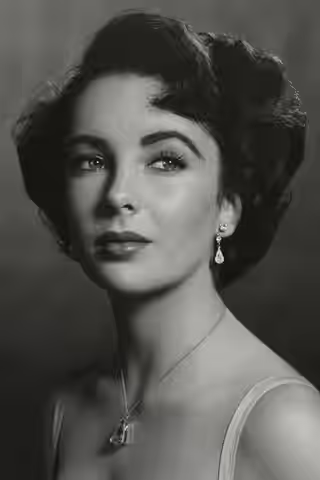
Elizabeth Taylor never had a lesson and never needed one when the part let her want something. Watchful and quick in the right room, she is at her best as a woman arguing, and at her weakest when asked only to be adored.
Fi1m perspective
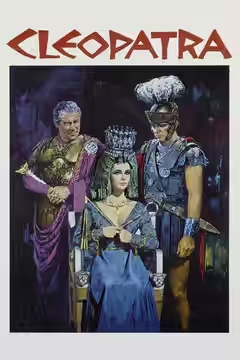
She is unrolled from a carpet at Caesar's feet in Cleopatra (1963), and Rex Harrison, instead of gasping, asks her what she wants. Watch what Taylor does with the question. She does not simper and she does not pose; she thinks, and we can see the arithmetic. That is the Taylor we trust: watchful, quick, with something to argue about and a man across the table to argue it with. In the first half of Joseph L. Mankiewicz's film she is a politician, and she is good at it.
She had no training and never claimed any. A child under contract at MGM after a 1942 debut, she became a star with National Velvet (1944), and the 1950s moved her into grown-up parts, in A Place in the Sun (1951), in Giant (1956), and above all in Tennessee Williams, with Cat on a Hot Tin Roof (1958). Williams suited her. His women are volatile and will not be told, and Taylor could do volatile without a run-up. Three of her films in these years were with Montgomery Clift.
The 1960s were the peak, and Richard Burton was the other half of it: eleven films together, most of them about couples who fight because they cannot leave. Who's Afraid of Virginia Woolf? (1966), with Taylor as Martha, is the one most critics point to when they want to prove she could act, and we would not argue. Cleopatra is the odder case. We were sad, somewhere past the three-hour mark, and not for Egypt. Once Burton arrives, the script hands the two of them one quarrel after another, each ending in a monologue, so that lovers who are supposed to be unable to keep apart are never quiet in the same room. Taylor is better as a politician than as a lover here, and we think the writing did that to her, not the reverse.
The case against her is the obvious one: that she played versions of herself, and that when the writing thinned the lack of technique showed. There is something in it. She could not hide behind a voice or a walk; when the part was not there, neither was she. After the mid-1970s she worked less often, in film, on television and on stage, and the films that did come were mostly judged lesser, The Flintstones (1994) among them. She would not have disputed the technique point. She said herself that whatever talent she had was not technique at all, but instinct.
Instinct is a good servant and a poor employer. Give her a room, an opponent and a reason, and she is as alive as anyone the studios produced. Give her a throne and a man to gaze at, and she waits, politely, for somebody to write her a line.
Biography
Elizabeth Taylor was a British-American actress. Born in London to American parents, she began her career as a child actress under contract with Metro-Goldwyn-Mayer.
She appeared in films including National Velvet (1944), Giant (1956), Cat on a Hot Tin Roof (1958), Suddenly, Last Summer (1959) and Butterfield 8 (1960), for which she received the Academy Award for Best Actress. Taylor played the title role in Cleopatra (1963) and won a second Academy Award for Who's Afraid of Virginia Woolf? (1966). She collaborated with Richard Burton on several films after their meeting on the set of Cleopatra.
From the mid-1970s Taylor appeared less frequently in film and took on occasional roles in television and theatre. She received the Jean Hersholt Humanitarian Award and was appointed DBE in 2001.