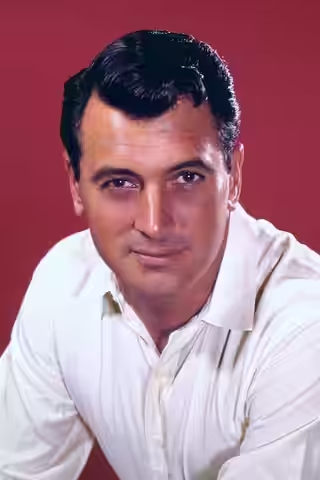
Rock Hudson's gift was to stand still and be talked at. Big, decent and slow to understand, he let cleverer people win the scene, and in Giant and the Sirk melodramas that patience is the whole point of him.
Fi1m perspective
Early in Giant (1956), Elizabeth Taylor walks into a room where the men are talking politics, is told to go and rest with the women, and declines. Watch Hudson. He is a head taller than anyone else there and he does nothing with it. He listens, and loses, and pretends he has not. Most leading men of his size used the bulk to win arguments; Hudson used it to absorb them.
He came to it without training, with a name invented by an agent, and Universal put him through B-westerns and adventure pictures for the first half of the 1950s, long enough for critics to decide he was wooden and mostly playing himself. Douglas Sirk saw something more useful. Magnificent Obsession (1954) made him a star, and All That Heaven Allows (1955) and Written on the Wind (1956) fixed the image: the solid, gentle man in the middle of a plot nobody could quite believe, saying his lines as if he believed them, which turned out to be enough. Nine films with Sirk is the partnership that matters. Then Giant in the same year, and from 1959 the comedies with Doris Day, beginning with Pillow Talk.
Giant is the one to start with, and not only because it is the one of his we have reviewed. Bick Benedict is a decent, slow man who is wrong about most things and takes years to find out, and Hudson plays the years. His quarrels with Taylor are about small things, a chair at a table, a doctor for a sick baby, and we found ourselves more moved by them than by any of the film's speeches, because he plays each one as a man who already suspects he will lose and has decided to stand there anyway. The speeches he and Taylor cannot save. The marriage is theirs.
The comedies are lighter than the man in them, and reviewers at the time said so; Seconds (1966), which asked him to play a man remade into somebody else, is the film to see if you want him unsettled. Television took him for most of the 1970s, with McMillan & Wife running from 1971 to 1977. Late in his career he said that the most dangerous thing for an actor is to refuse to listen to anyone else, to feel you know more than anybody. It is the nearest thing to a method he ever admitted to, and it is there on screen in every scene where somebody smaller than him is talking.
Biography
Rock Hudson was an American actor. He appeared in films including Giant (1956), in which he played Jordan 'Bick' Benedict, All That Heaven Allows (1955) and Pillow Talk (1959).
Hudson received an Academy Award nomination for Best Actor for his performance in Giant. He starred opposite Doris Day in the romantic comedies Pillow Talk (1959), Lover Come Back (1961) and Send Me No Flowers (1964). In the 1970s he starred in the television series McMillan & Wife (1971–1977).
In 1985 Hudson disclosed that he had AIDS. He died on 2 October 1985.