Film review

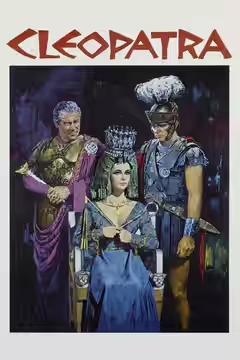
Cleopatra

1963 · Directed by Joseph L. Mankiewicz · 4h 11m · MPA G

In a sentenceRex Harrison wins the first two hours by talking; Richard Burton loses the second two the same way

DramaHistoryRomance

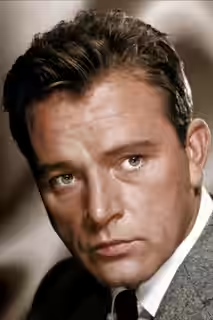
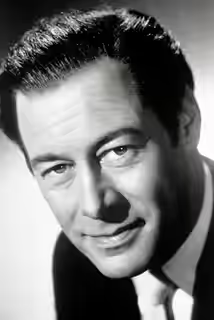
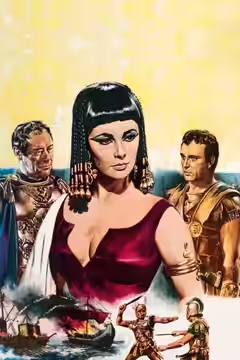
Alexandria, 48 BC. Julius Caesar (Rex Harrison) sails into Egypt after crushing Pompey and finds the country split between the young queen Cleopatra (Elizabeth Taylor) and her brother, a boy-king run by his ministers. Cleopatra has herself rolled inside a carpet and carried into Caesar’s quarters by her servant Apollodorus (Cesare Danova), and sets about persuading the general to make her sole ruler. Caesar wants Egypt’s grain and gold and, before long, an heir; his officer Rufio (Martin Landau) and his servant Flavius (George Cole) watch the arrangement with unease, and her tutor Sosigenes (Hume Cronyn) counsels patience. Street fighting sets the great library ablaze. At Caesar’s side stands Marcus Antonius (Richard Burton), who will not stay at his side for long.

Fi1m review

Joseph L. Mankiewicz’s four-hour spectacle is two films joined in the middle. The first, with Rex Harrison, is dry, clever and often funny. The second, with Richard Burton, is loud, wordy and half an hour too long. The sets are worth the ticket either way.

Joseph L. Mankiewicz, who wrote and directed All About Eve (1950), took over Cleopatra when the production was already in trouble, and the result is the most famous expensive mess in Hollywood history. It runs 251 minutes. It is also, for roughly the first half of them, a good film: a talky, adult, sceptical account of how a clever young woman handles the most powerful man alive. Then Harrison leaves it, for reasons every schoolchild knows, and the second half never recovers the tone.

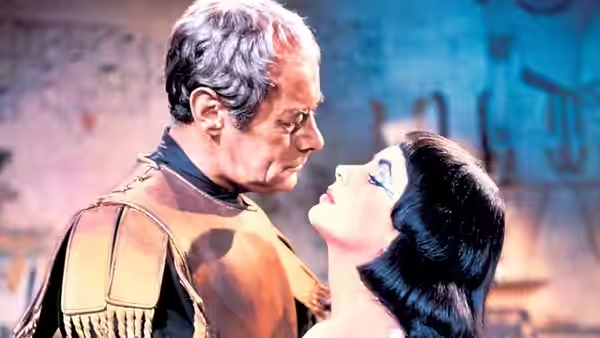
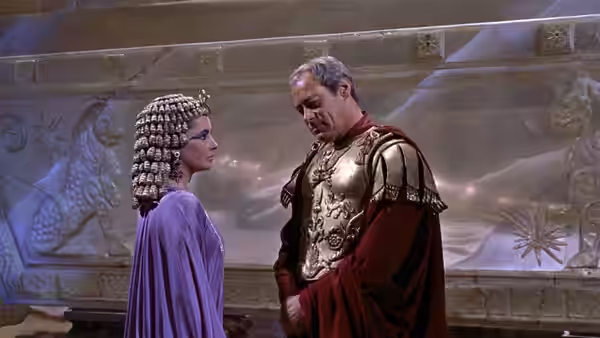
Harrison is the reason to sit down. He plays Caesar not as a marble bust but as a tired, amused administrator who has seen every kind of ambition and finds this one worth a second look. His scenes with Taylor are the best written in the film, because Mankiewicz gives them something to argue about other than each other: grain, gods, who gets to be a king and who only gets to be married to one. When she is unrolled from the carpet at his feet he does not gasp. He asks her what she wants. Taylor, at this stage, is watchful and quick, and she is better as a politician than she will be later as a lover.

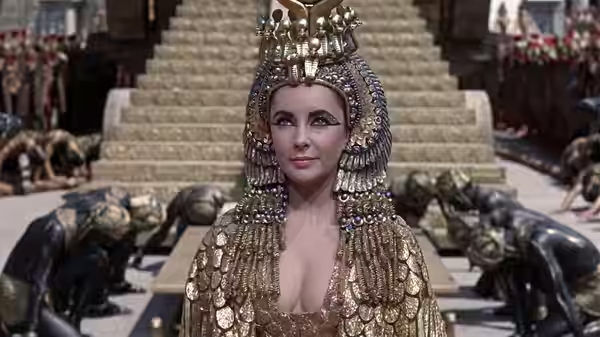
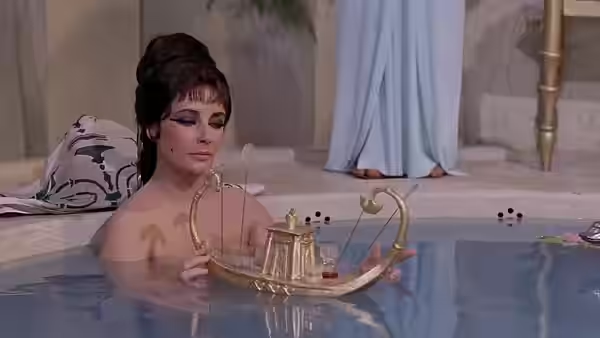
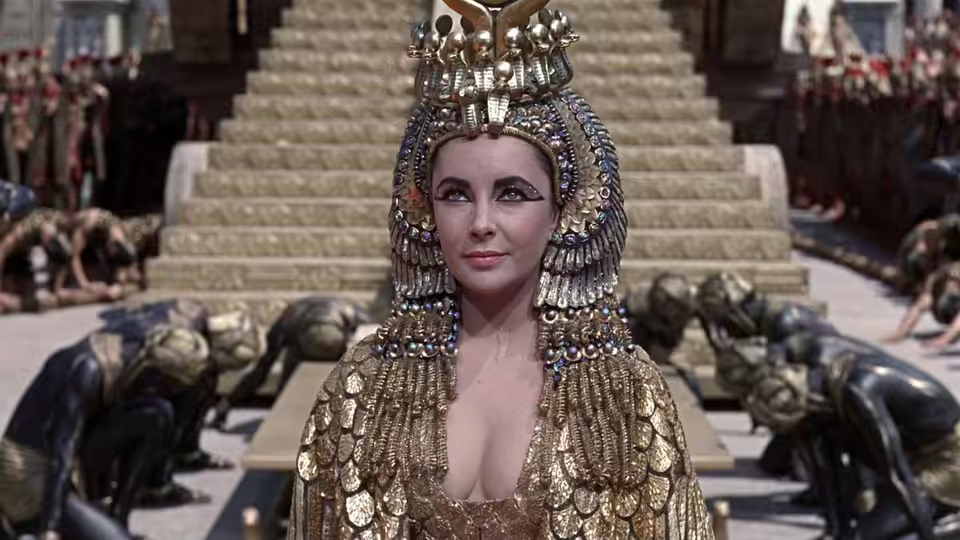
The spectacle earns its reputation. John DeCuir’s Alexandria is a city of pale stone and enormous doors, and his Rome is a forum big enough to hold a sea of extras without any of them looking painted in. Leon Shamroy keeps the wide frame level and lets the crowds fill it, so we always know how far away the throne is from the people. Irene Sharaff, Renié and Vittorio Nino Novarese dress Egypt in gold and Rome in wool, and the film’s single best idea is that the colours tell you which side you are on. Alex North scores the procession into Rome with brass and drums that build for what feels like ten minutes, and when the sphinx comes through the arch with Taylor on top of it we sat forward in our seats. It is a shameless scene and it works, because Mankiewicz for once stops writing and lets the picture do the talking.

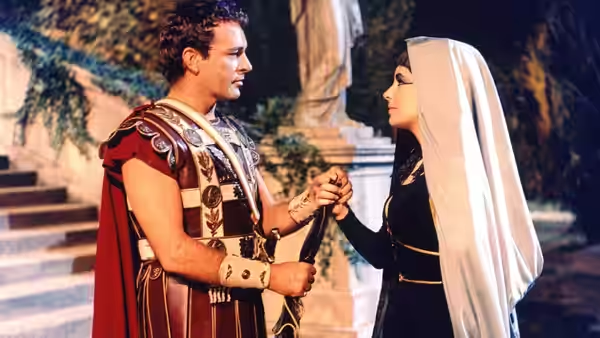
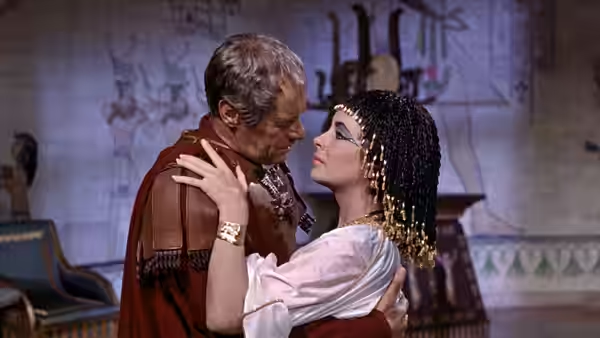
The trouble is Burton. He is not bad; he is miscast by the script, which has him drink, sulk and make speeches about his own inadequacy for two hours. Every love scene is staged as a quarrel and every quarrel ends in a monologue, so that two people who are supposed to be unable to keep away from each other are almost never quiet in the same room. We have never seen a screen affair spend so much of its time in committee. Around the three-hour mark we noticed we were tired, and then we were a little sad about it, because Burton and Taylor are plainly capable of the thing the film keeps describing and never once shows.

The supporting players do better than their material. Roddy McDowall’s Octavian is a pale, prim schoolboy who turns out to be the only person in the film who understands power, and his scenes with Andrew Keir’s Agrippa have a chill the leads never reach. Martin Landau is quietly good as the soldier who keeps his opinions to himself. Hume Cronyn and Pamela Brown, as tutor and high priestess, supply the little sanity Egypt has. Dorothy Spencer’s editing shows the joins: scenes open as if something before them has gone, and characters refer to events we have not been shown, which tells you the film we are watching is not quite the one that was made.

Set against Spartacus (1960) or Lawrence of Arabia (1962), this is a chamber drama that has wandered into the wrong-sized rooms. The battle at Actium is brief and confused, and Mankiewicz’s heart is plainly not in it. His heart is in the arguments, and when the arguments are Harrison’s they are worth the time.

Watch it at home, in two sittings, with an evening between them. Take the first half as the sharp political comedy it is. Take the second as a very long look at some very good costumes. It carries a PG certificate, and it opened in British cinemas on 12 July 1963.

Critical consensus AI synthesised

62
Positive
5
Mixed
2
Negative
3

Most critics lean warm, and the praise clusters in one place: the spectacle. Cleopatra’s entry into Rome comes up repeatedly, as do the sea battle at Actium and the barge, and several reviewers credit the thousands of real extras and the scale of the sets with a sense of the ancient world that studios no longer attempt. Elizabeth Taylor is the other point of agreement; even reviewers cool on the film grant that her presence carries it, and the earliest notices credit Mankiewicz’s script with unusual literacy for a costume epic.

The reservations gather around the drama beneath the pageantry. Several find the screenplay wordy and the story rambling, and Empire argues that Taylor and Burton never convince as lovers. The spread is wide, from outright admiration to Slant Magazine’s view that it is neither a triumph nor an interesting disaster but simply dull. The New Yorker splits the difference, finding the dialogue absurd and recommending it anyway for the look of the thing.

The Guardian
11 July 2013 · Peter Bradshaw
90*

The restored big-screen version of the four-hour 1963 spectacle should not be missed as a colossus of the analogue-epic era and the high point of Elizabeth Taylor's global celebrity. It is a stately but sometimes mindboggling spectacle that breaks into two halves as Cleopatra bewitches and unmans two Roman alpha-males, with the jawdropping entry into Rome singled out as a sensational Busby Berkeley fantasy.

Read the full review →
The New York Times
16 June 1963
90*

The critic calls the film a stunning and entertaining achievement that confounds skeptics, crediting Mankiewicz's sophisticated script for bringing literate life and historical sweep to the epic tale of ambition, love, and power. The production delivers spectacle in the finest tradition despite its length.

Read the full review →
The Hollywood Reporter
13 June 1963 · James Powers
70*

The critic finds it not a great movie but a vast popular entertainment with outstanding performances, especially Elizabeth Taylor's, and spectacular production values. Praises the opulence and acting while noting it prioritizes broad appeal over artistic greatness.

Read the full review →
Variety
1 January 1963
70*

The review praises the film as a supercolossal yet remarkably literate recreation of history, highlighting Mankiewicz's achievement in managing scope and complexity, strong big scenes like the Roman entry and Battle of Actium, and overall sense of time and place despite weaker love scenes.

Read the full review →
Evening Standard
12 July 2013 · Derek Malcolm
60*

The film is no masterpiece but its lavish splendour compensates for a wordy screenplay and uneven acting; it became one of the biggest commercial successes despite its troubled production.

Read the full review →
Time Out
8 July 2013 · ★★★ · Trevor Johnston
60

The critic finds the film lacks much substance as drama but excels as unmatched Hollywood spectacle thanks to its thousands of real extras and recreation of the ancient world. Elizabeth Taylor's larger-than-life star presence is singled out for praise amid complaints of a rambling, purposeless narrative.

Read the full review →

Cast

Awards

Academy Awards, 1964

Nominated
Best Actor
Nominated
Best Film Editing
Nominated
Best Original Score
Nominated
Best Picture
Nominated
Best Sound
Won
Best Art Direction, Color
Won
Best Cinematography, Color
Won
Best Costume Design, Color
Won
Best Visual Effects

If you liked this, try…

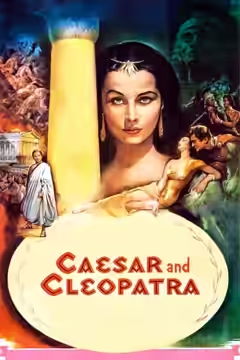
Caesar and Cleopatra poster

Caesar and Cleopatra

1945 · Shaw’s version of the same first act, with Vivien Leigh and far fewer extras

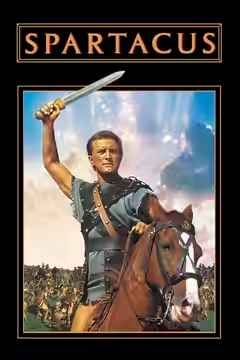
Spartacus poster

Spartacus

1960 · Kubrick’s Rome, where the spectacle and the argument arrive at the same time

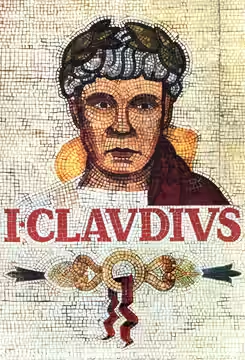
I, Claudius poster90

I, Claudius

1976 · Television Rome on cardboard sets, and the sharpest political writing the period has had

Rome poster

Rome

2005 · Caesar, Antony, Octavian and the queen again, with the dirt left on

The Last Emperor poster80

The Last Emperor

1987 · Bertolucci films a court in real palaces and makes the size mean something