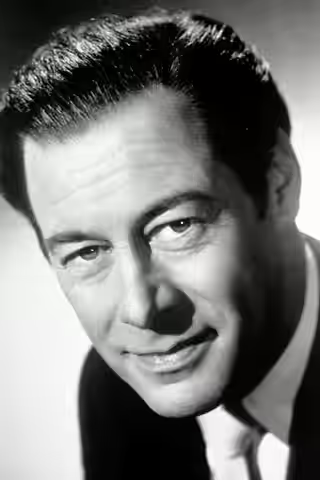
Rex Harrison made a career of Englishmen who had already seen the trick and were only mildly impressed. The diction was exact, the temperature low, and when a script gave him something to argue about, as Cleopatra did, few actors were better company.
Fi1m perspective
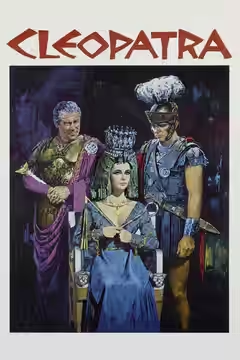
When Elizabeth Taylor is unrolled from a carpet at his feet in Cleopatra (1963), Rex Harrison does not gasp. He asks her what she wants. That is the Harrison manner in one beat: a man who has seen this done before, is quietly pleased by how well it has been done this time, and would like to get on with the paperwork. He plays Julius Caesar as a tired administrator rather than a marble bust, and for the first two hours of Joseph L. Mankiewicz's spectacle he turns the largest sets in the picture into a talky, sceptical chamber drama. Then he leaves the film, as history requires, and it never gets its tone back.
The manner was built on stage. He apprenticed with Liverpool Rep from 1924, reached the West End in 1930 and became a name in Terence Rattigan's French Without Tears in 1936. What the theatre gave him was diction: every consonant in place, every line delivered as if the speaker had thought of it a moment ago and was faintly bored by how good it was. Noël Coward's Blithe Spirit (1945) fixed the screen version, Charles Condomine putting up with a dead wife the way other men put up with damp, and Coward rated him the finest light comedian going, bar one. Hollywood followed, and The Ghost and Mrs. Muir (1947) put the same dry Englishman in a sea captain's coat.
Then came Henry Higgins. He played the part on Broadway from 1956, in London in 1958 and on film for George Cukor in My Fair Lady (1964), and because he could not really sing he spoke the songs in rhythm instead, which made a limitation into the character. A man who lectures a girl about her vowels ought to sound exactly like that. The children came later, with Doctor Dolittle (1967).
What he could not do, or would not, was warmth. The complaint followed him for forty years and it is fair; the eyes stay dry, and the case against him usually cites Unfaithfully Yours (1948). In Cleopatra, though, the coldness is the point. Caesar cannot afford to be moved, and Harrison lets the feeling show only in how much he enjoys being argued with. We laughed at the carpet scene more than at anything in the film's second half, and then, to our surprise, felt a little sad, because it is the last time in four hours that anyone speaks to Cleopatra as an equal. Mankiewicz, who directed him three times, knew what he needed: an intelligent opponent and a subject other than love. Grain, gods, who gets to be a king.
He was, by most accounts, difficult on a set, and none of it reaches the screen, which is the professional's trick. Start Cleopatra from the beginning and stop when he does. The rest is Burton's problem.
Biography
Rex Harrison (5 March 1908 – 2 June 1990) was an English actor. He began his stage career with the Liverpool Repertory Theatre in the mid-1920s and made his West End debut in 1930. He appeared in British films from the 1930s and later worked extensively in Hollywood.
Harrison received critical acclaim for stage and screen roles including Blithe Spirit (1945) and Anna and the King of Siam (1946). He played Julius Caesar in Cleopatra (1963) and reprised his stage role as Professor Henry Higgins in the 1964 film My Fair Lady, for which he won the Academy Award for Best Actor. He was knighted in 1989.