Film review

The Diary of Anne Frank

1959 · Directed by George Stevens · 2h 59m · MPA NR

In a sentenceEight people hiding in a few small rooms, shot on a screen wide enough to lose them in

DramaHistory

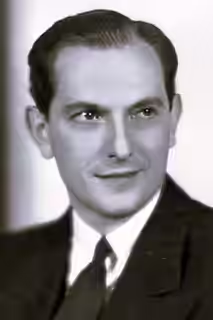
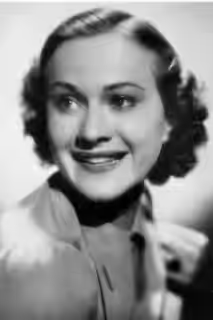
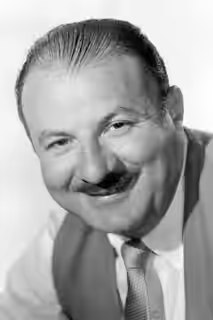
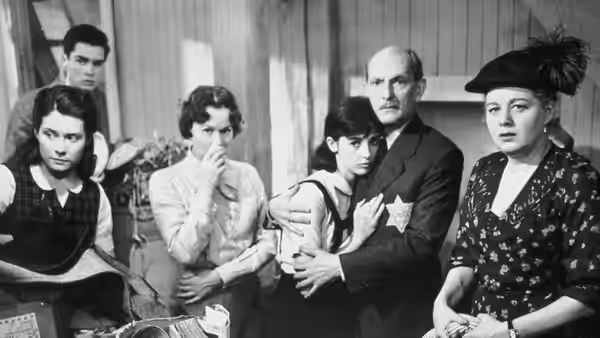
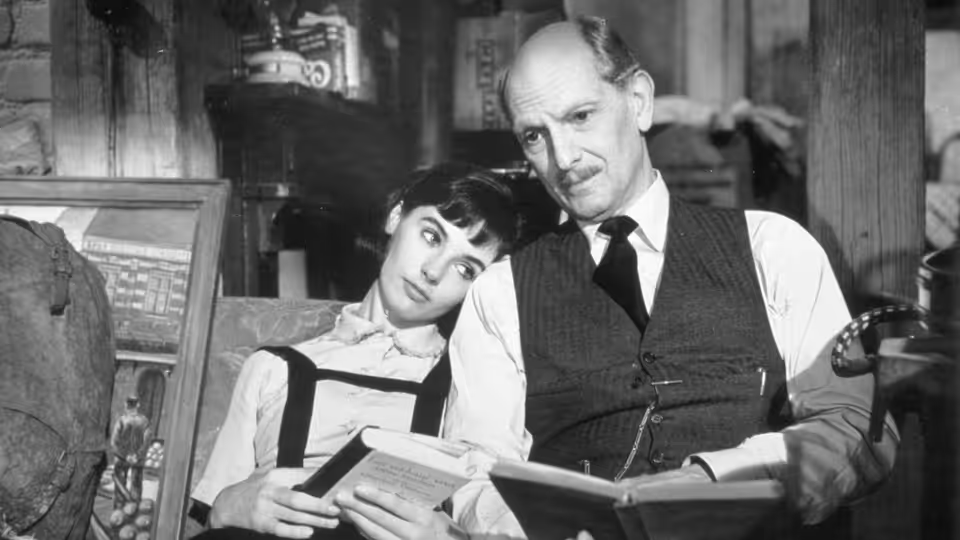
Amsterdam, after the war. Otto Frank (Joseph Schildkraut) climbs back to the hidden rooms above his old business and is handed a diary by Miep Gies (Dodie Heath). The film goes back to July 1942. The Franks, Otto, his wife Edith (Gusti Huber) and their daughters Margot (Diane Baker) and Anne (Millie Perkins), move into the annexe with the Van Daans: Petronella (Shelley Winters), Hans (Lou Jacobi) and their son Peter (Richard Beymer). Kraler (Douglas Spencer) and Miep bring food and news from the office below. The rules are laid down on the first day: no sound and no running water while the workers are in the building, no window opened, no light after dark. Anne, thirteen, restless and outspoken, starts writing. A dentist, Albert Dussell (Ed Wynn), arrives to make eight.

Fi1m review

George Stevens’s film of the diary is sincere and, in Joseph Schildkraut and Shelley Winters, well acted, but it runs three hours on a screen built for horizons, and eight people in hiding are never once allowed to feel hemmed in.

George Stevens directs a 179-minute film of Anne Frank’s diary, from a screenplay by Frances Goodrich and Albert Hackett, who adapted their own stage play. The material is eight people in a few rooms for two years, most of it spent trying not to be heard. Stevens shot it in CinemaScope, on a screen built for cattle drives and oil fields, and that one decision is the thing the film never gets past. It is sincere, well acted in places and far too long, and the width of the frame lets out the fear it needs.

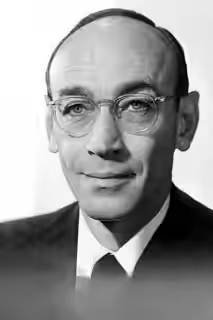
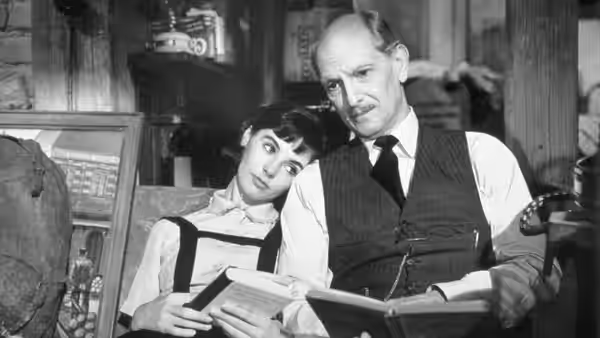
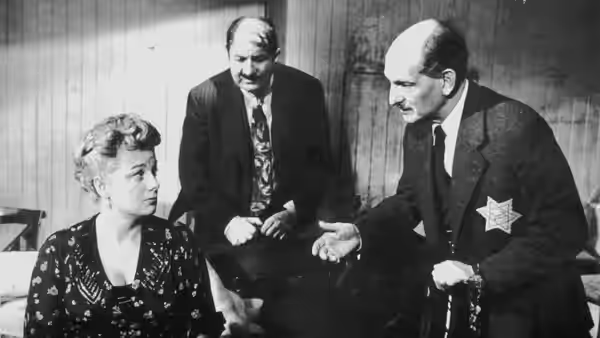
Start with what works, because a fair amount does. Joseph Schildkraut plays Otto Frank as a courteous, tired man who holds the group together by never letting them see him frightened, and he does it without a raised voice or a speech about it. Shelley Winters is Petronella Van Daan, who arrives with a fur coat and will not be parted from it, and she is vain, scared, funny and the only person on screen who seems to have a body temperature. Lou Jacobi gives her a husband who eats other people’s bread and hates himself for it. Ed Wynn’s Albert Dussell, the dentist who makes eight, is a fussing, timid man, and Wynn plays him small.

The best passages are the quiet ones. During the working day nobody may move, and Stevens lets whole minutes go by with the group frozen at the table while boots cross a floor below them, a lorry passes, a church bell strikes. William C. Mellor shoots these in a grey, flat light with no music under them, and we found ourselves holding our breath, which was not something we had planned to do for a film made in 1959. When Alfred Newman’s strings come back in afterwards we felt the relief and resented it at the same time, because the film had just shown it did not need him.

That is the trouble with Newman throughout. The score tells us what to feel at every turn, rising when a look would have done, and it makes a film about people who could not make a sound into one that rarely stops making them. The three editors, David Bretherton, William Mace and Robert Swink, let scenes run past their point; a row is played out, then played out again with the positions reversed. At 179 minutes the confinement becomes ours, and not in the way that was intended.

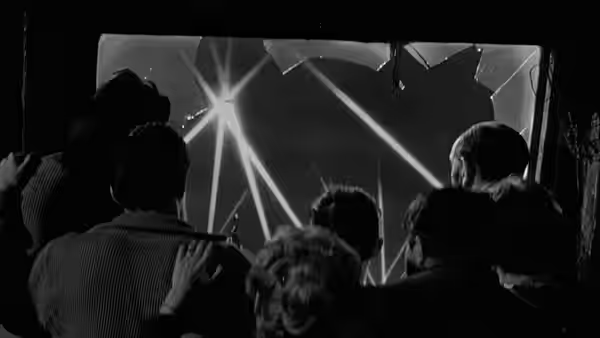
Then there is the frame. Mellor lights the annexe handsomely, and the rooms, with their blacked-out windows, hanging washing and single stove, look right. But the wide screen puts a yard of empty floor either side of every actor, and the camera sits back and watches a set with its fourth wall removed, which is what this is. Eight people who cannot get away from one another ought to be crowding the edges of the picture. Here they have room to pace.

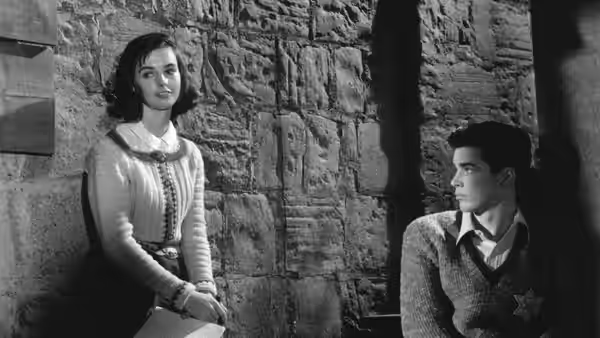
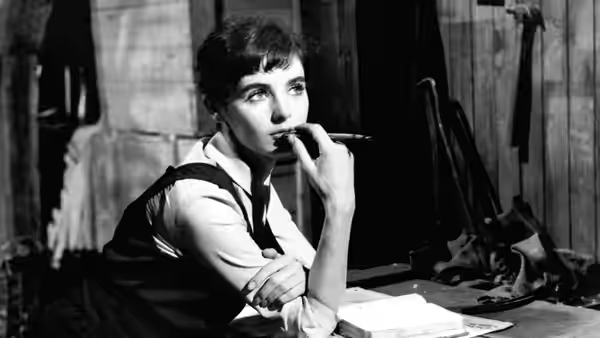
Millie Perkins has the face for Anne and not the quickness. The girl who wrote the diary was sharp, vain, self-mocking and often unkind about the people in the next room; Perkins gives us a sweet, well-brought-up child being brave, and her line readings are careful where they should be fast. Her scenes with Richard Beymer’s Peter in the attic are the love story the tagline promises and the slowest stretch of the film. Gusti Huber and Diane Baker, as Edith and Margot, are mostly asked to look pained in the background, and do.

Stevens made Shane and Giant, films about distance and horizon, and he treats these rooms as if they were another landscape, something to be looked at from a long way off. The film’s closing stretch we will not describe, except to say that the history does the work and Stevens, to his credit, mostly lets it.

Watch it at home, where the width matters less and the rooms close in a little. The U certificate is fair, and older children can sit through it if they will sit through three hours. It is a decent, honest account of the diary that would have been a better one at two.

Critical consensus AI synthesised

54
Positive
3
Mixed
1
Negative
2

Most critics find Stevens’s adaptation sincere and often moving, though the reviews split three positive to two negative with one in the middle. The praise gathers around the film’s fidelity to the diary and the play, its feel for the grinding daily ordeal of survival, and the supporting cast: Joseph Schildkraut as Anne’s father and Shelley Winters as Mrs Van Daan are both singled out.

The reservations are strikingly consistent. Nearly everyone finds it too long, even in the restored 170-minute cut. Several complain that the CinemaScope frame works against the material, opening up rooms that should feel cramped. And the casting of Millie Perkins as Anne draws objections from the earliest notices onward; The New Yorker treats it as the chief fault, and The AV Club simply calls her miscast. The spread is wide: The New York Times and Variety are warmly approving, while Time Out and The New Yorker come away underwhelmed despite admitting to tears.

Empire
1 January 2000 · David Parkinson
70*

The critic finds it a moving tribute to heroic victims of barbarism but faults the clumsy use of CinemaScope, which dissipates any sense of claustrophobia, and stagey performances that overshadow subtler ones. Even the restored 170-minute version only tells part of the story.

Read the full review →
The New York Times
19 March 1959 · Bosley Crowther
70*

The film is a substantially sound and eloquent rendering of the play that captures the drama and authenticity of the diary, with Stevens doing a superb job of conveying the harrowing ordeal of survival. It falls short of full spiritual splendor in the projection of the Anne Frank role.

Read the full review →
Variety
31 December 1958 · Variety Staff
70*

The film is of often extraordinary quality and manages to convey the beauty of a young inquiring spirit within a tense tragic situation. It is simply too long, with moments when the action lags and the dialog becomes forced.

Read the full review →
The AV Club
1 July 2009 · C- · Scott Tobias
50

The critic finds the 1959 adaptation miscast in its lead role and lacking in the necessary sense of confinement despite accurate production design. He notes strong work from Joseph Schildkraut as Anne's father but overall views the film as labored Oscar bait.

Read the full review →
Time Out
4 April 2012 · DP
35*

The film is a long, well-meaning but ultimately underwhelming adaptation that feels too theatrical despite its moving true story. Shelley Winters' performance as Mrs Van Daan stands out as a highlight.

Read the full review →
The New Yorker
21 March 1959 · John McCarten
30*

Stevens uses his lens artfully to relate the sad chronicle, and the film excites tears as it goes its way. The CinemaScope format fails to convey the sense of confinement, the picture is much too long, and the casting of Millie Perkins as Anne is a major objection.

Read the full review →

Cast

Awards

Academy Awards, 1960

Nominated
Best Costume Design, Black-and-White
Nominated
Best Original Dramatic or Comedy Score
Nominated
Best Picture
Nominated
Best Supporting Actor
Won
Best Art Direction, Black and White
Won
Best Cinematography, Black-and-White
Won
Best Supporting Actress

Golden Globes, 1960

Won
Best Film Promoting International Understanding

Silver nugget for the best foreign film, 1959

Won
Silver nugget for the best foreign film

If you liked this, try…