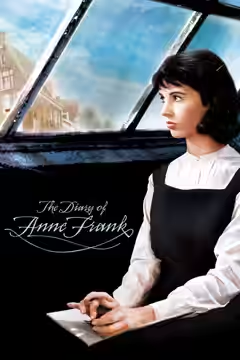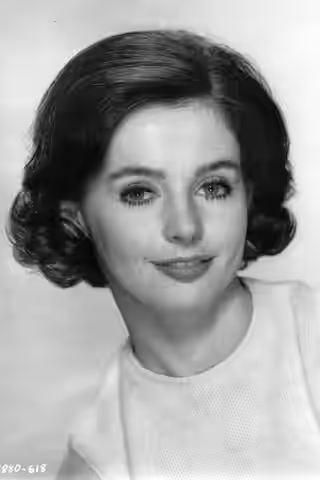
Millie Perkins was found by a photograph and cast as Anne Frank with no acting behind her, and the face carried it further than the voice did. A quiet, watchful presence that the studio never worked out how to use, and that two low-budget westerns did.
Fi1m perspective
In the attic in The Diary of Anne Frank (1959), Millie Perkins stands at the skylight and looks, and for as long as nobody speaks she is exactly right. The face is Anne's: young, open, not yet finished. Then a line arrives and she says it carefully, as a well-brought-up girl would, and the real Anne, who was quick and vain and unkind about the people in the next room, is not in the frame. She is at her best when she is not speaking, and that turned out to be true for the rest of her career.
She had never acted. She was a New York model whom George Stevens found from a photograph, and by her own account the part "would either be instinctive or nothing at all." Instinct got her through three hours, and most of the reviews at the time were kind. Ours is less so: we scored the film 58, and we thought Perkins had the face for Anne and not the quickness, her scenes with Richard Beymer's Peter being the slowest stretch of a slow film. We wanted, sitting through them, to like her more than the writing let us, and we came away sorry for her rather than moved by her, which is not what the diary does to a reader.
Fox put her under contract and then suspended her for turning a part down, and Stevens himself later thought she had arrived ten years too early for the system. She appeared opposite Elvis Presley in Wild in the Country (1961), then went somewhere the studio would not have sent her: two Monte Hellman westerns shot back to back in 1966, The Shooting and Ride in the Whirlwind, both with Jack Nicholson. We have not reviewed them, so we will not judge them at length, but they are the films people who follow her career point to, and the fit makes sense. Hellman's westerns are quiet, slow and short of explanation, and a performer who does her best work between lines belongs in them.
Then, for most of the 1970s, nothing in features. She came back in the 1980s as mothers: Table for Five (1983), At Close Range (1986), Wall Street (1987). It is a common fate for actresses who were once the girl on the poster, and she seems to have taken it as work rather than demotion, and kept at it, in television and the occasional film, until stopping after 2006.
What to make of her? A star for a few minutes, and then in work, on and off, for forty years. Start with the Stevens film and watch her face when she is listening; it is the best thing in her scenes. If you then find the Hellman westerns, you will see what a director who trusted that stillness could do with it, and you may wonder what else might have been.