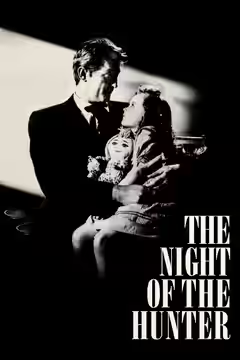
Shelley Winters played women who wanted the wrong thing and knew it: first the girls men use up, later the mothers nobody listens to. Her Willa Harper in The Night of the Hunter is the proof, a small part played without a scrap of self-protection.
Fi1m perspective
Willa Harper is a widow with a little money hidden somewhere in the house, and a preacher who has come for it. Most actors would play her as the dupe, the woman who cannot see what we can. Shelley Winters plays her as someone who sees it and walks towards it anyway, and the review we published on The Night of the Hunter (1955) put it in four words: she lets Willa want to be punished. We found her scenes with Robert Mitchum hard to sit through, not because Mitchum frightens us, though he does, but because Winters makes Willa reach for the harm herself, and there is nothing in the performance to hide behind.
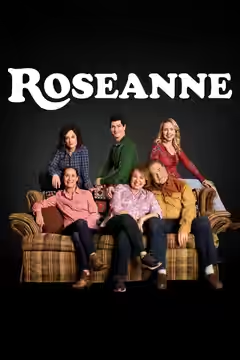
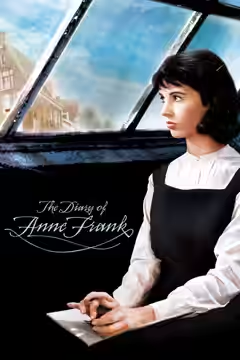
That was the middle of a career with two halves. She started in bit parts and chorus work in the early 1940s, and was noticed as the waitress in A Double Life (1947), the sort of role that exists to be murdered. A Place in the Sun (1951) gave her Alice Tripp, an ordinary woman under pressure, and it is the film to see if you want the first Winters: plain, needy, in the way. Then she went to the Actors Studio under Lee Strasberg, back to Broadway in 1955, and came out the other side a character actress. Petronella Van Daan in The Diary of Anne Frank (1959), Charlotte Haze in Lolita (1962), Belle Rosen in The Poseidon Adventure (1972): the matrons, the mothers, the women who talk too much at the wrong moment. She kept working, in films and on television including Roseanne, into the mid-1990s.
She was frank about how she did it. "I’m a Method actress, you know. I find feelings of my own to correspond with what’s in the script." You can see the method in the later parts, where the eccentric mother is never only a joke; there is always something underneath that the character would rather we did not notice and that Winters makes sure we do. The complaint that follows her is that directors cast her too readily for pathos, and The Night of the Hunter is usually the example. We think the example is badly chosen. A martyr played for our pity is tiresome. Willa is not asking for pity. She is asking for punishment, which is a different and much stranger thing, and Winters is one of the few actors who could have made the difference visible.
Charles Laughton directed her once and never directed anyone again, which is a loss on both sides. Start there, with Willa. Then go back to Alice Tripp, and see how much of the wanting was already in place.
Biography
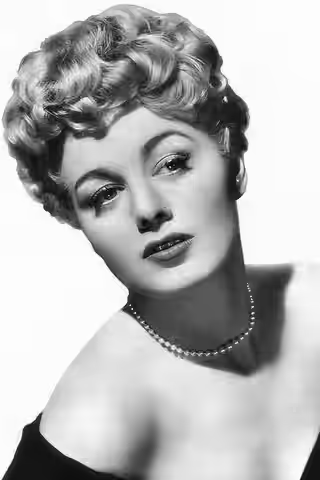
Shelley Winters was an American actor. Born Shirley Schrift in St. Louis, Missouri, on 18 August 1920, she died in Beverly Hills, California, on 14 January 2006. She played Willa Harper in The Night of the Hunter (1955).
Winters studied at the Actors Studio and appeared on Broadway, including in A Hatful of Rain. She received Academy Award nominations for her performances in A Place in the Sun (1951) and The Poseidon Adventure (1972), and won Best Supporting Actress Oscars for The Diary of Anne Frank (1959) and A Patch of Blue (1965). Other notable film roles include those in Lolita (1962) and Pete's Dragon (1977). She had a recurring television role in the sitcom Roseanne and wrote three autobiographies.