Schildkraut spent four decades in Hollywood being either the smoothest man in the picture or the one the picture had decided to ruin, and he was better at the second. His Dreyfus, silent while others speak for him, is the performance to start with.
Fi1m perspective
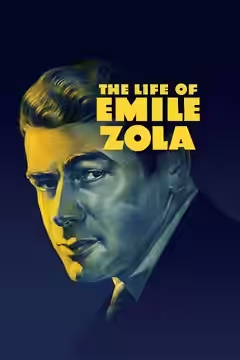
In The Life of Emile Zola (1937), an officer runs a finger down a list of names and stops, and for most of the film the man attached to that name barely gets a line. Schildkraut plays Captain Dreyfus as someone waiting to be told what he has done, and the waiting is the performance. The court martial and the ceremony after it, the sword broken and the crowd jeering, moved us more than any of the speeches made on his behalf, and it was his face that did it: a man who keeps expecting an explanation that the film, like the army, will not give him. He is the best thing in Dieterle's picture, and he does it almost without speaking.
He came to that stillness late. Trained under Max Reinhardt in Berlin and then at the American Academy of Dramatic Arts, he settled in New York in 1920 and made his Broadway name in Liliom (1921). Hollywood took him for costume and cunning: the Chevalier de Vaudrey in Griffith's Orphans of the Storm (1922), opposite Lillian Gish, and Judas in DeMille's The King of Kings (1927), with his father Rudolf playing Caiaphas on the same set. That fixed the pattern. For the next decade he was the man in the good coat whom the hero should not trust.
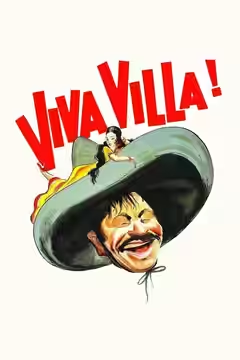
General Pascal in Viva Villa (1934) is that man exactly: sleek, snide and useful to the plot, a performance we admired without liking, which is what the part asks for. Ferencz Vadas in Lubitsch's The Shop Around the Corner (1940) is the same coat behind a shop counter. But put him in the dock instead of behind the desk and something else arrives. Dreyfus in 1937 and Otto Frank in The Diary of Anne Frank, on Broadway in 1955 and on film in 1959, are the two performances the name survives on, and both are men made to stand still while other people decide their lives.
The trouble was that Hollywood mostly wanted the first kind. After the 1930s the parts got smaller and the pictures cheaper, a run of secondary roles at Republic that nobody now watches for his sake, and the quality he had found in Dreyfus went largely unused until the stage handed him Frank nearly twenty years on. He was still working at the end. His Nicodemus in The Greatest Story Ever Told (1965) reached cinemas after he had died.
Start with Zola, and watch what he does with a face when the script has given all the words to somebody else. Then the 1959 Frank. The villains are fine, and Pascal is worth a smile, but they are the work of a man who could have played them in his sleep. Dreyfus is the one where he looks awake.
Biography
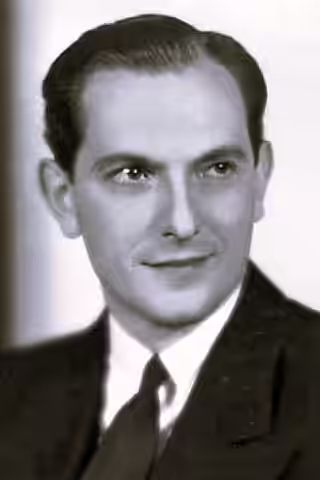
Joseph Schildkraut was an Austrian-American actor. Born in Vienna in 1896, he was the son of the actor Rudolph Schildkraut. He made his professional stage debut in Berlin in 1913 under Max Reinhardt and later worked in Vienna before moving to New York in 1920.
Schildkraut appeared in more than fifty films, beginning with Orphans of the Storm (1922). His credits include Viva Villa! (1934) as Gen. Pascal, Cleopatra (1934) as King Herod, The Life of Emile Zola (1937) as Capt. Alfred Dreyfus, for which he received an Academy Award for Best Supporting Actor, The Shop Around the Corner (1940) and The Diary of Anne Frank (1959) as Otto Frank. He also worked extensively in theatre and on television until his death in New York City in 1964.