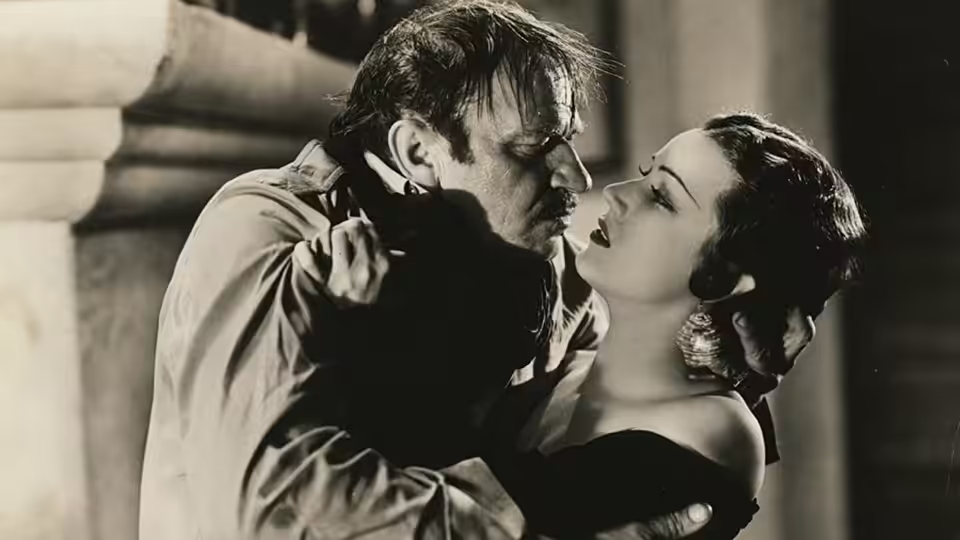
MGM’s Pancho Villa is a big, loud, handsomely photographed legend with Wallace Beery grinning at its centre, and it is good fun for most of its length. It is also careless with history, cheerful about slaughter, and a reel too long.
Metro’s Pancho Villa, produced by David O. Selznick from a script by Ben Hecht, wants to be two things at once: a rousing frontier legend about a peasant bandit who becomes a liberator, and an honest portrait of the appalling man underneath. It manages the first. Jack Conway is the credited director, some of the material was shot by an uncredited Howard Hawks, and more than one pair of hands shows. It is a big, handsome, noisy picture, good fun for most of its 115 minutes, and, in a way that took us a while to notice, rather pleased with murder.
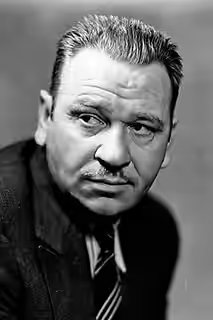
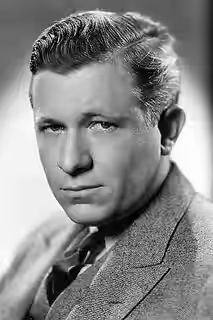
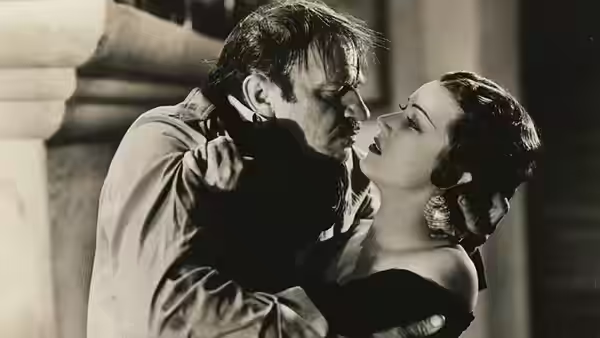
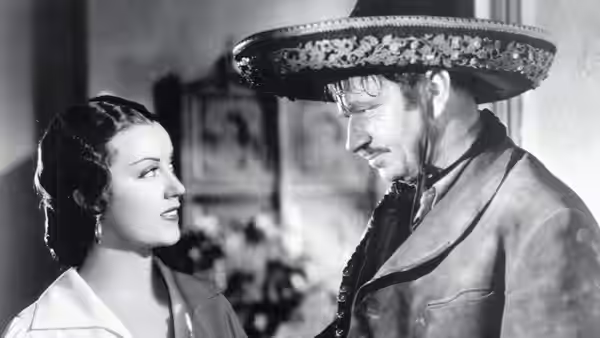
Wallace Beery plays Villa as an enormous child: grinning, weeping, roaring, taking a woman’s hand as though he might eat it. He asks Madero what democracy is, nods as if he has understood, and goes out and shoots somebody. His accent wanders from the Sierra Madre to the Bronx and back within a scene, and it hardly matters, because the performance is not about Mexico. It is about Beery, and Beery is a good deal to watch. When he is on screen the film has a pulse. When he is off it, waiting for him, it slumps.
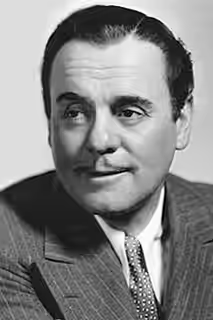
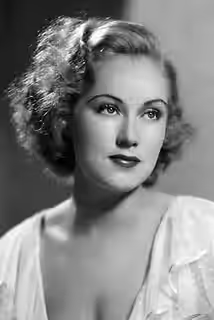
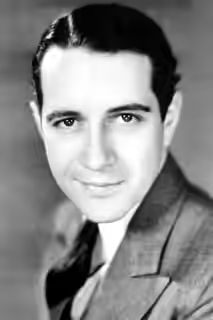
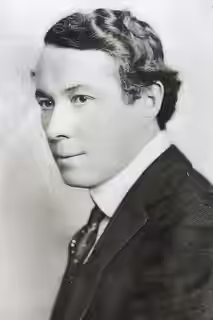
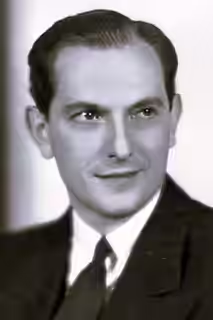
Stuart Erwin’s Jonny Sykes, the American newspaperman who trails the column, gets the best joke Hecht wrote. He cables home that Villa has taken a town Villa has not yet attacked, and Villa, once the dispatch is read to him, decides he had better take it so the paper is not made a liar. We laughed properly at that, and at Leo Carrillo’s Sierra, who kills with the cheer of a man doing you a favour. Henry B. Walthall gives Madero a stillness that is the nearest the film comes to an idea. Fay Wray, as Teresa, is given little to do beyond being looked at, and Joseph Schildkraut’s General Pascal is sleek, snide and useful.
James Wong Howe and Charles G. Clarke shot much of it in Mexico, and the exteriors are the film’s glory: long lines of horsemen crossing dry country under a white sky, dust rising behind them, crowds packed into plazas that were plainly not built on a back lot. The tagline promises a cast of thousands and for once that is roughly true. Then the film goes indoors and you can see the join. The haciendas and cantinas are lit flat and even, like studio drawing rooms, and the cut from one to the other is like being pulled in through a window. Herbert Stothart’s score leans on ‘La Cucaracha’ until we began to dread the tune.
What unsettled us, and it built as the film went on, is how lightly the killing sits. The opening, in which Frank Puglia as Villa’s father is flogged to death for asking that the peasants keep their land, is shot straight and it is horrible; we flinched. It is there to justify everything that follows, and the film then spends the next hour and a half treating that everything as a lark. Men are shot and the trial is held afterwards, as a courtesy. Villa’s tenderness towards Madero is real, and so is his good humour when the firing squad forms, and Hecht’s script does not seem to notice that the two are at war. Most critics have forgiven it this because the action is so brisk. We found it brisk and we found it cold.
It plays loose with the facts, and anyone who knows the Mexican Revolution will spend the film wincing. That is not by itself a fault; Hollywood has never let history stand in the way of a good hanging. The fault is length. The picture has two or three episodes more than it needs, and the last half hour, which we will not describe, goes round the same handful of rooms before arriving at a finish Beery plays for everything it has and then a little more. It is enormous. We were somewhere between admiring it and hiding behind the sofa.
See it for Beery, for Erwin’s cable, and for those exteriors, which Howe and Clarke shot as though they knew nobody would be allowed to build such a thing again. Watch it at home, where the studio interiors look less wrong, and be ready to find the hero a good deal more frightening than the film does.