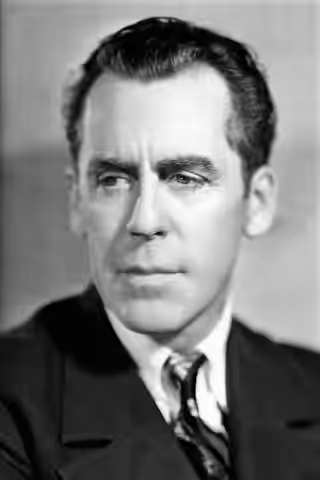
Jack Conway was the MGM contract director in the fullest sense: more than twenty years of star vehicles delivered on schedule, with no style you could pick out of a line-up. What he did have was tempo, and the sense not to get in a star's way.
Fi1m perspective
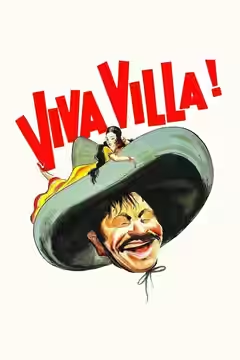
Watch Wallace Beery in Viva Villa (1934): grinning, roaring, filling the frame while the picture bangs along around him. That is what a Jack Conway film looks like when it is working. The star is at the centre, the machinery is out of sight, and the thing moves. We enjoyed most of its 115 minutes, and then, somewhere in the second half, we noticed how cheerfully it was killing people, and the enjoyment curdled a little. Conway is the credited director; Howard Hawks shot some of it before he went, and more than one pair of hands shows.
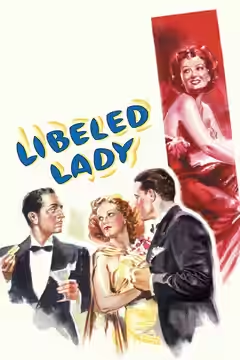
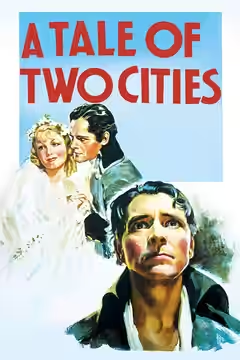
Conway began as an actor, on stage and then in films from 1909, including a spell in D.W. Griffith's stock company, and was directing shorts and features by 1912 or 1913. There were years at Universal, in 1916–17 and again in 1921–23, and then MGM from 1925–26, where he stayed until 1948. That is the whole shape of the career: one studio, two decades, whatever came down from the front office. What came down was mostly star vehicles. Red-Headed Woman (1932) with Jean Harlow, Viva Villa, A Tale of Two Cities (1935), Libeled Lady (1936), Boom Town (1940) with Clark Gable, whom he directed five times.
He was known at Metro as the man who brought pictures in on time, and it is easy to read that as faint praise. It is more than that. Handling the Paris crowds in A Tale of Two Cities, with some 17,000 extras, takes some doing, and so does keeping William Powell and Myrna Loy, who each worked with him three times, at the speed a comedy like Libeled Lady needs. The word that follows him about is agile, and in the comedies it fits.
The criticism is the same thing seen from the other side. Conway had no style of his own that we can point to, and his films tend to be remembered for whoever was standing in front of the camera. On Viva Villa that is Beery, and it is also Ben Hecht's script and David O. Selznick's production, and the picture never decides whether it is a frontier legend or a portrait of the appalling man underneath. A director with a firmer view would have chosen. Conway kept it moving instead, which is what he was paid for.
Start with Viva Villa, for Beery and for the noise, and go to Libeled Lady for the other thing he could do. Do not go looking for the man behind them. He seems to have been quite content to stay out of sight.
Biography
Jack Conway (born Hugh Ryan Conway, 16 July 1887 – 11 October 1952) was an American film director and actor. Born in Graceville, Minnesota, he began his career as an actor, joining a repertory theatre group after high school and appearing in early films. In 1911 he joined D.W. Griffith’s stock company, working primarily in westerns, and later served as assistant director on Griffith’s The Birth of a Nation (1915) and Intolerance (1916). He began directing feature films around 1915.
Conway gained experience at Universal Studios before joining MGM in 1925, where he remained until 1948. He directed numerous studio productions, often featuring Clark Gable, including Viva Villa! (1934), A Tale of Two Cities (1935), Libeled Lady (1936) and Boom Town (1940). He also directed Red-Headed Woman (1932) and other MGM titles such as Honky Tonk (1941) and The Hucksters (1947). Conway was known for delivering commercially successful films efficiently within studio constraints.