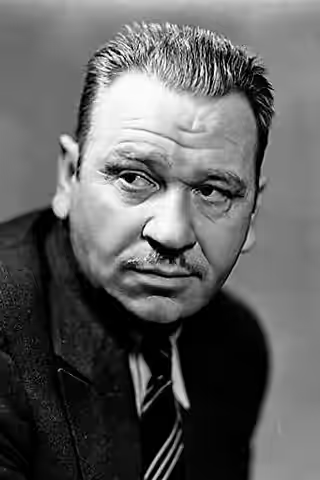
Wallace Beery was a big man who played killers and bullies as if they were sulky children, and made you like them without ever letting you trust them. In The Big House the trick still works, and it is worth seeing why.
Fi1m perspective
Wallace Beery stands in a doorway and fills it. George W. Hill, who directed him three times, keeps putting him there in The Big House (1930), because there is nowhere else to put a man that size, and because the shot tells you what the picture is about before anyone speaks. Then Butch Schmidt opens his mouth, dictates a letter to a sweetheart who may not exist, grinning like a schoolboy, and a scene later threatens to open a man's throat over the meat ration with exactly the same grin. That is the act. Beery did it for twenty years and it was worth doing.
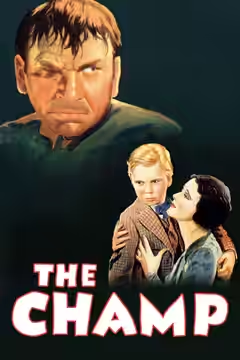
He came to it late and by an odd road. He had trained elephants in a circus and worked on the New York stage before Essanay put him in films in 1913, in comedy shorts, as a Swedish maid called Sweedie. Through the 1920s he played villains in silents at Paramount and elsewhere, a heavy among heavies. Sound made him a star: The Big House at MGM, then Min and Bill (1930), the first of three films with Marie Dressler, The Champ (1931) as an over-the-hill boxer, Grand Hotel (1932) as Preysing, Treasure Island (1934) as Long John Silver. He was still working in character parts when he died in 1949.
The idea was his own, and he was open about it. He said as much in 1934: he had decided to temper his heavies with a touch of humour, had tried it once, seen it work, and never played a heavy without it again. It works because the humour is not an apology. Butch is not a killer with a soft side; he is a bully and a child at once, and the childishness is what makes him frightening, because a child does not weigh consequences. We laughed at the letter, and a minute later, when the grin did not change over the meat, we stopped laughing and felt a little cold. Chester Morris, as the forger Morgan, plays it still and small beside him, and the stillness is what makes Beery look enormous.
The risk in the method is plain. Soften a brute often enough and you get the lovable slob, and the run of 1930s parts, the boxer, the pirate, the scoundrel with a heart of gold, suggests that is where the studio wanted him. Whether those films keep the menace under the sentiment we will say when we have written about them. What we can say is that in The Big House nobody, Hill included, asks us to forgive Butch, and the performance is stronger because nobody does. Start there, in the cell block, and watch the face when the letter ends.
Biography
Wallace Fitzgerald Beery was an American actor. He began his career in the circus and on stage before entering films in 1913, initially appearing in comedies including the Sweedie series.
Beery appeared in more than 250 films over 36 years. He played Machine Gun 'Butch' Schmidt in The Big House (1930) and won the Academy Award for Best Actor for his performance in The Champ (1931). Other notable roles include appearances in Min and Bill (1930), Grand Hotel (1932), Dinner at Eight (1933) and Treasure Island (1934). He was the brother of actor Noah Beery.