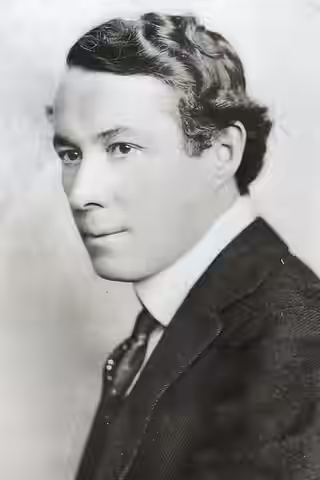
Griffith's leading man became the sound era's dependable elder, and the method never changed: Walthall stands still and lets the film come to him. In small parts he can move you more than the leads, and after 1920 he was mostly given small ones.
Fi1m perspective
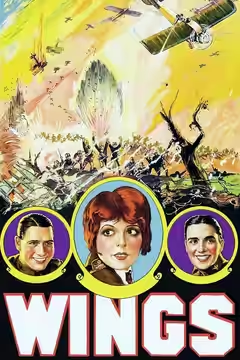
Near the start of Wings (1927), a boy is going to the war and his parents see him off. Henry B. Walthall, as the father, does almost nothing. A small keepsake changes hands, a look is held a fraction longer than is comfortable, and that is the scene. It moved us more than the whole love triangle the film spends two hours on, because Walthall and Julia Swayne Gordon play it as two people who suspect how this ends and have agreed not to say so. He is on screen for a couple of minutes, and he is the best thing in the reel.
That stillness was his trade from the beginning. He came off the New York stage into Biograph in 1909 and became one of D. W. Griffith's regulars, appearing in dozens of shorts before Griffith made him the Little Colonel in The Birth of a Nation (1915), the part that made him famous, in a film that has not been forgiven. Through the 1910s he was the dignified Southerner, the Confederate officer, the doctor, the man of standing: parts that ask an actor to hold himself upright while everything around him gives way. He left Griffith, tried a production company of his own that did not last, and spent the 1920s in cheaper pictures than he deserved.
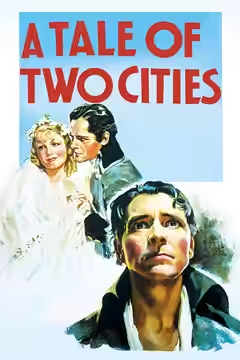
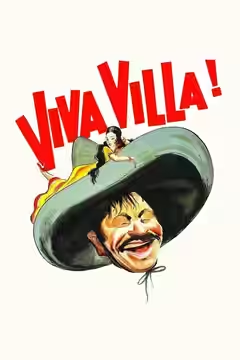
Sound saved him. He had a voice that recorded well and a bearing to match, and the 1930s gave him a run of supporting parts in large productions: the Reverend Ashby Brand for John Ford in Judge Priest (1934), Dr Manette in A Tale of Two Cities (1935), Marcel for Tod Browning in The Devil-Doll (1936), his second film with Browning and one of the last things he made. From this stretch we have reviewed only Viva Villa (1934), in which he plays Madero and in which his stillness is, as we said at the time, the nearest that loud film comes to an idea. Everyone else in it is shooting or grinning, Wallace Beery loudest of all. Walthall stands in the middle of it and looks like a man who has already read the history.
The limit is plain. An actor who does his best work by not moving needs a director willing to hold the shot on him, and the two films of his we have reviewed give him, between them, perhaps five minutes of that. That is itself a verdict of sorts on how Hollywood used him after he stopped being young. It is not a verdict on him. If you want to see what he could do, watch the send-off in Wings, then the two hours around it, and notice which stays with you.
Biography
Henry B. Walthall (16 March 1878 – 17 June 1936) was an American stage and film actor. He appeared as Mr. Armstrong in the 1927 film Wings and as Col. Ben Cameron in D. W. Griffith's The Birth of a Nation (1915).
Born in Shelby County, Alabama, Walthall began his stage career in New York in 1901. He made his film debut in 1909 at Biograph Studios in A Convict's Sacrifice, directed by Griffith, and became a regular in the director's company. He later worked at Reliance-Majestic and Pathé before forming his own production company in 1917.
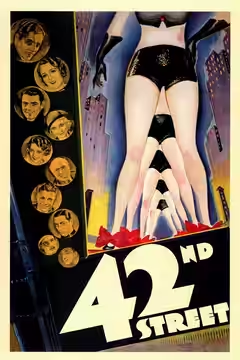
Walthall continued acting into the sound era, appearing in films including 42nd Street (1933), A Tale of Two Cities (1935) and The Devil-Doll (1936).