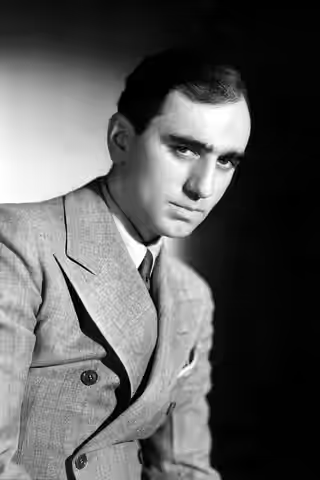
Busby Berkeley makes dance for a camera positioned where no theatre audience could sit. We admire the overhead patterns and the freedom from stage-bound space; the storytelling is less dependable, and sometimes his stars have to do the rescuing.
Fi1m perspective
The dancers arrange themselves into a pattern that makes sense only when Berkeley's camera looks straight down. A chorus becomes a geometric shape, and the number expands beyond anything that could fit on the stage where it began. He also uses close-ups to pick out individual faces, a welcome detail among so many synchronised bodies. His preference for a single camera gives him control over how each formation is seen.
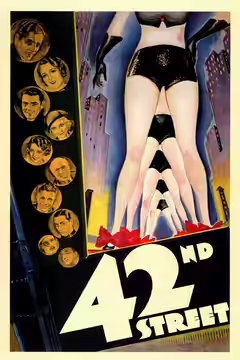
His Hollywood work began in 1930 with Samuel Goldwyn's Eddie Cantor films, after dance direction on Broadway. His choreography for 42nd Street (1933) helped establish his style at Warner Bros.; in Gold Diggers of 1935 (1935), he was both director and choreographer. The move to producer Arthur Freed's MGM unit brought films built more closely around their stars, including Babes in Arms (1939). There, the test was how well he could sustain a musical comedy whose chief assets were Mickey Rooney and Judy Garland.
Babes in Arms is an agreeable but limited example of his work, and we would recommend it chiefly to admirers of its leads. We enjoyed the musical numbers, whose reliable pleasures made the returns to the tired story disappointing. Rooney and Garland hold our attention, but the screenplay depends too heavily on them to keep familiar plotting interesting. Across its 93 minutes, the entertainment is sufficient for an interested look without making the weaknesses disappear. It is a useful warning against choosing a whole film on the strength of the name attached to its musical numbers.
The geometric routines can become repetitive, too, especially when another symmetrical arrangement adds little surprise. His later work still found room for large-scale invention: The Gang’s All Here (1943) features Carmen Miranda and elaborate, prop-heavy numbers. Berkeley remains most interesting when a number is allowed to escape the limits of its supposed theatre. Start with the musical sequences in 42nd Street; save Babes in Arms for an evening when Rooney and Garland are already sufficient enticement.
Biography
Busby Berkeley (born William Berkeley Enos) was an American film director and musical choreographer. He was born on 29 November 1895 in Los Angeles and died on 14 March 1976.
Berkeley began his career directing dances for Broadway musicals in the 1920s. He moved to Hollywood in 1930 and became known for staging elaborate production numbers in films such as 42nd Street (1933), Gold Diggers of 1933 (1933) and Dames (1934). He later directed features including Gold Diggers of 1935 (1935), Babes in Arms (1939), For Me and My Gal (1942) and Take Me Out to the Ball Game (1949).